Latest News
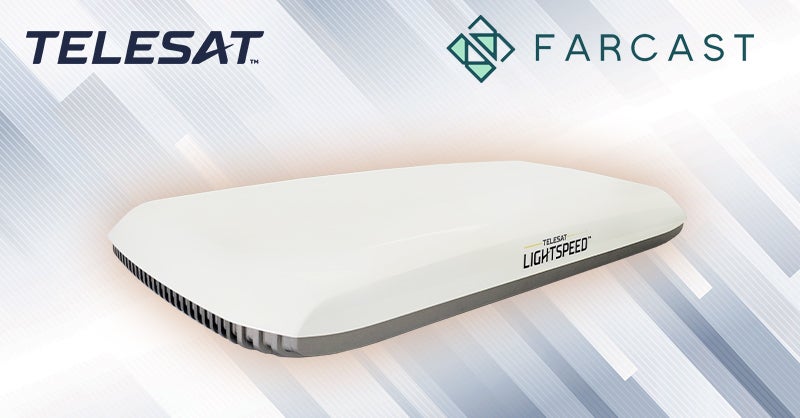
A Farcast user terminal for the Lightspeed network. Photo: Telesat
Telesat is making a $5 million U.S. dollar investment into flat panel antenna developer Farcast as it prepares for its Lightspeed network. The Canadian operator announced the investment on Tuesday along with its third quarter financial results, reporting 27% revenue decline year-over-year for its Geostationary Orbit (GEO) business.
Farcast is a San Francisco-based startup that has developed a proprietary Active Electronically Scanned Antenna (AESA) that can simultaneously transmit and receive data from the same aperture. Telesat has worked with the company since 2022 building and testing hardware to operate on the Lightspeed network.
Now, Telesat is making an equity investment into Farcast. Under the new agreement, Farcast will deliver an enterprise-class flat panel antenna user terminal integrated with the Telesat Lightspeed modem, for volume production. Terminals that are fully integrated with Telesat Lightspeed modem are planned to be available for 2027.
“Throughout prototype development, we’ve seen firsthand Farcast’s innovative approach to extending satellite communications capability and reach through small form factor FPAs that deliver outstanding performance,” said Michel Forest, Telesat CTO. “We see value not only in what Farcast can provide for Telesat’s telecom and enterprise customers, but also the wider satellite industry for mass-produced, high-performing terminals, including aviation and defence applications.”
Q3 Financials
Separately, Telesat announced its Q3 financials on Tuesday, reporting revenue of $101 million Canadian dollars ($72 million), a decrease of 27% compared to the same period in 2024.
This year Telesat is bringing in lower revenues from Dish Network on the Nimiq 5 contract. Lower revenue was also due to reduction in service to an Indonesian rural broadband program, and lower revenue from broadcast customer Shaw, now part of Rogers.
Telesat’s net loss for the quarter was CA$121 million ($86 million) compared to CA$68 million ($48 million) in net income for the same period in the prior year. The change was due to lower revenue combined with a foreign exchange loss this year.
CEO Dan Goldberg said this year has “developed largely as we had expected” in terms of the the GEO business. “We maintain our disciplined focus on maximizing the utilization of, and cash flow from, our existing GEO satellite fleet, while remaining open to value-creating opportunities,” he said.
Stay connected and get ahead with the leading source of industry intel!
Subscribe Now