
Over the last half century, space-based assets have helped to provide terrestrial users with ubiquitous services like broadband communications and position, navigation and timing (PNT). But although we think of these services as space-based, they don’t actually work in space — especially not in the area between Earth orbit and the Moon known as cislunar space, that is the new frontier for Artemis and other missions.
NASA and the European Space Agency (ESA) are each pledging billions to kickstart a commercial ecosystem of lunar missions over the coming decade, but the critical foundation for that effort is replicating those taken-for-granted terrestrial services across the vast distances of cislunar space.

Explore the August 2026 Issue
Check out more from this issue and find your next story to read.
Multiple efforts are already underway on both sides of the Atlantic to build lunar satellite constellations, providing PNT and broadband communications for Artemis and other missions, and building out the infrastructure that could service future commercial activity on the Moon, like mining or low gravity manufacturing.
Lunar PNT Key to Successful Landings
Intuitive Machines, the Houston, Texas-based company that’s put two landers on the Moon’s surface, understands better than most the criticality of PNT data for lunar missions. Both of its landers tipped over after landing, owing in part to problems with the laser rangefinder that was one of the ways engineers tried to compensate for the absence of lunar PNT.
“Our first two missions gave us real flight experience in the most demanding operating environment on the Moon, the South Pole,” Intuitive Machines President and CEO Stephen Altemus tells Via Satellite.
The company also used artificial intelligence algorithms to help the landers navigate the Moon’s surface, comparing images from the vehicles’ cameras with maps compiled by the Lunar Reconnaissance Orbiter.
A lunar PNT constellation would “add another layer of independent navigation and timing data to the lunar operating environment,” explains Altemus, making it easier and safer for lunar missions. Last year, NASA awarded Intuitive Machines a contract to build just such a lunar constellation. The Lunar Communications Relay and Navigation Systems (LCRNS) award is for a five-year term, extendable for another five years and with a maximum value of $4.82 billion. The first LCRNS satellite is slated for launch later this year, on the same mission as Intuitive Machines’ third lunar lander.
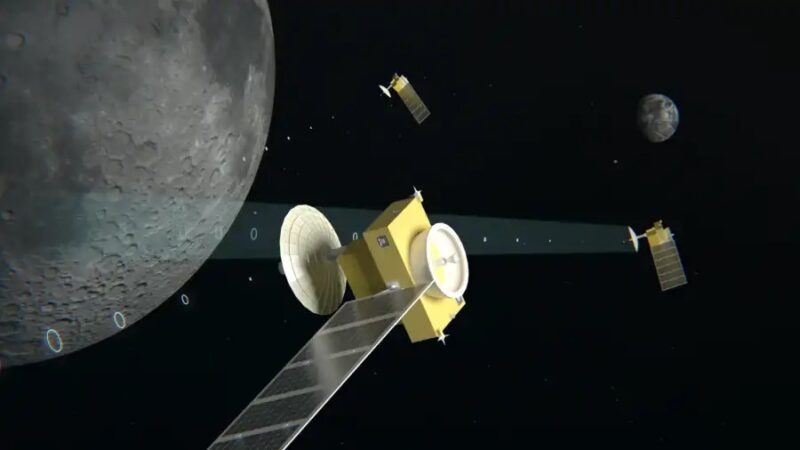
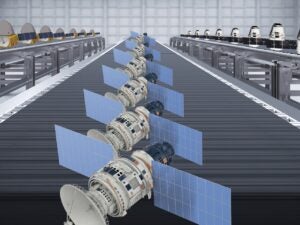
satellites. Photo: NASA/Dave Ryan
When complete, the five-satellite constellation will provide round-the-clock communications and PNT coverage of the area around the lunar South Pole, which is the region targeted for Artemis IV’s landing early 2028 and for subsequent crewed and uncrewed missions.
The constellation will also cover large areas of the so-called dark side of the Moon, which gets the same amount of sunlight as the rest of the Moon, but is permanently turned away from Earth, meaning radio signals can’t travel back and forth directly.
With accurate PNT data, “you can actually target your landing spot without having to do all the heavy compute of comparing those maps, which tend to drain the CPU power. We’re maxed out in our flight computer and our ability to do any other computations when we’re trying to navigate to a spot 50 meters wide,” Altemus says.
In addition to PNT, the LCRNS constellation will also provide high bandwidth data relay and real time communications services for the Artemis lunar lander and rover and for other Moon missions like NASA’s Commercial Lunar Payload Services (CLPS) program, he adds. There will be S-band, X-band, and K-band capability relayed from the lunar surface to a network of Earth ground stations with the massive 30-plus meter dishes required to receive transmissions from more than 250,000 miles away.
“We can get near real-time data, but not high-definition video real-time as it’s occurring,” Altemus says, because the “trunk line” that connects the constellation to the ground stations didn’t have sufficient bandwidth. The Artemis II mission was able to provide live-streaming high definition video using the Orion Optical Communications System (O2O). Developed by MIT’s Lincoln Laboratory, O2O is a spotlight-sized payload that provided Artemis II with bandwidth of up to 260 megabits per second, using a laser, rather than radio waves, to carry data.
As satellites in the LCRNS constellation become operational, they will be integrated into the Near Space Network (NSN) of ground stations and Geosynchronous Orbit (GEO) satellites managed by NASA’s Goddard Space Flight Center.
While the constellation is being built and launched, NASA missions will be able to use the services of a low-cost ESA-funded experimental British satellite called Lunar Pathfinder.
A ‘Pathfinder’ to Lunar Communications
Pathfinder will be Surrey Satellite Technology Ltd’s and indeed Britain’s first lunar mission, Lunar Program Lead Ben Hooper says — and the first-ever lunar communications satellite. It’s funded by ESA to the tune of $23.5 million, along with $15.2 million in UK Space Agency development money, which is bargain basement pricing for a lunar mission.
And Pathfinder is hitching a ride to the Moon in a manner befitting the scrappy and creative spirit of SSTL, considered by many to be the original “New Space” company.
An ESA-NASA memorandum of understanding essentially gives the satellite “a free ride to the Moon” as part of Firefly Aerospace’s Blue Ghost lunar lander Mission Two, planned for late this year or next, Hooper says. “In return ESA has bartered our capacity to provide service to NASA for their missions for at least two years,” Hooper said.
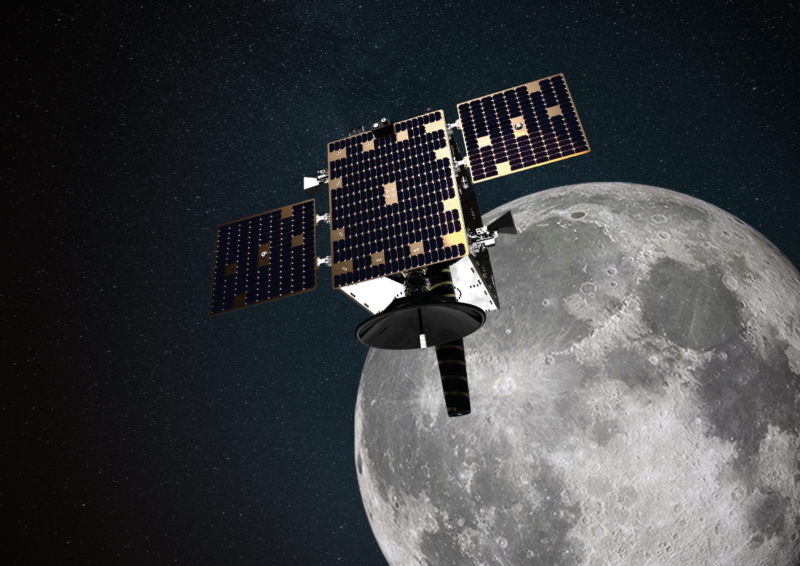
Pathfinder was planned as a service for uncrewed research missions that needed asynchronous data transfer, he adds. It will communicate with the lunar surface via S-band and relay communications back to Earth ground stations in X-band.
Like the LCRNS constellation, Pathfinder will be in a Highly Elliptical Lunar Frozen Orbit (HELFO) — an orbit optimized for long-term
stability and providing coverage of the lunar poles.
Hooper says that streaming, real-time communications weren’t in the Pathfinder specs, “but we engineered the future in.” Because Pathfinder is a software-defined satellite and uses software-defined radio for wave-forming, at any time during its eight-year life, SSTL can offer a software update to Pathfinder that would enable real-time video streaming, though not in high definition.
Owing to the 1.3 second lightspeed delay, Netflix “would be ropey and in standard definition,” Hooper jokes. But he underlines that the technical capability is there if a business case and customers emerge. “We could do it,” he says.
The Thinking Behind Moonlight
If Pathfinder was designed as a proof of concept for lunar communications satellites, Moonlight is the prototype — an ESA public-private partnership aiming to provide real time communication, asymmetric data relay, and PNT services for the lunar market. Moonlight will service the rovers, the landers, the orbiters, and eventually the space habitats which Artemis and the commercial ecosystem it hopes to kick start are already beginning to build.
Although the program is still being planned out, the aim, according to ESA, is to have a handful of satellites in lunar orbit by the end of the decade. The prime contractor is Italian space company Telespazio.
Moonlight will provide the interoperable communications infrastructure that will enable multi-national and public-private projects on and around the moon, explains Yasrine Ibnyahya, vice president of Innovation, Viasat. Viasat was contracted by Telespazio to lead the design and delivery of the communications infrastructure and service for Moonlight.
“That means the communication satellites in lunar orbit, the Earth ground stations, and the user terminal that is going to the lunar surface,” she says.
Currently, cislunar communications rely on NASA Goddard’s Near Space Network. But relying on direct to Earth communications would mean transporting to the lunar surface a massive transmitter, capable of broadcasting over that vast distance, Ibnyahya says. It would also mean no connectivity to the lunar surface in parts of the polar region and on the misleadingly named dark side of the Moon that is not visible from Earth — all areas that that lunar missions are targeting.
By putting a relay satellite in lunar orbit, which collects transmissions from the lunar surface and retransmits them to Earth, Ibnyahya says, Moonlight can hugely reduce the size, weight and power (SWAP) requirements for the lunar surface terminal. “For some applications, the terminals could [eventually] be no bigger than your phone,” she says.
Moonlight will enable various applications, such as asynchronous data downloads by scientific research sensors and perhaps even live-streaming high-definition video for Artemis astronauts from the lunar surface.
“We can provide narrowband, wide-area S-band and broadband Ka-band coverage to the Moon’s surface, which means some services will support mission critical services, while others will be used for high throughput applications” Ibnyahya explains. “And what is expected in this new lunar era is that we will see delivery of 4K video in real time” by the Artemis astronauts on the lunar surface.
Enabling the Larger Vision
But the vision for Moonlight expands beyond Artemis, deep into the multi-national and commercial lunar ecosystem it hopes to precipitate. Interoperability standards are absolutely critical to enable that vision, Ibnyahya says.
And the existing ubiquitous terrestrial standards don’t work in space. Due to bandwidth bottlenecks, store and forward policies and the delays inherent in the 1.3 seconds or so that radio waves take at lightspeed to make the trip to Earth from the Moon, neither the Near Space Network, nor any of its planned Lunar constellation replacements can use the conventional TCP/IP protocol that computers use to communicate on the terrestrial internet.
The delay tolerant network protocol it uses instead is one of a whole set of standards NASA and its international partners are developing for use on the Moon and in lunar orbit. The LunaNet Interoperability Specification (LNIS) “is the standard currently being defined by NASA, ESA, and also the Japanese Space Agency, JAXA,”
Ibnyahya says. The aim was “to ensure interoperability amongst the various services that are going to be launched on and around the Moon by … international, commercial, and institutional partners.”
A common standard enables all comers to compete for business on the same playing field and ensures that service providers have something to sell that anyone could use. LCRNS and indeed Moonlight itself, would have to work for a variety of different use cases.
“Some applications will have a need for real time. Others will have more of a store and forward capability, because they’re not time-sensitive,” Ibnyahya says. A common standard would also enable innovation, she argued, “Right now, there’s a lot of startups coming up with also very exciting new concepts that are beyond what we can think of right now,” all enabled by the communications infrastructure Moonlight is building.
Moonlight was underwritten to the tune of $201.4 million at the ESA Ministerial Council meeting last November. Eight times the cost of Pathfinder, but still modest by NASA’s standards.
The first phase of NASA’s Commercial Lunar Payload Services (CLPS) program, the agency’s effort to jump start a for-profit lunar services industry, runs from 2018-2028. It has awarded 14 missions, announced another three and is capped at $2.6 billion.
The follow up CLPS 2.0 will run 2028-2043, with a budget cap of $6 billion. It will fund roughly 77 lunar lander and rover missions during its 10 year awarding timeline, says Carla Filotico, partner and managing director of consulting firm Novaspace.
The long term Artemis vision of a commercial ecosystem of lunar missions relies critically upon extending these communications and PNT services to the Moon, she said.
Artemis and other programs aimed to kick-start a commercial “lunar delivery market” of launch vehicles, she comments. But “in the early stages … this is definitely still an economy driven by government demand.”
And it is likely to remain that way, Filotico says, until the services being piloted by programs like Moonlight or LCRNS prove they aren’t just science projects, but can deliver in a reliable and cost-effective way.
“If we see all this demonstrated in the next 10 years … and a more economical way to go back and forth from the Moon, then you can start justifying potential mission costs commercially,” assuming that there were manufacturing, mining or other profitable activities that companies might want to undertake in low-gravity lunar conditions.
“We need to show we can do this repeatedly, reliably, and at a lower cost,” Filotico says, so companies would have the confidence they could run a business on the Moon.
Realistically, Filotico believes there won’t be substantial commercial demand for at least 10 years. But in the meantime, multi-year service contracts like Moonlight and CLPS are crucial to enable the infrastructure build-out that future commercial lunar activity will rely on. “It is a market signal for repeat utilization by more diverse and multiple customers,” she says. VS
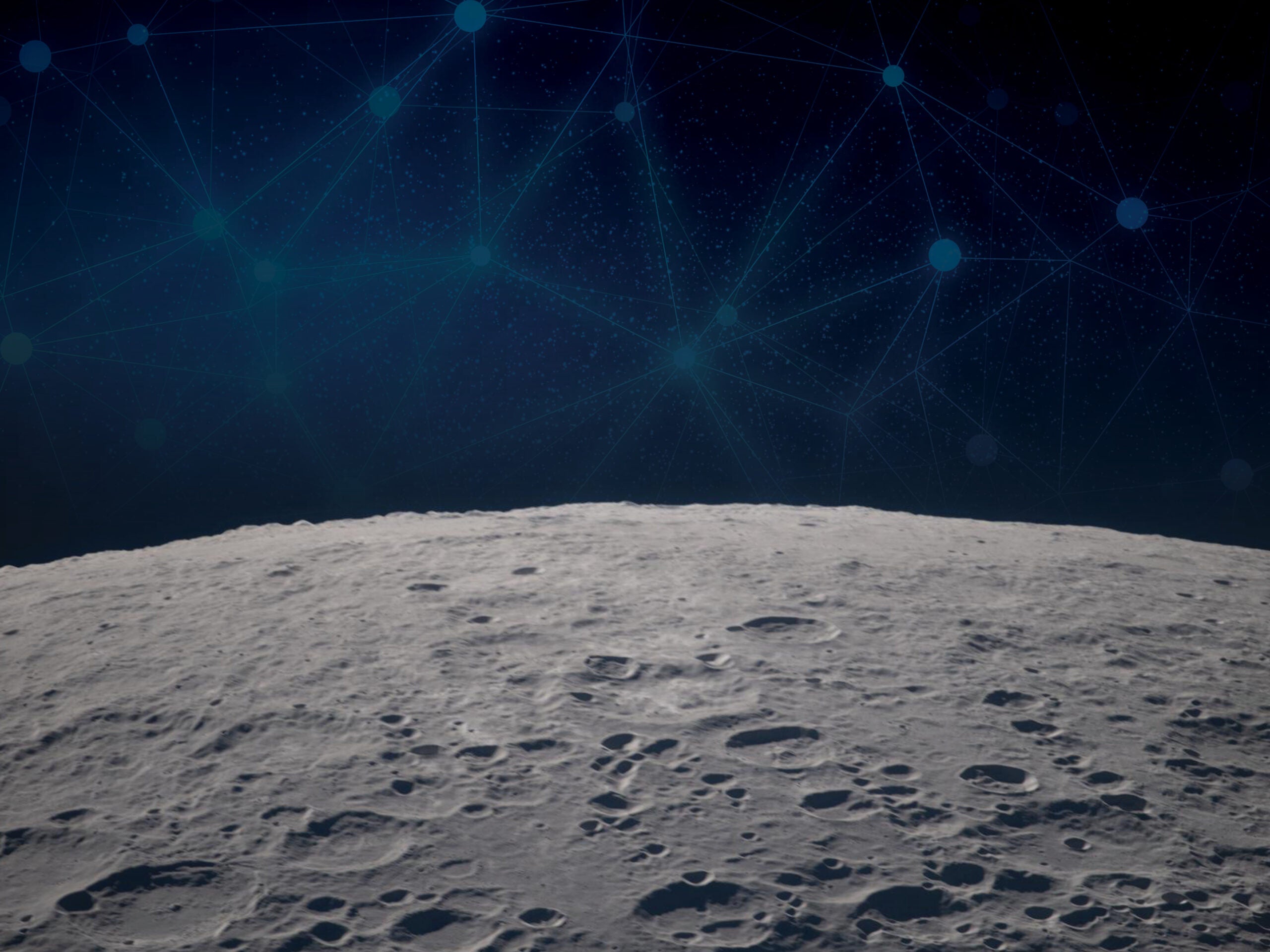
Lead photo: Via Satellite illustration using an image of the lunar landscape captured by the Artemis II crew. NASA/Via Satellite illustration