Latest News
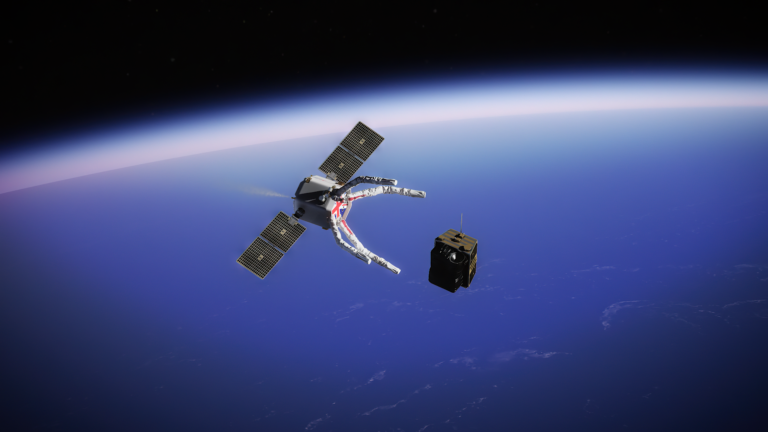
Rendering of the CLEAR debris capture mission. Photo: ClearSpace
ClearSpace completed Phase 2 of the CLEAR mission, in a milestone the company said contributed to de-risking technologies for active debris removal (ADR).
CLEAR is a UK Space Agency mission to remove two derelict objects from Low-Earth Orbit. In this mission, the CLEAR servicer will rendezvous with one of the objects, capture it and transport it to a lower altitude to burn up in the atmosphere, then repeat the actions with the second object.
ClearSpace announced Wednesday that the spacecraft’s robotic capture system passed mechanical derisking tests, proving it can withstand the harsh launch loads. The company also developed and tested image processing algorithms to detect and track space debris. Some of the mission’s close-proximity phases have been tested using a hardware-based spacecraft emulator to validate operational sequences.
“This is a significant milestone in our national ADR program, and we are delighted that ClearSpace and partners have successfully delivered all requirements in this de-risking focused phase of work. We are now entering a particularly exciting period of further innovation which further supports our prioritization of space sustainability and development of a national ISAM capability,” commented Ray Fielding, head of Sustainability for the UK Space Agency.
UKSA recently hosted an engagement event to outline the next steps for the national UK ADR mission.
ClearSpace also completed detailed programmatic estimates to inform UKSA mission planning. The company worked closely with partners Critical Software for flight software; Indra-Deimos for rendezvous GNC algorithms; Plextek for the rendezvous and proximity operations (RPO) radar; and Spirit AeroSystems for manufacturing and structural testing.
ClearSpace is also working on the separate, ClearSpace-1 mission with the European Space Agency.
Stay connected and get ahead with the leading source of industry intel!
Subscribe Now