Latest News
ETL Systems CEO: Flexibility and Modularity Will Define the Next Generation of Ground Networks
ETL Systems CEO Kevin Dunne. Photo: ETL
ETL Systems is a leading radio frequency (RF) designer and manufacturer and the company’s technology supports satellite networks for many of the top satellite operators. With the increase in satellite capacity on orbit over the last few years, the company is evolving its roadmap to give customers more flexible and scalable options.
In this interview, ETL Systems CEO Kevin Dunne shares how ETL Systems is differentiating itself by offering end-to-end services, and how it’s working more closely with partners and customers to bring the most compelling capabilities to market. He also talks about how the business has embraced Digital IF and is supporting its customers by helping them integrate digital their existing RF infrastructure.
VIA SATELLITE: ETL has carved out a niche with the extent of its ground segment portfolio. Can you tell me about the range of capabilities ETL Systems offers?
Dunne: Over the last more than two decades, ETL Systems has been focused on developing innovative RF distribution systems, very much looking at the mission-critical satellite ground segment. More recently, it’s really about delivering turnkey RF solutions between the antenna and the modem for large ground station implementation right through to small VSAT terminal requirements. Anything from large-scale down to smaller individual components. It really covers the full range of capabilities around high-power amplifiers, block upconverters, both in traveling wave tube form and solid-state power amplifiers, full ranges of frequency converters, RF over fiber, with matrices, and more recently the move into RF over IP with our Genus Digital wave. The focus has been on the full suite of RF subsystems and how we provide our full, scalable, and flexible solution, whilst maintaining that highest level of performance.
VIA SATELLITE: What sectors drive the most business for you, and who are your major customers?
Dunne: We have a very broad customer base with hundreds and hundreds of different customers all around the world. We sell into over 120 different countries. That’s a very broad customer base across the major satellite operators, broadcast, telecoms, and government and defense. When you look at the distribution of the business, we sell into the top 20 satellite operators, but the largest part of our business is actually government and defense. We have seen a recent shift in the market focus, looking at sovereign capabilities and the need for nations to ensure their independence over their communications and infrastructure. We’re seeing more growth in that area.
VIA SATELLITE: What does that distribution look like with governments around the world?
Dunne: It’s all of them. A large portion of our business is U.S. government customers. About 40% of our business is in the U.S., 40% is in Europe, and 20% in the rest of the world. From a European standpoint, some of the programs coming up like IRIS² are creating a lot of opportunity and a lot of focus on sovereign capability.
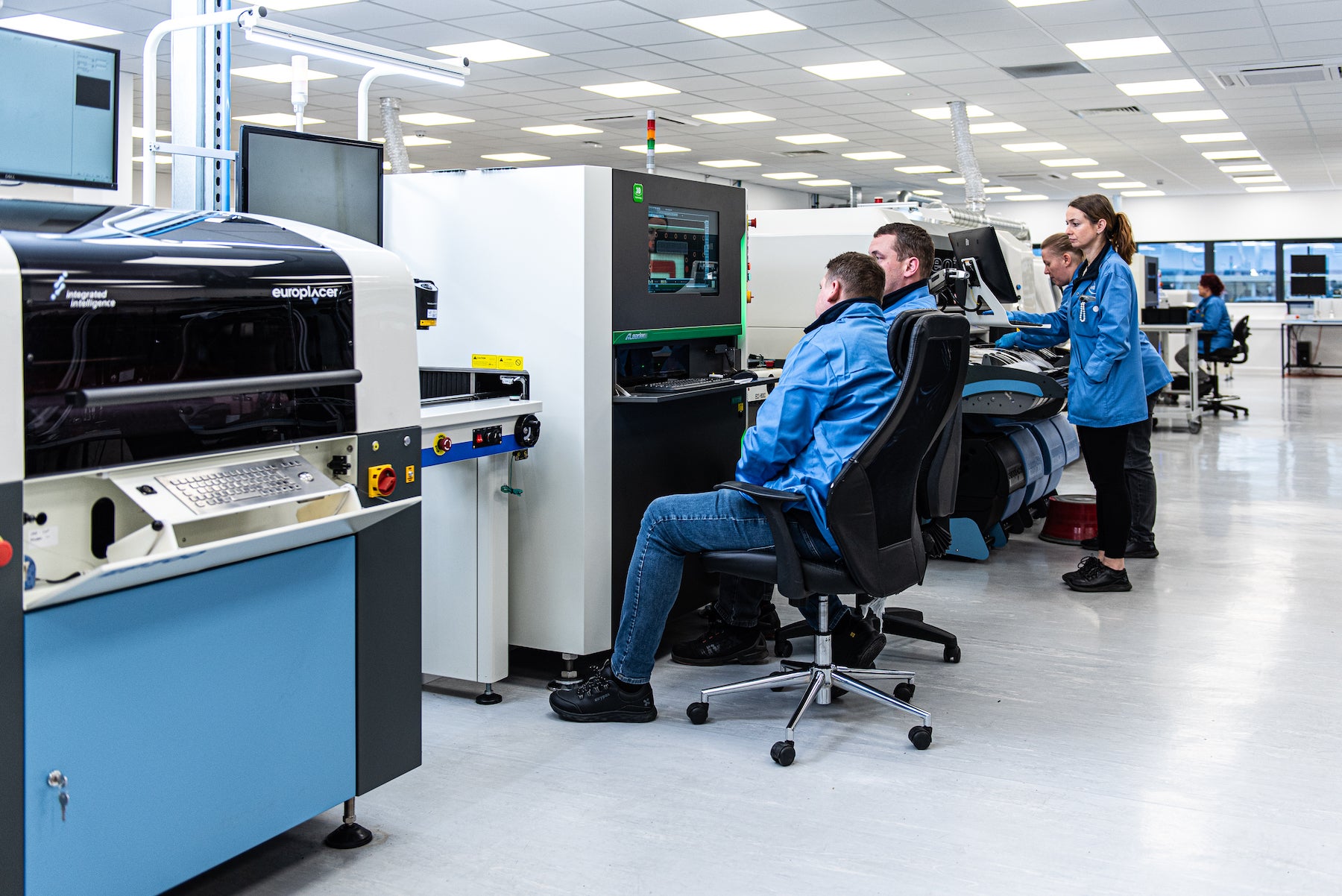
One of the three SMT lines at ETL’s manufacturing facility in Hereford, U.K. Photo: ETL Systems
VIA SATELLITE: What other changes in the market are you seeing and how is ETL Systems evolving to meet those changes?
Dunne: I think the main driver is an increase in demand for capacity. There’s an insatiable desire for more capacity on a year-on-year basis. The satcom industry has been adopting that shift in terms of Non-Geostationary Orbit (NGSO) constellations. Obviously we’ve seen Starlink in a quite prevalent position driving a lot of the shift. Now that’s moving to other organizations and it’s happening across the traditional Geostationary Orbit (GEO) environment and newer players in Low-Earth Orbit (LEO) and Medium-Earth Orbit (MEO) constellations.
I think this is shifting in terms of the architecture of ground stations and the general infrastructure. We need to have a much higher level of flexibility and scalability. With our roadmap and technology development, we are looking at keeping pace with the rate at which satellites are being launched and being able to adapt to flexible, integrated ground systems. How do we provide a very flexible, very scalable system for the operators and integrators to be able to take on board and move forward? That lends itself into Digital IF.
VIA SATELLITE: You have been a vocal proponent of Digital IF. Why do you think this is something the satellite industry needs to embrace?
Dunne: That flexibility is becoming an absolute necessity. As you start managing in that more complex environment where you’re coordinating different bands across different orbits, you have to be able to switch and manage all of that efficiently. I think doing that in hardware becomes exceptionally difficult and not really practical. Once you move that into the software, you have much more control over how you’re managing signal distribution and what you can do with that signal. The other benefit of the digital domain is that you don’t end up with any RF signal degradation. Once you’re in the digital domain, you can transmit that over an IP network and not lose any integrity of the signal. That’s a really important point for the increasingly distributed nature of how we are moving information around the world.
VIA SATELLITE: Where does ETL Systems stand in terms of the switch to Digital IF and building up capabilities in the area?
Dunne: We have digital products available now. What we’re seeing is that market adoption and the market transition is quite slow. The critical element here is the ability to marry together the RF environment and the digital environment. That’s a big part of the equation. We’re not seeing wholesale adoption end-to-end of large digital, virtualized environments. I think part of that is down to the fact that it’s exceptionally costly to implement all of this from scratch. Given the fact there is already huge infrastructure in place with traditional RF, we’re seeing that adoption of looking at how you integrate digital into your existing RF infrastructure, and doing it on an almost piece-by-piece basis, so that it can be upgraded over a period of time. We’ve been looking at how to integrate that digital capability into our existing RF — that’s something that appeals to a number of customers.
VIA SATELLITE: How is ETL differentiating itself in a market where scalability and agility are becoming a priority for ground segment providers?
Dunne: Our Genus platform is a modular, rack mount and outdoor unit configuration environment where you can pick and choose which capabilities you need. They’re standardized units where you can interchange frequency converters, RF over fiber, switches, DC injectors — all of that is entirely flexible in the architecture. You can remove and replace — everything is hot swappable. Scaling that enables operators and integrators to be able to navigate that new environment.
The other piece that we’ve been looking at is, how do we get all of the building blocks from an end-to-end point of view so that we can offer a service to our customers? This will allow us to be able to say, ‘Give us your entire requirement, and we will optimize your system. You specify what you need in terms of expansion, characteristics, future scalability, and we will build that into the system.’ We’re doing more of that with our customers and providing that as a service. That is serving well in terms of starting to seamlessly integrate Digital IF into that RF background. Our Genus Digital modules fit into exactly the same architecture as our existing RF, so you can put them side-by-side and choose how you wish to manage your ground segment.
VIA SATELLITE: Where do you see the greatest growth opportunities for ETL in the next three to five years?
Dunne: Given the fact that there are so many satellites going up, there is still a huge amount of ground infrastructure that needs to be put in place. We are seeing a big uptick in the number of ground stations being implemented. I think it’s the same on both the fixed and mobile gateways and VSAT terminal environment. There’s a lot more capabilities still required to satisfy the demand for satellite. It’s always a bit of a challenge in terms of the number of satellites going up and keeping up with the ground infrastructure to actually be able to utilize the capacity that’s there in the network.
We still see a huge amount of opportunity over the next three to five years of refreshing new ground station infrastructure that needs to go into place. We’re seeing that across slightly different customers. Some of the operators are now looking at how they operate their ground segments as service models rather than running them as stand alone. That’s just another factor in terms of how we support those parties. We’re looking at how we manage that from a hardware provision and from a software integration perspective.
VIA SATELLITE: In the past year ETL has acquired SpacePath Communications and IRT Technologies, how have those acquisitions expanded your portfolio?
Dunne: I think there are two elements here. One area was an obvious gap in the portfolio of capabilities for ETL. It also provides a platform to integrate other capabilities that we have in the portfolio. Integrating in the likes of frequency converters to power amplifiers, block upconverter, looking at how we integrate digital into those products and platforms is how we provide the full end-to-end. Now, we can provide everything from the feed on the antenna all the way through to the modem in a full, turnkey solution.
VIA SATELLITE: What are your goals for the company for the rest of this year and looking to 2026?
Dunne: The biggest priority is always supporting our customers. We pride ourselves on spending a lot of time with our customers and having a very interactive engagement. It’s also continuing the development of our technology. We’re busy developing the next generation of capabilities, focused on the next phases of generations of Genus Digital products. We’ve got a number of new Genus products due to come out in the next few months.
We’re also looking at how we support the shift in the market to Q- and V-bands across our high-power amplifier portfolio, across our frequency converter portfolio. We have products that are being tested and demonstrated at the moment in that environment. It really ties together the market picture in terms of the shift to those higher frequencies to meet the capacity demand.
VIA SATELLITE: Given the increasing complexity of satellite networks, how important are partnerships to ETL’s strategy?
Dunne: We are actively partnering with a number of organizations now, and I think it will inevitably be a feature of the business going forward. Some are partnerships with customers in terms of how we combine capabilities into specific customers, whether it be operators or integrators. In other areas, it’s partnering with suppliers, other technology developers to look at how we bring those capabilities to market in the most highly efficient and compelling way.
It’s going to be a function of the market as a whole. If you’re not partnering, if you’re not aligning yourself with the shift in technologies — it is very hard to stay at the forefront of everything. The last 20 years have been relatively slow in terms of the pace of change, and that’s really accelerated in the last few years. It really is about bringing complementary capabilities and technologies and how to engage partners to bring compelling solutions to the market.
VIA SATELLITE: I’ve seen a lot of emphasis from the U.K. lately on encouraging the national space industry. Do you see ETL as a key part of the U.K.’s space industry, and how would you like to see the national space industry grow more?
Dunne: Absolutely, I see ETL Systems playing a key role in space-based innovation in the U.K. I think sometimes the ground segment gets a bit of a rough ride, it’s often a less publicized element of the space, but it’s just as critical.
If I was going to look at this holistically, bringing together that vertical integration of the pure space in terms of launch and satellite, bringing that closer together with the ground segment, and tying together some of those programs where it’s much more joined up – I think that that would really support the U.K. as a leader in space.
VIA SATELLITE: What are you most excited about for the future of the ground segment, and what do you think will define the next generation of players?
Dunne: Going back to some points, the next successful tranche of players in the ground segment will be able to combine that RF engineering excellence alongside the innovative software, cloud, and network automation side of technology advancement. I see that as a shift that presents a lot of exciting opportunities for us as a business, but also for the market as a whole. It’s attracting talent into the market. We’re already seeing that space has become a lot more interesting as an area for engineers to come in and get involved in the industry. I’m very proud that ETL is in the middle with a deep technical credibility in that space and continuing to evolve our model to make sure that we are a platform enabler across both the RF side and across the software and automation side.
Stay connected and get ahead with the leading source of industry intel!
Subscribe Now