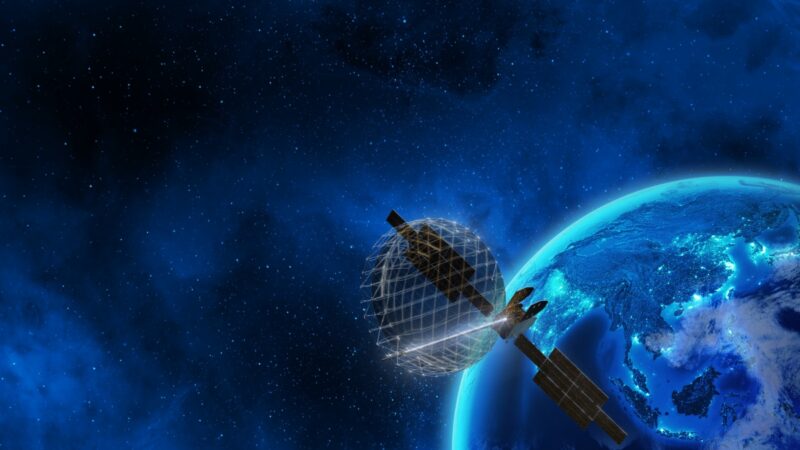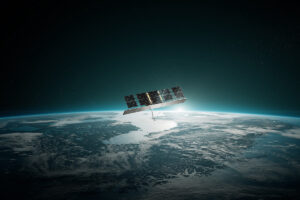

Orbital data centers are now taking shape enough to have brand names. SpaceX has put Starmind on the map, with Elon Musk describing it as an AI satellite megaconstellation that could eventually operate as “orbital data centers” at enormous scale. While that is the headline, the footnote is more interesting. Reuters reported that SpaceX has warned investors its orbital AI compute plans remain technically complex, unproven, exposed to the harsh space environment, and may not become commercially viable.
That contradiction is the real story.
The public pitch is simple: AI needs power, space has sunlight, vacuum is cold, and launch costs are falling. It is a good slide. It is also incomplete. Physics does not care that the renderings look clean. A hyperscale cloud in orbit still has to survive radiation, thermal cycling, launch vibration, orbital debris, limited servicing, short technology refresh cycles, and a communications architecture that does not turn every workload into an expensive round trip.
The more serious play is not to lift today’s data center into orbit but instead force a new semiconductor stack into existence: radiation-tolerant AI processors, edge inference modules, optical links, power electronics, advanced packaging, memory architectures, and autonomous software designed for systems that cannot wait for Earth to think for them.
Starmind matters because it turns “data center in space” from a novelty into a demand signal, however, the first killer application is unlikely to be a million orbital GPUs serving terrestrial chatbots. It is an agentic space layer: satellites, sensors, relays, inspection vehicles, and defense payloads that can perceive, plan, route, prioritize, and act locally when bandwidth is scarce or the link is contested. In that world, compute is not a back-office utility. It is part of guidance, navigation, communications, and survival.
That is why Tesla’s semiconductor push belongs in the same conversation. Reuters also reported that Tesla has been recruiting Taiwan-based engineers for Terafab, described in job listings as a vertically integrated semiconductor factory spanning logic, memory, packaging, testing, and mask production. The same postings reportedly referenced chips for edge inference and “space-hardened” orbital satellites. Strip away the Musk theater and the strategic logic is exposed. If you depend completely on someone else’s silicon roadmap, autonomy at planetary scale and autonomy in orbit both break.
While some may think it is just Nvidia licking every cookie they can, their play here is like strategic. In March, the company announced a formal space-computing initiative: Space-1 Vera Rubin Module, IGX Thor, Jetson Orin, and RTX PRO Blackwell platforms for orbital data centers, geospatial intelligence, and autonomous space operations. It also named Aetherflux, Axiom Space, Kepler, Planet, Sophia Space, and Starcloud as users or partners. But Nvidia’s own release says the Space-1 Vera Rubin Module comes later, while the available products are largely adaptations of existing platforms. This is real, but not yet a mature orbital silicon industry. It is an orbital beachhead.
Others are already more concrete. AMD says its flight-qualified Versal AI Edge XQR device brings AI inferencing to space in a radiation-tolerant adaptive SoC, with Arm Cortex-A72 and Cortex-R5F cores, programmable logic, and AI Engines for onboard processing, autonomous navigation, and sensor workloads.
STMicroelectronics is even more revealing because its business is less glamorous. STMicro said in May that it expects more than $3 billion in cumulative space-chip revenue from 2026 to 2028, driven by low-Earth-orbit satellite networks, and that its LEO revenue is already approaching $1 billion in 2026. A dark horse could be HPE which has fielded multiple generations of the Spaceborne Supercomputer on the ISS. When you combine vertical integration, orbital beachheads and commoditization a supply chain begins to emerge.
The same shift reaches manufacturing. NASA’s InSPA program argues that microgravity can reduce gravity-driven barriers in semiconductor crystal production. A 2024 npj Microgravity meta-analysis reviewed 160 semiconductor crystals grown in microgravity from 1973 to 2016 and found improvement in at least one reported metric in 86% of materials with data. Of course, that does not mean TSMC will be replaced by an orbital fab. Rather, it means space may become a strategic materials lab for substrates, power electronics, photonics, and defense-grade components where defects, purity, and thermal properties matter more than commodity wafer volume.
This is also why the critical-mineral competition is not separate from the space-compute story. The U.S. Geological Survey lists gallium, germanium, hafnium, tantalum, tellurium, and silicon among critical minerals tied to semiconductors, aerospace, harsh environments, or microchips. The International Energy Agency (IEA) notes that China restricted exports of gallium, germanium, and antimony to the United States in 2024 and that critical-mineral export controls have proliferated since 2023. Space-scale silicon will not be sovereign if its feedstocks, packaging, and specialty materials are not.
China understands this and is taking action. Its Three-Body Computing Constellation launched an initial group of 12 satellites in 2025, with China’s State Council news site describing a planned thousands-satellite orbital computing network aimed at real-time in-orbit data processing and a target of 1,000 peta operations per second. The message is blunt: orbital compute is not merely a Silicon Valley energy workaround. It is becoming an industrial-policy and national-power instrument.
So yes, the data-center-in-space rhetoric is inflated. It may even be intentionally inflated, but dismissing it as hype misses the asymmetric move. The public is being shown green AI in orbit. The real buildout is a semiconductor ecosystem for autonomous, contested, power-constrained, radiation-exposed space infrastructure.
Space is not coming for the cloud first. Space is coming for Silicon.
Zaheer Ali has been a research physicist, F50 executive, and start-up founder. He is now Program Director of the Space MBA and Professor of Practice of Space Commercialization and Strategy at the University of Central Florida.