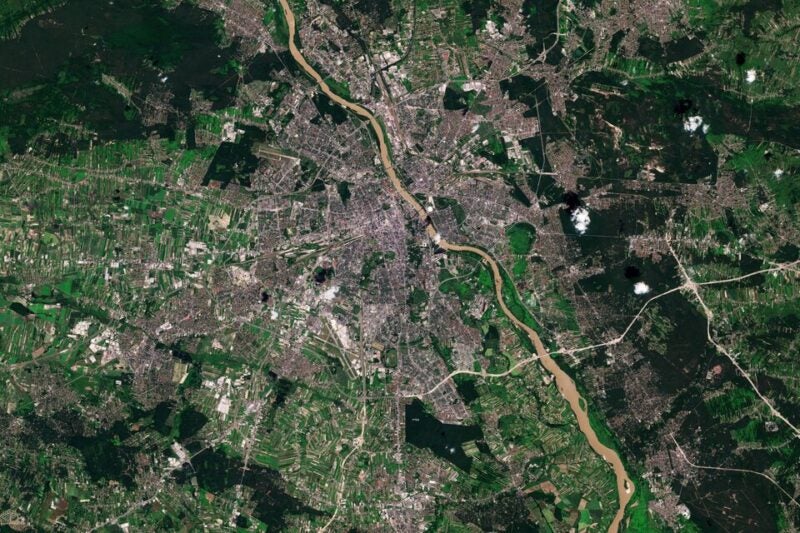
On April 4, Planet Labs told customers it would withhold imagery of Iran and the surrounding conflict zone indefinitely, retroactive to March 9. The company said the U.S. government had asked all commercial imagery providers to do the same. Vantor said it had not been contacted but was applying its own enhanced access controls across parts of the region.
For most of the industry this registered as a wartime measure. But in Gulf procurement offices it registered as a demonstration that a commercial service agreement can be suspended by a party who is not on the contract, without notice, and with retroactive effect on data already paid for.
That policy is still running. And the question Gulf government buyers now put to operators early is no longer only about throughput, coverage, and price. It is some version of: under what circumstances does this stop, who decides, and what do we get if it does?
Anyone selling into the region who does not have a good answer to that is competing on price alone.
On the night of October 13, the same question was answered again, on a different service in another theatre. Starshield terminals in Ukraine stopped working above roughly 160 kilometers per hour. Ukrainian units found out from customer support after filing a fault report; the 7th Corps cancelled missions, and interceptor drones flown against Russian Shaheds went down with the strike drones.
Elon Musk’s position was that the limit was not his to set: “Starshield systems are owned and controlled by the U.S. government. Any limits on speed or usage are decided by the U.S. military and ultimately POTUS.” Reuters reported on October 16 that the instruction came from inside the White House; but the Wall Street Journal reported this week that Musk himself ordered the slowdown, after discussions with the White House. President Trump and other White House officials have denied involvement.
Whoever gave the order, the customer found out from customer support. For a Gulf procurement office that is the entire lesson. What a procurement office reads twice is the contract underneath. Starshield is in Ukraine because the Pentagon bought the service directly, after an earlier episode in which a company’s own judgement interrupted operations. Buying through the government was the fix. It produced an off-switch with a different hand on it, and still no notice.
The Evidence is in Deal Structure
It is easy to dismiss “sovereign capability” as a slogan Gulf states have attached to space programs for a decade. What changed is visible in how the contracts are now built.
Take Space42’s arrangement with the UAE government: 18.7 billion UAE dirham, about $5.1 billion, running 17 years to 2043, replacing two agreements due to expire at the end of this year. The headline number is not the interesting part. The interesting part is that the government advanced AED 3.7 billion — roughly a billion dollars — to build Al Yah 4 and Al Yah 5, against a total program cost of about $1.1 billion covering spacecraft, ground segment, launch and insurance.
A customer who pre-funds almost the entire build cost of the satellites it intends to lease capacity from is not behaving like a customer. It is buying an asset and leaving the operating risk with the operator. That is a structure, and structures tell you more about intent than press releases do.
Look at what is being bought, too. Al Yah 4 and Al Yah 5 are Airbus Eurostar Neo platforms with software-defined payloads reconfigurable in orbit — coverage, bandwidth, and frequency allocation adjusted after launch. You buy that when you cannot specify your requirement in advance, because you do not know what the next five years look like. It is capability bought against uncertainty rather than a defined mission.
Then there is Es’hail-3 and Türksat-Biruni. Thales Alenia Space took the manufacturing contract in June at around $347 million, launch expected in 2030, and Es’hailSat and Türksat signed a strategic agreement on capacity sharing alongside it. Two operators, in two countries, pooling a spacecraft and the commercial reach around it.
Qatar and Turkey building shared capacity is a redundancy decision as much as a cost one. It creates a path that does not run through any single Western supplier relationship, without either party building an independent industrial base.
Around those the pipeline widens: Altair, Arabsat’s next-generation fleet, Oman’s first national communications satellite, Space42’s manufacturing joint venture with Iceye in Abu Dhabi — the supply chain, not only the asset.
What This is Not:
It would be wrong to read any of this as the Gulf detaching from the global industry. Airbus builds the Emirati satellites. SpaceX launches them. Thales Alenia builds the Qatari-Turkish one. The $695.5 million facility behind Al Yah 4 and 5 was arranged by Crédit Agricole, Santander, Société Générale, and Natixis, and backed by Bpifrance Assurance Export — a French state export credit agency underwriting Emirati sovereign capability.
Sovereignty here is a procurement posture, not autarky, and nobody in Abu Dhabi, Doha, or Riyadh is pretending otherwise.
It would also be wrong to treat the imagery restrictions as a commercial betrayal. On March q, the second day of the war, an Iranian one-way attack drone struck a tactical operations center at Port Shuaiba in Kuwait, killing six U.S. Army reservists and wounding more than 30. Commercial imagery of basing and force concentration is useful to anyone planning a strike like that, and it is sold to whoever has a credit card. The providers faced a real operational problem and used the lever they had. The decision was not necessarily the wrong one. It was made, it stuck, and every procurement office in the region watched it happen.
The Commercial Opening
Here is what I think operators are getting wrong about this market, and it is correctable.
The instinct when a customer starts talking about sovereignty is to treat it as a threat to the service model — the prelude to losing the account to a national program. Sometimes it is. More often it is a request for terms nobody has offered yet, because the industry has never had to.
Service continuity is a contractual question and it is almost never contracted. Ukraine is why the standard reassurance — that a government customer stands between the buyer and the switch — has stopped closing the conversation. Who holds authority to suspend or degrade service, under what instrument, with what notice, and what the customer is owed if it happens are all writable terms. An operator with specific language around them is answering the question Gulf buyers are already asking internally, while competitors answer with reassurance.
Jurisdictional diversity is a feature that can be priced. So is a ground segment on the customer’s territory under the customer’s law, and processing done locally rather than in a facility subject to another government’s instructions.
And the Es’hail-3 structure deserves more attention than it has had. Capacity-sharing between operators in different jurisdictions gives a government a second path without the cost of a second program. For commercial operators that is a template, and a way to stay in a market that would otherwise build around them.
On Mordor Intelligence’s numbers the Middle East satcom market is worth about $4 billion this year and reaches $5.64 billion by 2031, maritime the largest vertical at close to 40% of revenue and defense ministries second. That growth will be spent by buyers who spent this year learning what a revocable service looks like.
The operators who win it will be the ones who stop treating that lesson as a problem and start writing it into the contract.
Kelevitch is a space policy analyst covering national security space and satellite programmes, with a focus on the Gulf. He works from Arabic, Turkish and Persian primary sources. He has published two commentaries this year for SpaceNews, on wartime restriction of commercial satellite imagery and on GNSS jamming across the Gulf.