Latest News
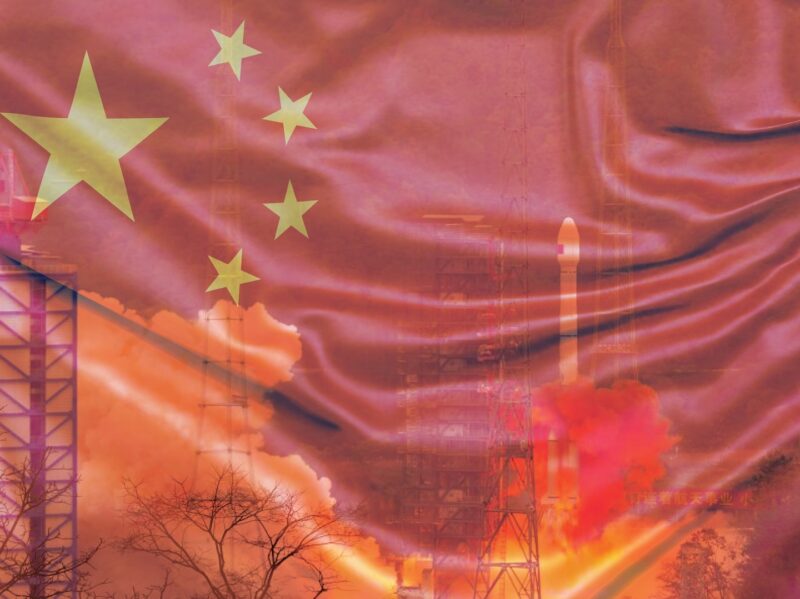
A launch at China’s Xichang Satellite Launch Center. Xinhua image and Via Satellite illustration
A realistic appraisal of China’s potential in space requires us to suspend the natural but distortive habit of projecting our own views onto another. This is one of the great risks of intelligence. As Americans, we tend to think of space as an orderly, professional domain where science and government come together for the achievement of honorable missions. It’s crew-cut, all-American bros cheering as Apollo 11 lands on the moon.
Can the same be said for China? We think it is a mistake to assume that China’s space program and military space projects embody these clean-cut American values. Even a casual review of recent scandals and purges affecting China’s domestic and military space programs, coupled with the enmeshment of global criminal gangs into the Chinese government, will reveal a far shakier and unpredictable enterprise than we might imagine.
This article examines the impacts of corruption, questionable leadership, and criminal entanglements on the potential for China to achieve its objectives in space. It also extrapolates current Chinese practices on the ground to analogous scenarios in space. Nor is China operating in a vacuum. The country faces risk exposure from conventional adversaries like the US and irregular threats such as pirates and criminal organizations operating on the ground. How strong is China in space, really, and what will its space operations look like in practice?
China’s Twin Space Programs
China has two essential space portfolios: military and civilian. However, as is the case with many Chinese endeavors, it is difficult to know where the boundaries are between the two. Militarily, China is rapidly advancing in the realms of space-based intelligence, surveillance, and reconnaissance (ISR) deployments, counter-space weapons, and ballistic missiles.
The China Manned Space Agency is pursuing its own impressive set of space missions. Their 25-year roadmap includes the operation of a Chinese space station, Mars probes, as well as a lunar research station. The agency is also developing numerous scientific projects and more durable, long-term space habitation.
Space is a high priority for China, with the country’s leader, Xi Jinping, declaring in 2024, that China should “explore the vast universe, become a great power in space!” Xi also said that space has a role to play in China’s national defense, remarking that its military and technology establishment should work to “safeguard China’s security interests in outer space, electromagnetic space and cyberspace,” while also creating “effective governance in space.”
The United States is responding, embarking on a “space superiority” strategy to counter China’s growing prowess as a space power. Remarking on China’s new “space dogfighting” capabilities, Vice Chief of Space Operations Gen. Michael Guetlein said, “That capability gap used to be massive. We’ve got to change the way we look at space or that capability gap may reverse and not be in our favor anymore.”
Questioning China’s Assertion of Ascending Dominance in Space
Is China a formidable space power in the making, an adversary that the U.S. and others should fear? While it would be naïve to underestimate China’s potential in space, a more nuanced view is probably appropriate. It would be a mistake to view China’s space capabilities solely as they present. The reality of China’s space programs is more complex and multi-layered than a superficial read would suggest.
Indeed, in our view, China is facing at least three forms of trouble in space. Some is innate, due to corruption and related problems. Other trouble is by design, given China’s history of blending criminality with geopolitics. The rest is unexpected, caused by adversaries and blowback from its own off-the-books criminal projects.
Innate Trouble
China’s space program is experiencing its share of self-inflicted problems. There have been some high-profile disasters and purges. A scandal broke out in 2024 over allegations that rockets were filled with water, not fuel. Fifteen military leaders were removed from their positions in 2023, allegedly for corruption. Many of the deposed were from the Rocket Force, including its commander.
The problems in China’s domestic and military space programs, which are deeply intertwined, arise in part from deep, systemic corruption in the Chinese Communist Party (CCP) and the People’s Liberation Army (PLA). The rocket malfunctions are an example of quality problems that emerge when leadership is focused on self-dealing rather than excellence. This pattern will likely result in more catastrophic episodes.
More broadly, the PLA is generally unstable, as evidenced by recent purges. Instability and distrust in leadership ranks don’t bode well for highly complex, long-term projects like building space stations and off-planet colonies. Issues related to manufacturing quality and command coherence will likely plague these efforts and hamper China’s progress in space.
Trouble by Design
CCP and PLA collaboration with China’s notorious triad criminal gangs is an underappreciated element of China’s overall geostrategic profile. Western observers tend to look at China as an adversary and compare military and industrial strength on a peer-to-peer basis, e.g., China has X number of rockets vs. the U.S., which has Y number of rockets. This is an incomplete and sub-optimal perspective. The triads represent a critical but sub rosa partner for the CCP and PLA, enabling China to achieve its goals through a combination of official acts and subversive campaigns.
Examples of the government-military-criminal partnership abound. They run the gamut from smuggling fentanyl into the United States to weaken American society to complex programs of human trafficking, dealing heroin, and smuggling rare commodities in Mozambique. The process is becoming globalized, with cooperation now existing between the triads and Latin American drug cartels.
This is not a new phenomenon. Collaborative, mutually beneficial relationships between Chinese political powers and criminal gangs go back centuries. The expansion of the Chinese economy since 1991 has simply enriched this status quo’s potential.
Involving criminals in government and military processes is not auspicious for space programs, however. The partnership is allegedly at arm’s length, given that the CCP and PLA don’t want public exposure of their links to criminal groups. This means the triads are free to pursue their criminal programs without accountability. The triads may exploit their insider knowledge of lucrative space projects to extort money or engage in blackmail, theft, or piracy. Any of these scenarios could lead to disaster in space, a domain that requires tight controls and fierce discipline.
Unwelcome External Trouble
China’s cyber vulnerabilities are another under-discussed factor that could expose its space program to risk. Most of the focus in the West is on China’s prowess as a cyberattacker, and the concerns are real. China has been perpetrating a formidable array of attacks on American government, military, and corporate targets for years. However, China itself is far more exposed to cyber threats than the CCP would ever let on.
There have been several spectacular breaches in China. As recently as two weeks ago, researchers at Cybernews revealed that four billion private records about Chinese citizens were found in an unsecured online file repository. In 2021, 1.1 billion pieces of Alibaba user data leaked, and on and on. China, fixated on being on the offense in cyberspace, appears to have neglected cyber defense. This weakness will likely affect its space projects, which depend on secure connectivity and data integrity on the ground and in space.
What the Future May Hold for China in Space
With these risks in mind, what does the future look like for China in space? Here are a few possible scenarios:
Chinese space assets serving as platforms for illegal activities — It is probable that Chinese space installations, such as its space station or lunar colonies, will be sites of criminal activities by triads, such as drug dealing, extortion, and human trafficking. This may not happen right away, but the dynamics of governance and life support in space make it likely that malicious actors will at least have the opportunity to take control over the operations of a space asset and use that control for their advantage.
Corruption and criminality destroying Chinese space projects — If the past indicates future trends, China may see space projects fall apart before or after they get aloft. Mechanical problems due to substandard manufacturing and unsustainable financial losses are two possible paths to this inauspicious fate.
Chinese space assets launching with stealth cyber compromise — The porous boundaries between criminal organizations and the Chinese space program might easily result in space assets being compromised, in cyber terms, from the point of development and throughout their entire lifecycles. This would render them vulnerable to espionage and sabotage.
Criminal gangs hijacking space assets for ransom by CCP — Criminal groups, including but not limited to triads, might hijack Chinese space assets. This could be a false flag operation or a masked cyber-attack, with the goal of extorting money from the CCP in return for the asset’s survival.
China is a rising space power, one whose potential should not be ignored or minimized. However, if the United States wants to assess China’s space operations accurately, it should factor in the programs’ inherent corruption and the impact of its deep, deliberate collaboration with criminal organizations. The criminal nature of the Chinese space programs is both a threat and a weakness, from the American perspective. It is a source of vulnerability for China, but also a vector of unexpected attacks. The United States should adapt and plan accordingly if it wants to counter China effectively in the space domain.
 Hugh Taylor is the Director of the Center for the Study of Space Crime, Piracy, and Governance. He is the co-author, with Marc Feldman, of the book “Space Piracy: Preparing for a Criminal Crisis in Orbit” (Wiley, 2025). Prior to working in the space sector, Hugh served in executive roles at Silicon Valley startups, Microsoft, and IBM. His writing has appeared in Security Boulevard, The Daily Beast, HuffPost, and The Washington Spectator, in addition to his cybersecurity blog, The Journal of Cyber Policy.
 Marc Feldman is managing partner of Eonia Capital Management, an aerospace/space and defense-based venture capital fund. Marc has more than 35 years of experience in commercializing technologies and scaling startups. He has led teams across various industries, including life sciences, entertainment, media, telecommunications, consumer products, and aerospace/space. Having worked at and advised Shamrock Capital, Disney, Interpublic Group, Univisa Satellite Services and News Corp, Marc has extensive experience globally, including in Asia, Europe, Russia, the Middle East, and Latin America.
Stay connected and get ahead with the leading source of industry intel!
Subscribe Now