Latest News
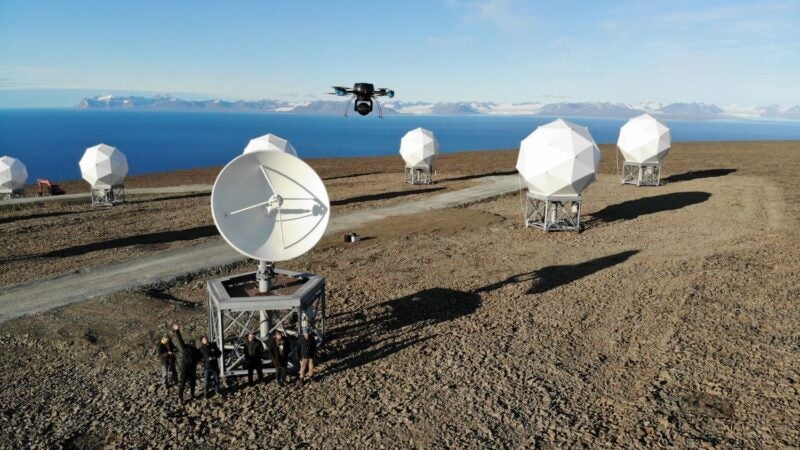
Image of a teleport. Photo: Quadsat
Last year, Look Up Space logged the milestone that there are more than 10,000 active satellites in orbit. When you consider that in 2020, there were just over 3,000, it is clear to see that this is a massive increase and is likely to have a wide-reaching impact on the entire space environment. More satellites in orbit than ever before, and in multiple orbits, brings added complexity, which could of course spell an increased risk of errors, leading to radio frequency interference (RFI), due to frequency and orbital congestion. As we look to the future, the types of services teleports need to support will also change, especially with the launch of proximity operations for active debris removal and in-orbit servicing.
The report also cited that the vast majority (more than 9,000) are in Low-Earth Orbit (LEO). Of course this changes the technology needed on the ground, as LEO requires antennas that are able to track satellite passes. And yet, in this environment, the ground segment is more important than ever to ensure reliable and sustainable access to space.
How can teleports manage this complexity and keep up with the rapid pace of change?
Keeping Spectrum Clean
Simply put more satellites means more signals and more room for errors, even more so when you add in the complexity in different orbits. When interference occurs, it can be detrimental to service provision. The industry has numerous processes and tools in place for dealing with interference when it happens so that the impact on the end consumer can be minimized, if not completely avoided. However, the same can’t be said for everyone else in the chain, as all the methods come with a cost. In some cases, perhaps the interference can be found and removed, which takes time and resources, but in many other cases, it renders parts of the spectrum unusable, reducing profitability.
Teleport operators are under pressure to ensure that the ground equipment neither causes nor experiences interference. As complexity increases, that is becoming more challenging. Teleports also need to factor in other sources of interference locally, such as 5G networks, in addition to atmospheric conditions that can lead to signal degradation. And much of this changes with time, as the local environment changes or as equipment degrades. The only way to ensure there is no interference being introduced, other than waiting for it to happen, is to instigate a system of regular testing on site.
Keeping Pace with Changing Technology
It is not surprising that changes in space mean that technology is changing fast. For example, it is not possible to use the same antennas that have been relied upon for many years in Geostationary Orbit (GEO) for LEO or even Medium-Earth Orbit (MEO), because we are introducing the need to handle satellite passes and tracking. We are seeing a whole swath of new tools and technology emerge to handle the ever-evolving requirements. We are also witnessing a move toward cloud-enabled networks, which brings a number of benefits in terms of efficiencies, but also changes the skillset needed on the ground. Teleport operators need to keep on top of all these changes and ensure they are equipped to continue manage the ground segment, without risking errors.
At the same time, satellites are increasingly relied upon for the more data-hungry services, which means that even the sheer amount of data being managed has increased dramatically. Teleports need to ensure they can maximize throughput and capacity as much as possible, while delivering seamless connectivity to enable next-gen services.
All of this means there is a growing need to understand new technology in space and embrace new technology on the ground to keep up with those changes.
Securing the Future of Space
The subject of space sustainability has risen up the agenda. It is not surprising when you consider that according to the European Space Agency’s latest Space Environment Report, there are more than one 26,000 pieces of debris that are larger than 10 cm in size. If you look at pieces larger than 1 cm, which is still large enough to do considerable damage, there are more than 1 million pieces of debris. The recent outage of Intelsat 33e demonstrates how easy it is for things to go wrong. Add this to an already congested environment, and it is clear to see why this has become so important.
As with everything that gains traction, we are seeing a lot of innovation and ideas of ways to tackle the situation. While we don’t yet have active debris removal or in-orbit servicing in operation, with so many people looking at this, it is only a matter of time. Once these are proven, it will likely scale up significantly in a very short timeframe and the ground infrastructure will need to be ready. The biggest challenge with that is that we don’t yet know what that means for the ground segment and whether new technology will be required to manage these. It is clear however that teleports will be an important piece of the puzzle and it will mean a dramatic shift in operations.
It also brings into question other parts of the infrastructure, such as information security. Many systems are old and simply not secure enough to meet today’s demands, so we need to be considering the assurance of secure space operations as part of making space more sustainable. Achieving a more sustainable environment will require innovative technology, global cooperation, and more stringent regulation.
The environment has changed so rapidly that it is almost impossible to predict exactly what it will look like in 10 years’ time. However, what we do know is that space has an important role to play for global communication, the environment will get more crowded, and technology will get more sophisticated. Teleport operators have an important role to play in ensuring the continued use of space and keeping ahead of that evolution will give them a competitive advantage.
 Rico Behlke is the Channel Manager for Quadsat, which provides on-site testing and calibration of antennas and RF systems, as well as monitoring of the radio spectrum.
Stay connected and get ahead with the leading source of industry intel!
Subscribe Now