Latest News
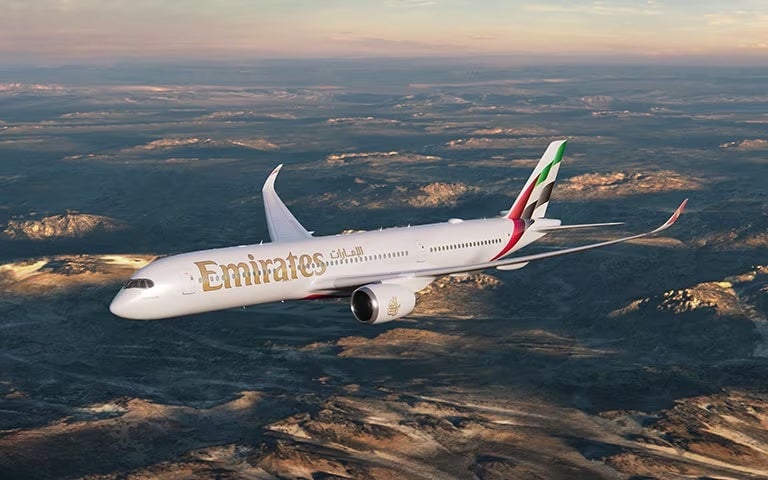
Photo: Emirates
In November last year, Emirates stunned the in-flight connectivity (IFC) world when it announced a move to adopt Starlink.
Emirates is deploying Starlink Wi-Fi across its entire in-service fleet, beginning with Boeing 777 aircraft in November 2025 and completing the rollout by mid-2027. The investments comes as part of a $5 billion fleet refurbishment program for Emirates.
Via Satellite caught up with Patrick Brannelly, senior vice president of IFE & Connectivity for Emirates to talk about why the airline decided to go down the Starlink route and what this means for the overall market. In a candid interview, Brannelly talks about the whole process and gives a very interesting perspective from an airline about the decision-making process.
VIA SATELLITE: In terms of a timeline, when did you start thinking of Starlink as a viable possibility for your in-flight service?
Brannelly: The legacy systems weren’t working. No matter how much money we threw at them, passengers still complained, and it was impossible technically for everybody that wanted to connect to connect. We studied the data, and could see that the overall penetration was not as high as it should be. Clearly the data volumes were too low, which was unnatural. The noise of complaints, people saying, ‘it just doesn’t work’ and ‘I just can’t get connected to the portal.’ Some people would get connected without problems.
Then Starlink came along saying, ‘We guarantee it, it will work.’ With a very pragmatic technical viewpoint, insisting on XWAPs, to connect 100%, and to install more than one antenna to handle demand and for redundancy. It was like for the first time, talking to people that actually understood how the internet works in a highly dense environment on an aircraft.
It seemed our legacy connectivity industry didn’t really understand the core technologies needed to deliver customer connectivity happiness. But Starlink absolutely understood it.
Now, in addition, the big fundamental shift from the first generation of Starlink was the evolution of satellite-to-satellite laser connectivity. So, if you’re a middle of the ocean, where you’ve got nowhere to ground the traffic, Starlink could just pass the traffic through adjacent satellites until there’s one over a ground station. That worked much better than I think anybody had imagined.
VIA SATELLITE: Were these discussions in 2025?
Brannelly: We’d always been in touch with Starlink. The other important aspect was lower latency. You can adjust your browser settings to inflict the 700 milliseconds of latency experienced with Geostationary Orbit (GEO), and experience how it affects the internet experience. It slows everything down dramatically which people confuse with low bandwidth.
Latency was a lot more important than anybody had ever said. Of course, they never mentioned it because they were all running Geostationary networks, and really wanted to make it out that that was not that important as you cannot reduce it. Low latency is significantly important to a good internet experience, not just to people playing games, but regular old, boring websites, apps and VPNs.
VIA SATELLITE: Was it difficult to move on from Viasat/Inmarsat after a 30 year relationship?
Brannelly: Viasat have their new technologies and more in the pipeline. They will be absolutely in that space for the future. They are enterprise company for the aviation industry, cockpit, and passenger. Starlink is a consumer company, focussed on passenger needs. It’s not connected to the cockpit. They have kept it really simple. They put on the antennas, the WAPs, job done. It is really simple.
VIA SATELLITE: Do you think Starlink’s position in the market creates the possibility of a monopoly?
Brannelly: Low-Earth Orbit (LEO) and Medium-Earth Orbit (MEO) may become a monopoly. There are other solutions coming in LEO and MEO, which, which are very exciting. But whether we need that, I don’t know. If this solution sorts out the airline industry then the airline industry is not that keen on switching hardware off planes and putting new stuff on. So, being an embedded first-mover is quite important, and I think they’ll see benefit in that for years to come. If in five years time, if there is a alternative competitor that is priced better/technically better — well then, competition is fabulous, and it will be considered.
Most people don’t care whether they have fiber or copper to their house – just whether it works. Most homes in Dubai have fiber, and 1000 megabits per second is pretty common. In the U.K., I’ve only got 32 Mbps – indicative of legacy infrastructure not scaled for the future and they’ll need to invest to upgrade it.
The airline connectivity systems need to be scaled for the future and for high demand because of the nature of the customers – data consumption onboard is higher than at home on a Tuesday evening! Likewise in a sport stadium – so many are streaming live, video or audio – what’s happening at other matches etc. — Infrastructure needs to be future-proof, or swappable easily.
VIA SATELLITE: You said Starlink find solutions “refreshingly fast” in this industry. What does “refreshingly” mean?
Brannelly: Aircraft connectivity is massively clever and, over the years, we’ve pushed the envelope of what’s possible. From the mid ’90s and Swift 64 to Swift Broadband, to Ku- and Ka-band over GEO it is amazing what has been done. But it wasn’t good enough for what was needed. In parallel, data demand and connectivity demand on the ground grew exponentially – my phone is consuming twice the data versus a year ago.
VIA SATELLITE: In our interview in 2023, you said, “The emerging LEO options look exciting and promise a potential paradigm shift in terms of in-flight connectivity but are yet to be proven technically and commercially in commercial aviation on wide-bodied aircraft” When did this change? When was the tipping point?
Brannelly: When it flew. Starlink has also dramatically evolved their technology and technical capabilities and continue to do so – they’re not standing still.
VIA SATELLITE: What frustrations did you have in the past in terms of deploying services on GEO?
Brannelly: Rather than the problem being GEO alone, I see most of the customer frustration has been compounded by poor on aircraft systems, old WAPs incapable of handling hundreds of users, clunky portals not built for success. Aircraft are similar to stadium seating and new generation WAPs are built for higher density demand – the industry should have installed XWAPs much earlier.
VIA SATELLITE: Do you believe most airlines will go for a solely LEO-based service in the future, or will GEO stay around in the form of multi-orbit services?
Brannelly: It’s been said by experts that lower latency is the secret sauce for a good internet experience – so LEO, maybe MEO. GEO cannot reduce latency but can provide necessary bandwidth – the question is whether bandwidth alone is enough. The problem isn’t with GEO alone. I see most of the customer frustration has been compounded by poor on aircraft systems, old WAPs incapable of handling hundreds of users, clunky portals not built for success. Aircraft are similar to stadium seating and new generation WAPs are built for higher density demand – the industry should have installed XWAPs much earlier.
VIA SATELLITE: How do you view the ROI now considering Starlink Wi-Fi will be free for all of your customers?
Brannelly: Connectivity is a hygiene factor now … what’s the ROI on an in-flight washroom? It’s hard to measure the customers you’ll lose if you don’t offer connectivity, or to measure how many customers fly Emirates because the wine we offer is world class. When Emirates chose to become the first airline to install seatback TVs on all seats back in 1991 there was no business case possible, it was a leap of faith based on common sense. It seems to have worked and I believe a commitment to great product focus works for most businesses.
VIA SATELLITE: You said you know the bandwidth and data capacity needed per 100 passengers by route by time of day. It’s a huge multiple of what has been delivered previously. Can you give a bit more detail on this? Did the usage surprise you?
Brannelly: I’m not going to put numbers to it yet. I get the feeling some of the legacy people knew those numbers – it should have been the starting point.
What surprises me is the high demand even on shorter flights. We had a plane diversion a few weeks back during a weather event. During the 25 minute repositioning flight between DWC and DXB, almost 100% of people connected using more data over Starlink than we’d typically see on a 7-hour flight. They were all probably getting on Emirates website and app to look at their connecting flight rebooking.
Stay connected and get ahead with the leading source of industry intel!
Subscribe Now