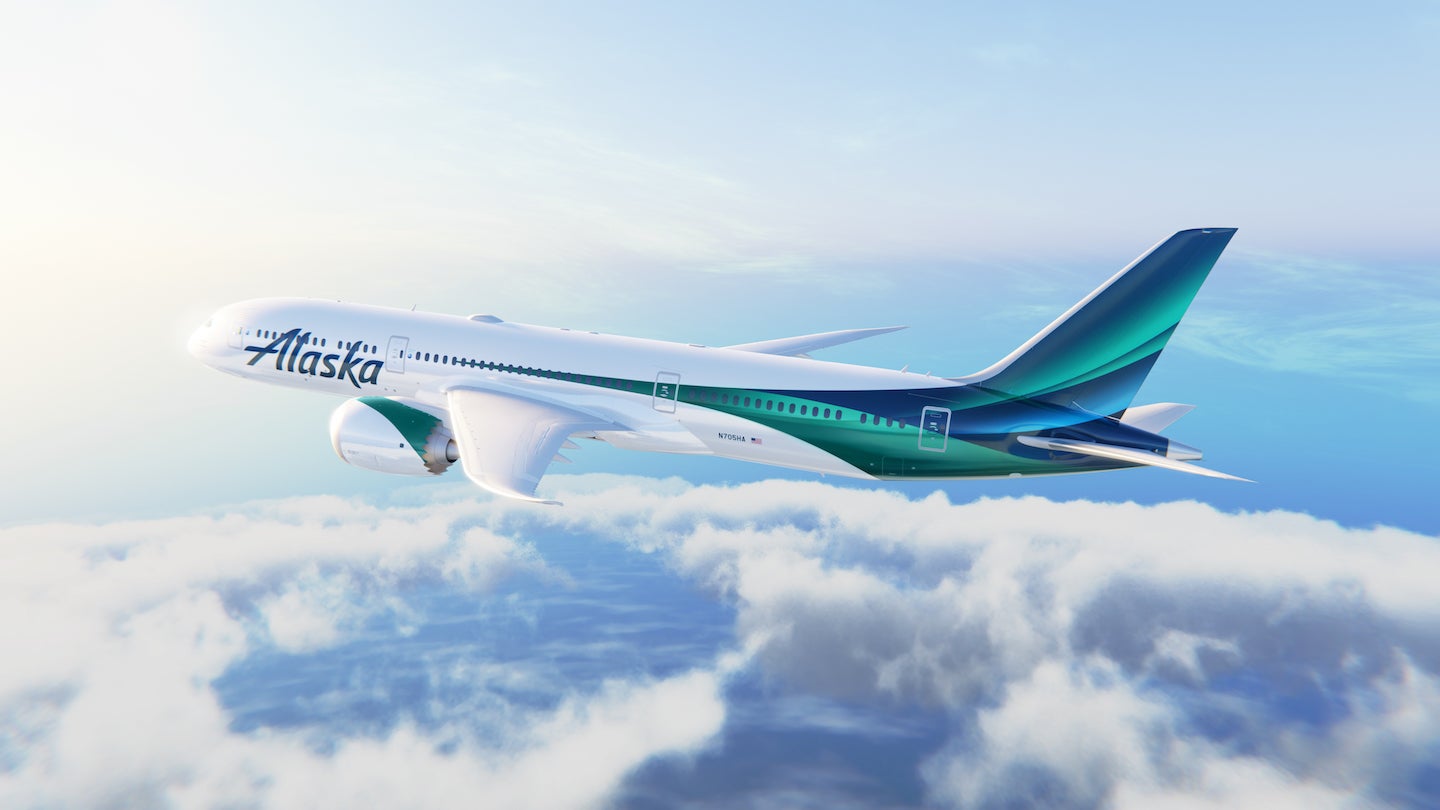
Alaska Airlines has tapped SpaceX‘s Starlink to equip its entire fleet with in-flight connectivity (IFC) service — swapping out its existing IFC provider Intelsat.
Alaska Airlines announced Wednesday that all aircraft – regional, narrowbody and widebody – will be connected with Starlink by 2027, with some planes entering service in 2026.
This comes after Alaska Airlines acquired Hawaiian Airlines in September. Hawaiian Airlines was the first major airline to offer Starlink.
“With Starlink already live on Hawaiian Airlines and installations starting this winter across Alaska’s fleet, we’re proud that we’ll offer the fastest, most reliable in-flight internet in the skies – with gate-to-gate connectivity on nearly every aircraft across both airlines,” Alaska Air Group President and CEO Ben Minicucci said in a release.
Alaska Airlines highlighted the speed of the Starlink Low-Earth Orbit (LEO) system compared to Geostationary (GEO) systems, the small footprint of the antenna, and uninterrupted Wi-Fi service for international travelers who take northerly routes to Asia and Europe.
Alaska Airlines was a longtime customer of Gogo, and then Intelsat after it acquired Gogo’s commercial aviation business in 2020. The airline’s mainline fleet is currently equipped with Intelsat’s 2Ku service, Alaska Airlines confirmed to Via Satellite.
Alaska Airlines also had a deal with Intelsat to equip its Embraer E175 regional jets with Intelsat’s multi-orbit IFC offering, announced in early 2023.
Intelsat had not started work on the E175 installations, both Intelsat and Alaska Airlines confirmed to Via Satellite.
“We’re beginning the winddown of our work with Intelsat and want to thank them for being a great partner over the years, helping us bring satellite Wi-Fi to our guests. Guests will continue to enjoy Intelsat’s Wi-Fi service as we roll out standardizing Starlink across our fleet,” Alaska Airlines Senior Brand Public Relations Manager Maria Cid told Via Satellite.
Intelsat is now part of SES after it was acquired last month, the company said it will support Alaska through the transition.
“SES values the long and innovative partnership we shared with Alaska Airlines. While disappointed in today’s decision, SES will continue to support Alaska until the fleet transitions to a single-orbit solution,” SES said in a statement to Via Satellite.
SES said its electronically steered array (ESA) has been installed on 250 regional jets for customers American Airlines and Air Canada, and it is on track to have 600 aircraft flying the new multi-orbit system by the end of the year.
Alaska Airlines is the latest airline to move to equip its full fleet with Starlink. Its roster of airline customers also includes Virgin Atlantic, WestJet, Qatar Airways, United Airlines, Air France, and SAS.
Valour Consultancy Senior Analyst David Whelan, said the decision for Alaska was likely impacted by Hawaiian Airlines using Starlink.
“Given Alaska had recently acquired Hawaiian, it isn’t a huge surprise that they have decided to harmonize coverage across their fleet and return to working with a single vendor as this has been their preferred approach so far,” Whelan said.
“It’s not ideal to lose an existing customer to Starlink. However, it’s something we are seeing across the market. The majority of Starlink’s backlog is for aircraft already equipped with IFC from another operator, as opposed to unconnected aircraft,” he added.