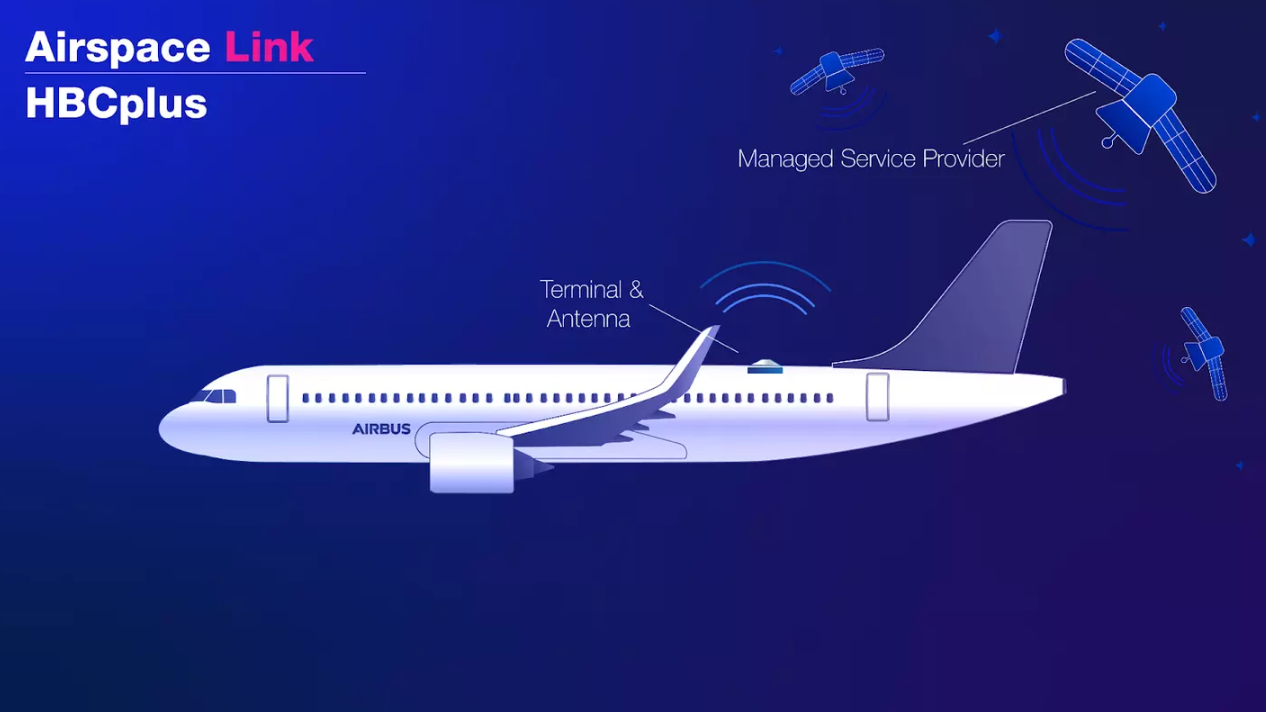
Airbus is investing in an ecosystem to enable better satellite-based connectivity on its aircraft. Its HBCplus program is a multi-orbit offboard connectivity solution aims to give more flexibility to airlines when looking to choose which service provider to go with.
With HBCplus, Airbus made the choice to decouple the connectivity provider from the terminal, which lets airline customers choose and change their managed service provider and combine it with different in-flight entertainment (IFE) systems.
Via Satellite recently caught up with Tim Sommer, Airbus vice president and head of Connected Aircraft Program to talk about the latest developments with HBCplus.
At the recent Aircraft Interiors (AIX) event, Airbus made a slew of announcements including new partnerships with the likes of Project Kuiper, Amazon’s satellite internet network and Hughes among others. Airbus and Amazon plan to integrate Project Kuiper’s connectivity solution into the Airbus line-fit and retrofit aircraft catalogue of managed service providers. This will give Airbus customers the option of using Project Kuiper’s IFC service to enrich passengers’ onboard experience and optimize flight operations.
Sommer says HBCplus is all about “enabling our customers to have the best possible connectivity solution and the best possible connectivity provider at all times.”
He adds, “It will allow airlines to flexibly choose the best possible service providers out there. New service providers have become available and we want to do this in as frictionless way as possible in terms of limiting the change on the aircraft side.”
With new satellites and constellations coming online across different orbits, Sommer sees advantages in both multi-orbit and Low-Earth Orbit (LEO)-only solutions, and wants to give customers the choice.
“We definitely think multi-orbit can be a great solution for airlines. There are definitely a few advantages when it comes to managing capacity. You also have a solution that is globally operable with the right rights and in different parts of the world. You can have great service in multi-orbit. You can have a great service in LEO. We are trying to enable both,” he says. “That is our vision of providing to the customer whatever is best for them. We want to make LEO available both for Ka-band and for Ku-band.”
With HBCplus, Airbus has a Ka-band product which is based on the Thinkom antenna. That has quite recently entered into service and Airbus is ramping that up. It has new customers and new programs coming online this year. Sommer said that antenna is going live on A320s and A330s aircraft this year and Airbus is growing the volumes on the A350s.
“We are evolving the product with new providers. Hughes, Telesat and Amazon Kuiper. We are starting to look at what comes after. So, we are beginning to look at a Ku-band solution We already have Intelsat and Panasonic signed up for that. That is one of our big priorities,” he says. “The other one is to make sure when Amazon comes online, we have a great solution that will provide that service to our customers.”
Sommer expects Airbus will announce a Ku-band solution within 12 months, with tentative plans to have that in service in 2027. “I am pretty sure we will have some interesting customers in the program as well,” he says.
“There will be a step-by-step approach. Working with Amazon will be determined on the availability of their constellation which is going to start ramping up soon in terms of deployment of satellites in the coming months. That will be global and it will likely be fully online in 2028. We are making sure we have an antenna solution on the aircraft that is compatible with that,” he says.
Sommer says that while the IFC industry has been driven by tech, airlines that are interested in passenger experience don’t want to necessarily want to go into all the details of LEO and GEO and the antenna technologies, modem technologies, etc. He believes the approach taken has not necessarily been the right one.
Airlines have been told that “having a modem and technology that only works with one set of satellites, is the best solution. I think this is nonsense,” he says. “You need to have a great network but then you want to have equipment as standardized as possible. We need to drive standardization on the equipment side and you want flexibility in terms of how you can globally interoperate with different constellations with different providers, without being a tech nerd and having to change all of the equipment. the Airbus view we believe that the future should be in openness, standardization and flexibility.”
The IFC market is one of the most competitive in satellite with the traditional operators going head-to-head with Starlink, which has made impressive inroads into this market over the last couple of years.
Sommer says that Starlink has a “great constellation,” but projects the market will evolve in the next few years.
“These things always go in waves. So, Starlink has attracted big customers. But, if you project what the world will look like in two to three years, it will not only be a Starlink world. There will be other big players next to Starlink. I think Amazon will be one of them. But, some of the incumbents are making big investments also. They will be around. The industry has consolidated. Will the landscape be the same in five years? Definitely not. Will it be just Starlink? Definitely no,” he says.