Latest News
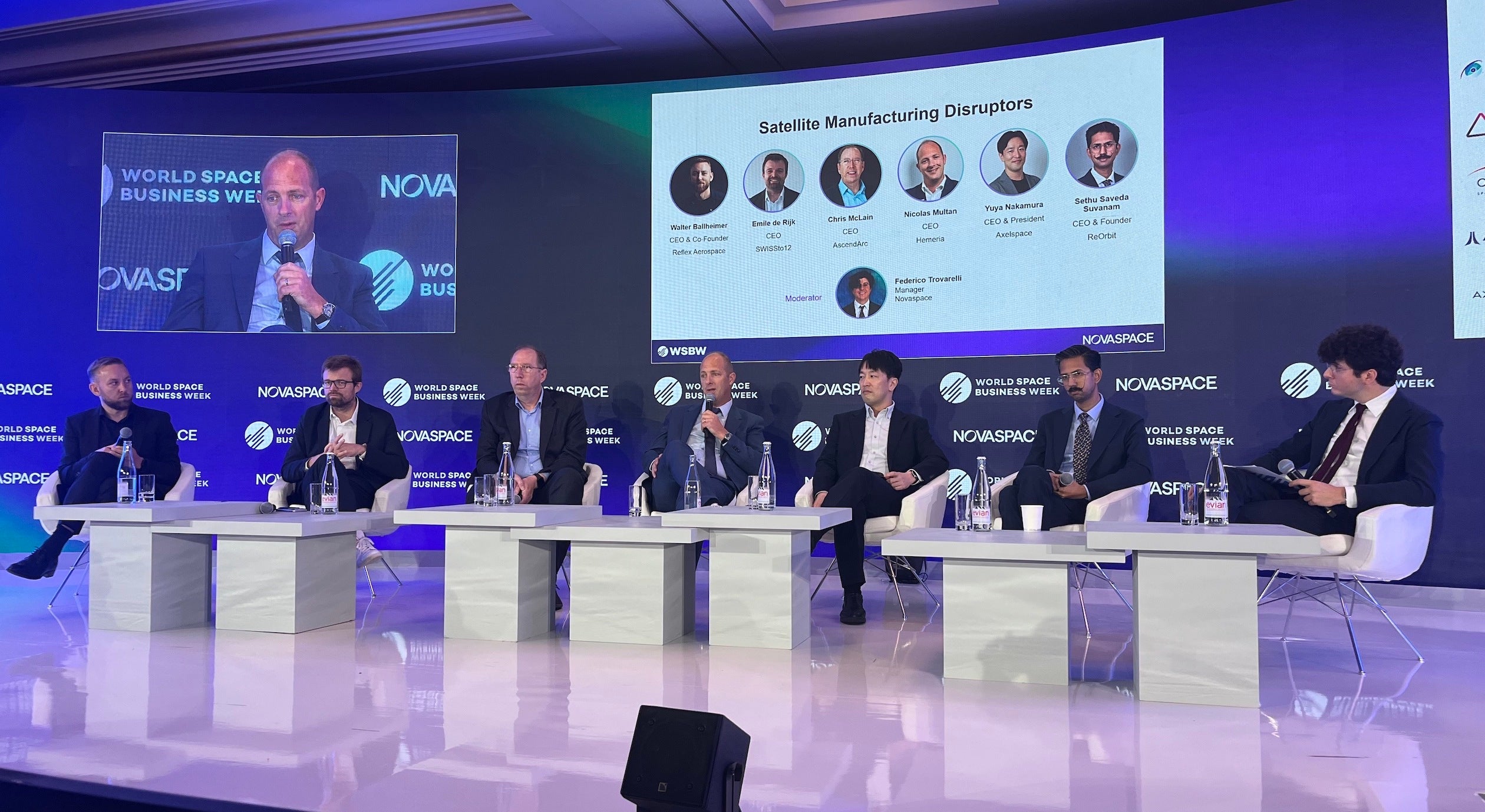
From left: Reflex Aerospace CEO Walter Ballheimer; Swissto12 CEO Emile de Rijk; AscendArc CEO Chris McLain; Hemeria CEO Nicolas Multan; Axelspace CEO Yuya Nakamura; and ReOrbit CEO Sethu Saveda Suvanam. Photo: Via Satellite
PARIS — While satellite manufacturing startups are working to lower the cost of satellite ownership, there is wide debate about the best ways to bring down cost, how to structure supply chains, and deal with sovereignty requirements for customers, whether it be for Earth Observation (EO) or connectivity applications.
Walter Ballheimer, CEO and co-founder of German manufacturer Reflex Aerospace, is skeptical that manufacturers will secure large constellation orders to support large factories, when many constellations are vertically integrated, arguing for a leaner approach to manufacturing.
“Megafactories do not create global supply. A megafactory based in a European country will not be able to address a potential customer in the U.S.,” Ballheimer said. “You will never, ever operate at peak load unless you get a fantastic, fairytale megaconstellation customer.”
Ballheimer described the ideal customer for contracted satellite manufacturing as one with a complex platform and a constellation that is not big enough to justify vertically integrated manufacturing. “I think a granular, distributed manufacturing approach to small, CapEx-efficient factories in the markets which need to be served is the most sustainable one,” he added.
Reflex Aerospace is vertically integrated and focuses on high-performance satellite platforms for satellites between 100 kilogram to 500 kilograms. Ballheimer said its customer missions are typically focused on remote sensing; intelligence, surveillance, and reconnaissance (ISR); and sovereign communications, and the company does not build payloads.
Finnish satellite manufacturer ReOrbit, which recently raised a $53 million Series A round, is purely focused on sovereign capabilities. CEO and Founder Sethu Saveda Suvanam called the company’s approach “sovereignty as a service.”
ReOrbit assembles satellites but does not build any components or hardware. “None of the hardware that goes into the satellite comes from us. We buy everything,” Suvanam said. “We do the software — that’s the core backbone to our architecture. We do the system architecture and then we procure everything based on the customer’s needs.”
Suvanam compared it to Apple’s software platform iOS that powers Apple products whether it be an iPhone, MacBook, or iPad. He argued the procurement model gives the customer control of the suppliers they want to work with, and the software aspect allows them to control where data lands within their country.
“A country can get end-to-end, full of sovereignty,” Suvanam said. “Space, defense, and connectivity — there’s a new market that’s coming in the center of it, and that’s where we are trying to focus.”
AscendArc, which came out of stealth mode in January and just sold its first satellite to KT SAT, has the bold goal to make Geostationary Orbit (GEO) more accessible by offering satellite capacity cheaper than fiber, whether it be governments or commercial customers.
“There are a lot of people in the world that do not want to trust a megaconstellation operated from the U.S. for very, very good reasons. We can provide that sovereign capacity and not do it with compromise,” AscendArc CEO Chris McLain said.
McLain previously worked for SpaceX on the Starlink constellation, and is working to bring mass-manufacturing to GEO. AscendArc is not fully vertically integrated, but is vertically integrated for its proprietary payload technology. McLain admitted AscendArc has been “a little coy” about its satellite configuration. Its satellite is based on a very large antenna designed to generate 800 beams to produce a large amount of sellable gigabits per second out of a “modest amount of mass and power.”
“We firmly believe that a GEO satellite that is mass-manufactured like a LEO satellite can be an order of magnitude lower cost than providing those same bits from LEO,” he said. “The lowest cost bit will always have a place in the market. Some bits are latency sensitive — every bit is cost sensitive.”
Swissto12, which manufactures small GEO satellites, has had commercial adoption from traditional operators, with satellites in the works for SES (ordered by Intelsat) and Viasat.
CEO Emile de Rijk said Swissto12 is looking to give operators a cheaper way to close the business case on GEO for applications where GEO has an “intrinsic advantage” over LEO, like broadcast and sovereign, secure connectivity.
“I think giving operators and nations the tools to invest in a more alternative way on those applications where it makes sense and not over-invest in big markets [that are] challenged by constellations, is a good way to address the evolution.”
Japanese satellite manufacturer Axelspace sees a unique niche for hosting in-orbit demonstration and verification missions, CEO and President Yuya Nakamura said. The company operates a constellation of EO satellites, but also has a separate business line developing microsatellites for customers and hosting in-orbit demonstrations.
“As the space industry expands, we are witnessing a growing number of non-space companies entering this field, especially in Japan. The automotive manufacturers are starting to develop components for satellites and rockets,” Nakamura said. “In order to commercialize their products, they need to prove their products in space. Despite this growing demand, very few players were providing this kind of service. We see this gap as a major business opportunity.”
Axelspace designed its satellite with compartmentalized internal structure that allows it to test multiple components simultaneously. Nakamura compared it to SpaceX’s rideshare missions for in-orbit testing.
French manufacturer Hemeria is moving from a platform manufacturer to a satellite solution provider, CEO Nicolas Multan said. Hemeria is focused on very specific missions — including multi-spectral, infrared, space situational awareness, and EO, he said.
One of Hemeria’s differentiators is developing mobile clean rooms out of shipping containers for hyper-local assembly, integration, and testing (AIT).
“With three containers, you have all that you need to integrate and test satellites. You don’t have to wait for the local AIT center, you can be really agile. It’s one of the key assets to have a fast delivery for competitiveness.
Stay connected and get ahead with the leading source of industry intel!
Subscribe Now