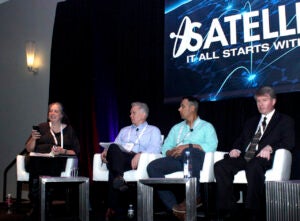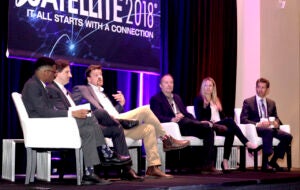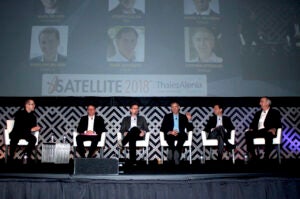

Unrelenting demand for launch availability, particularly from Low Earth Orbit (LEO) constellation operators, is pushing launch providers to diversify and adapt their existing vehicle lineups. As evident during Monday’s closing session at the SATELLITE 2018 Conference & Exhibition, a common thread running through major launch companies’ strategies is the need to accommodate “opportunistic” launches for smaller satellites — while still dutifully serving the traditional medium-heavy lift market.
To meet this demand, Mitsubishi Heavy Industries (MHI) is in the midst of bringing a new rocket to market called H3, said Mitsubishi Vice President Ko Ogasawara. The medium-lift rocket will come in multiple variants, including a small version that will be “cheaper for constellation or smallsat programs,” Ogasawara said. MHI intends to conduct the Critical Design Review (CDR) for the first stage engine this upcoming winter. Once operational, H3 will increase the company’s average launch rate from four per year to 10, Osagawara confirmed, and potentially even more by 2025.

Explore the Show Daily 2018 Day 3 Issue
Check out more from this issue and find your next story to read.
Osagawara noted too that a significant limitation for Mitsubishi Heavy Industries is that it only leverages one launch site, Tanegashima Space Center (Uchinoura Space Center is now typically only used for suborbital missions.) As such, the company intends to add another launch pad at Tanegashima to accommodate H3’s increased launch rate.
In a similar strategy, International Launch Services (ILS) is now offering a smaller two-stage launch vehicle, Proton Medium, which takes advantage of the heritage propulsion and avionics systems used on ILS’ Proton Breeze M. According to ILS President Kirk Pysher, the rocket’s 5.2-meter fairing is well suited for deploying LEO constellations. “The restartable Breeze M upper stage allows us to insert in multiple planes, so that vehicle is in the sweet spot of where we believe the market is today,” Pysher said. “We have the opportunity to now accommodate [smallsats] whereas maybe in the past we didn’t.”
Although ILS is considering a light launch vehicle that would have a lift capacity of “less than 3,500 kg,” for now the company’s strategy skews toward rideshare agreements, Pysher added.
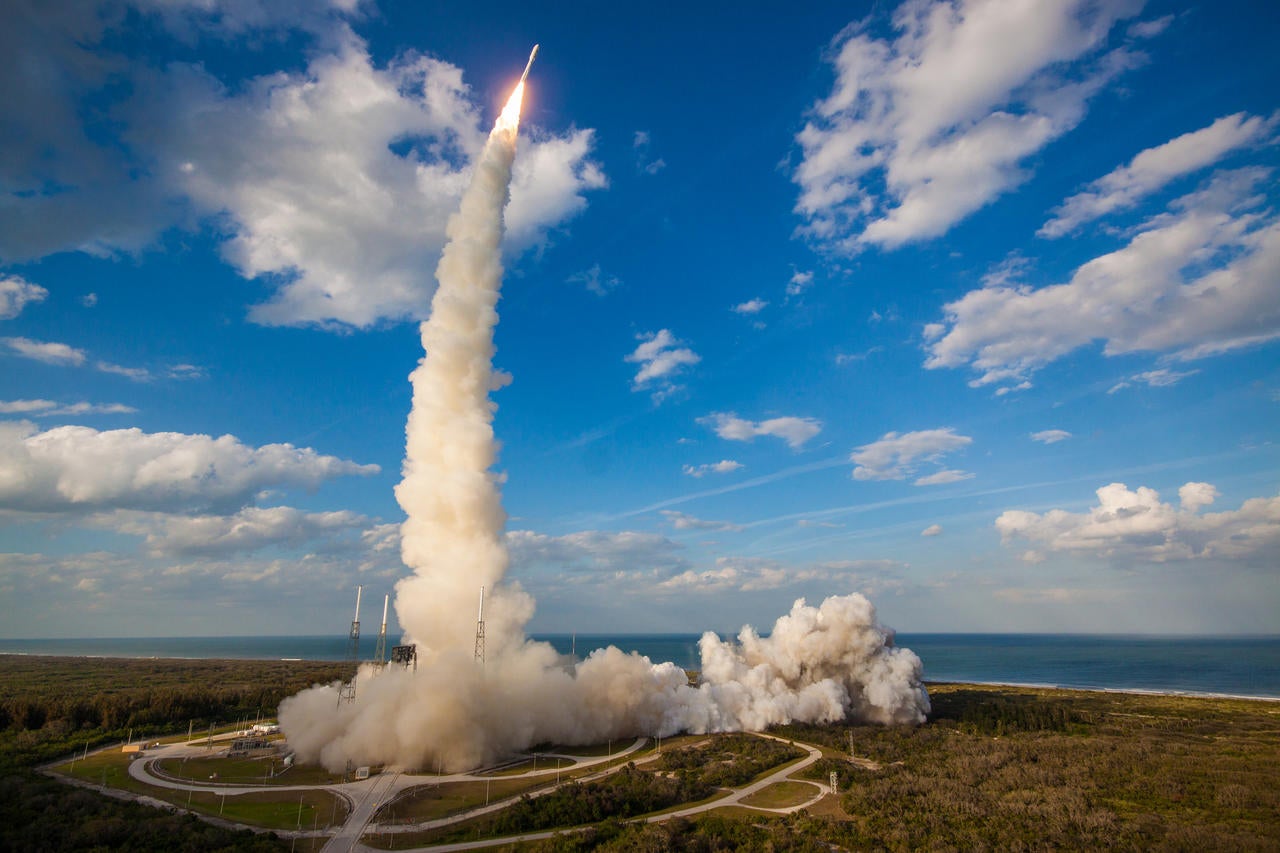
After years of launching exclusively for the U.S. government, United Launch Alliance (ULA) is also shifting its attention to the commercial marketplace, said president and CEO Tory Bruno. However, rather than adapt a new vehicle for dedicated smallsat launches specifically, ULA is instead investing in a new heavy lift rocket called Vulcan. With the new vehicle, ULA intends to offer more manageable price points for smallsat operators via rideshare missions, while also catering to the higher end of the mass spectrum. “Will spacecraft get bigger or smaller? We realized the answer was yes,” Bruno said.
Arianespace is taking a similar approach: its medium-heavy lift rocket Ariane 6 is set to debut in 2020 at a lower cost per launch — and with more frequent availabilities — than its predecessor. “We’re targeting a cadence of 11 launches a year with [Ariane] 6, but if there is demand we can go further,” said Arianespace CEO Stephane Israel.
The boat has already sailed for a dedicated smallsat launch vehicle when it comes to SpaceX. According to president and Chief Operating Officer (COO) Gwynne Shotwell, the company quickly realized that its Falcon 1 rocket “could not earn its share of [the] production floor” back in 2008. Reusability, of course, is now the crux of its business proposition.
But as Pysher pointed out, SpaceX’s ambitions are unique in that facilitating interplanetary travel is founder Elon Musk’s ultimate goal. “[SpaceX] needs reusability to accomplish those things,” Pysher said. “The only thing we’re here for is to take your satellite and put it into orbit. If we can do that with a vehicle that could be expended, and do it at roughly the same price point and reliability as the others, we’re going to continue to go down that path.”
Bruno agreed, but admitted that ULA does see potential for reusability in its future rockets. In particular, the company is interested in recycling Vulcan’s upper stage, the Advanced Cryogenic Evolved Stage (ACES), which Bruno asserted will revolutionize transportation in cislunar space “in a way that economic advantages in lift from the [Earth’s] surface can never do.”
“We can’t all try the same thing. You’re not going to have any innovation if we all copy each other,” he added.
Ultimately, the panelists agreed that traditional launch providers such as ULA and ILS won’t be competing directly with the dedicated smallsat launch providers whose commercial debuts are just over the horizon. Large rockets like Vulcan might be a good option for launching initial revenue-generating spacecraft clusters, but the cost efficiencies begin to disappear once those assets begin to age. “When there are dozens, hundreds, or — dare I say — a thousand [satellites] or more on orbit aging out at various times, a maintenance and replenishment mission will exist where it’s not necessary to [launch] a dozen or 50. That is a natural fit for the small launch vehicles,” Bruno said.
For Bob Smith, CEO of Blue Origin, there’s room at the table for both sects: “I think there’s a lot of opportunity when those [launch] costs come down. It’s already started to materialize,” he said. VS