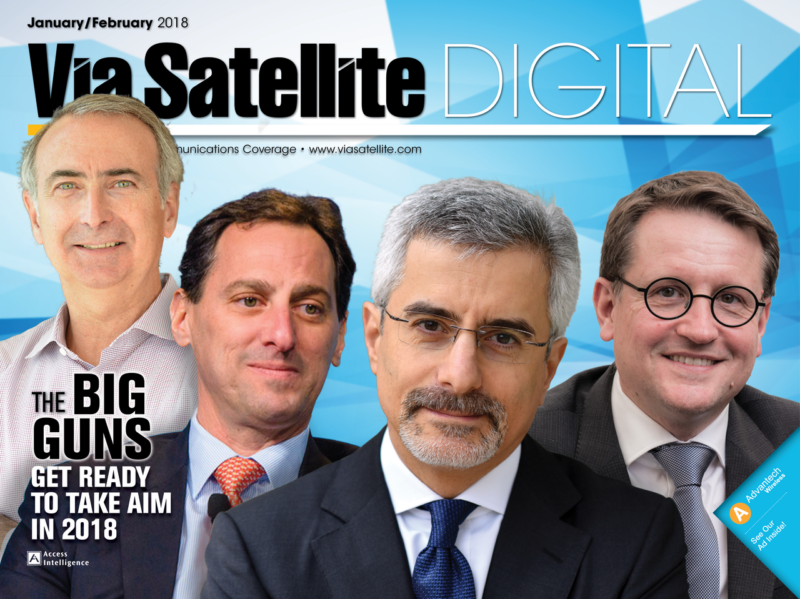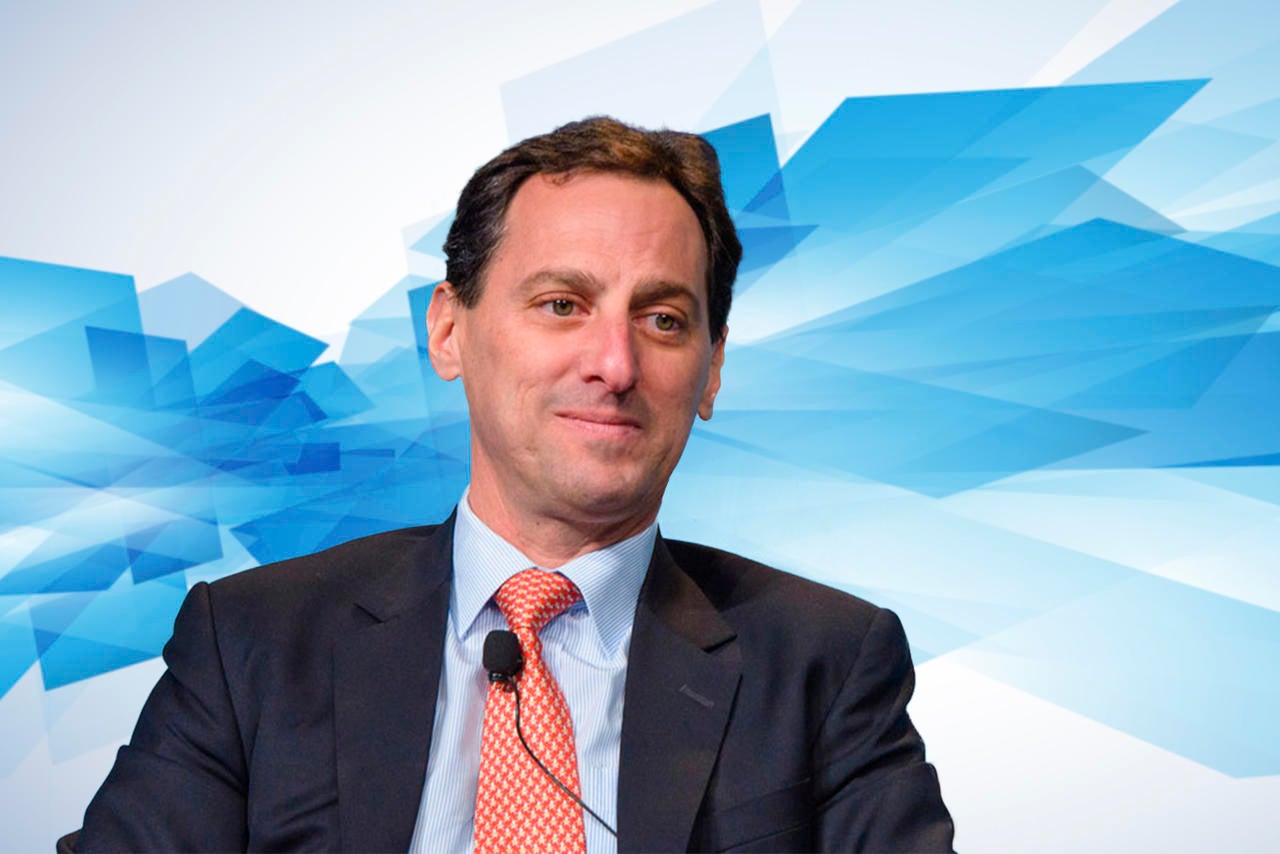

Telesat maybe the fourth member of the “Big Four’” operators, but that does not mean it is any less relevant than its peers. The company has one of the most interesting growth strategies at play, and is intending to be a big part of the Low-Earth Orbit (LEO) revolution in the satellite industry. 2018 is set to be a big year as CEO Dan Goldberg talks about LEO as being “very much the future” of the company.
VIA SATELLITE: What are Telesat’s plans for 2018?
Explore the January/February 2018 Issue
Check out more from this issue and find your next story to read.
Goldberg: This will be a busy year as we are planning to launch two high throughput satellites, Telstar 18 VANTAGE over Asia and Telstar 19 VANTAGE over the Americas. And Telesat will be advancing our LEO constellation that will revolutionize broadband communications services around the world for business, government and individual users. The initial constellation will consist of approximately 120 satellites by 2021 providing full global coverage and Telesat is evaluating options to expand our system beyond this initial configuration. These will be very sophisticated, very advanced satellites.
VIA SATELLITE: If everything goes well with Telesat’s Phase 1 LEO Satellite, what will be next for Telesat’s LEO plans?
Goldberg: We are working with several contractor teams right now. We have given the vendor community a set of technical and commercial requirements, performance objectives, schedule objectives and all that. We have been meeting with prospective customers and potential partners. So next steps will be further advancing these discussions and I expect we will make some announcements about vendor selection in the coming months. We’re also excited about our Phase 1 testing that will demonstrate certain key features of Telesat’s LEO design. Telesat has installed ground infrastructure at our teleport in Allan Park in Canada to support testing and has customers in growing enterprise segments who are eager to participate in trials during 2018.
VIA SATELLITE: Will Telesat go ‘big’ into LEO?
Goldberg: I think this is where the future lies. If our assumptions are right about what we can achieve technically, the price points that we are seeking to achieve, and the response from the customer community, we will go very big into this. I can see this very much being the future of the company. It will play out over the course of this year.
VIA SATELLITE: SES made their big mPOWER announcement. Will Telesat’s ambitions have a similar scale?
Goldberg: For sure. It will be terabits of capacity. We have a very flexible, high throughput, low latency architecture. It is a broadband play. We will target many of the same verticals we are serving today on the enterprise side, including mobility, government and cellular and IP backhaul requirements. Initially we will focus less on direct-to-consumer services, as I believe there has to be further development of the user antenna to make that more cost competitive. But right out of the gate, we are looking at a community aggregator model where we are bringing in a large broadband pipe to a somewhat densely populated area, and then distributing broadband connectivity through a terrestrial network – fixed wireless, WiFi or 3G/4G.
VIA SATELLITE: When did you start seeing LEO as the future for Telesat?
Goldberg: We started to think about it over three years ago and I’m pleased with where we are today with our program. Although we were disappointed that our first Phase 1 LEO Satellite suffered a launch failure in late November, we had the foresight to order two Phase 1 Satellites and plan to launch the second one in early January. We have priority ITU rights in Ka-band and have been authorized by both the Canadian government to operate the constellation and by the FCC to serve the U.S. market. We’ve also filed for patents to cover some of the intellectual property around our particular design.
VIA SATELLITE: Was it a case that in order to stay relevant, you had to look beyond GEO?
Goldberg: Yes, we more or less came to that conclusion. Customer requirements have been evolving – including the increasing importance of lower latency applications – and we concluded that within a few years even terabit class GEO satellites or satellites operating in MEO would not be able to provide the performance needed to meet customers’ expectations. LEO is a significant capital investment for us. We could have gone down the road of VHTS in GEO. It wasn’t about concerns over the capital investment. But if we were going to make a significant investment, we wanted to be confident that it would address the requirements we’re seeing in the market today as well as the requirements that we anticipate are coming. Moreover we wanted to ensure that our significant investment in a next generation satellite architecture would give Telesat a differentiated and sustainable competitive advantage in the market. That’s our overriding objective and what we plan to achieve with our LEO constellation.
VIA SATELLITE: There are a number of ambitious plans out there with the likes of OneWeb, LeoSAT, as well as what SES is doing in MEO. Is there going to be enough demand to fuel these constellations?
Goldberg: There will be winners and losers, as there always tends to be in business. I think that will be the case for satellite broadband, whether it is delivered in GEO, LEO or MEO. We obviously want to be one of the winners. As for the supply-demand question, I do think there is a big market to be addressed and believe also that it is growing very significantly. In addition, there will be new requirements that the industry is not serving today. Some of that will be because these new architectures will allow us to address new markets that you cannot address in GEO and some of that will be because things like ‘Connected’ vehicles and IoT exist somewhat today but will become much more significant in the future. So I do think the market will be very large. But I also believe some of the constellations will be better engineered to deliver what that market is looking for and we are very focused on designing and implementing that architecture.
VIA SATELLITE: You have been the CEO of Telesat for over 11 years. Do you see this LEO constellation as a defining moment of your tenure?
Goldberg: I don’t think about it that way at all. It is important that any company has a compelling growth plan. We have created a significant amount of equity value over the last 10 years. There is an opportunity here to continue to do just that. The market is changing. If we are going to remain a leader and very relevant and continue to grow and build equity value, we need to keep executing as we have been which means evolving our offerings to the market. To be clear, Telesat LEO is about investing capital and achieving an attractive return for our shareholders. We will advance the market in important ways, and drive a lot of public policy benefits around the world. We never take our eye off the ball. Our overriding focus when making big capital investments is to have a very high likelihood of achieving strong returns for our shareholders.
VIA SATELLITE: Taking off your Telesat hat for a minute, has the pace of change really surprised you recently in the satellite industry?
Goldberg: In some ways what has been surprising is how long it has taken for the industry to undergo a period of rapid change like this. This is not to suggest that the industry hasn’t been evolving. To be clear, in the time of my involvement in the industry, which is over 25 years, there has been a lot of evolution and change. The satellites are much more capable and powerful. We have gone from analog to digital and incorporated some very sophisticated coding and modulation, as well as signal compression. There have been new launch vehicles. But I do agree that over the last five years, the environment seems more dynamic and the pace of change is greater than what we have collectively experienced over the prior two plus decades.
VIA SATELLITE: As a CEO, is this a more enjoyable period to be leading a satellite company?
Goldberg: It is harder now. It is about making meaningful investment decisions against a backdrop that is more dynamic, and this is more difficult compared to making those decisions in an environment where you think you have a much better feel for where the world is going in 5-10 years. But while it is more difficult, it is also very stimulating and for my technical colleagues, those engineers who like to build things, I would say they are really energized to be operating in this environment.
VIA SATELLITE: Is the culture changing within Telesat?
Goldberg: Telesat has always been a very innovative, forward facing, customer focused organization. It has changed a lot in its history. There was a Telesat Act of Parliament which set the company up and now we are purely private. So, in that sense, the company has evolved significantly. But the company has always been an innovator. It was, for example, the first to launch a DTH satellite as well as the first to bring to market a Ka-band broadband satellite. There is a long history of innovation and real focused customer service. We are hiring some new skillsets to support our LEO initiative. But I think we are still pretty close to the formula that’s made us successful for decades – giving our customers an edge in the markets they serve by delivering strong, technical innovations backed by outstanding customer service.
VIA SATELLITE: When we talk about new verticals and IoT, what new areas can the satellite business play in that traditionally it has not played in before?
Goldberg: What we are bringing with Telesat LEO is genuinely fiber-like broadband connectivity. You hear that a lot but it’s true with our system. Our round trip latency will be around 30-50 milliseconds that, for some connectivities, will be lower latency than fiber. And I do think in the terrestrial wireless industry, the lack of fiber connectivity has impeded the rollout of terrestrial wireless infrastructure. There are other barriers to that roll out, but lack of high capacity backhaul is a non-trivial one. So even in places like the United States, Canada and Western Europe, terrestrial wireless networks will benefit from the build-out of microcells to add system capacity to address surging mobile broadband use. Backhauling traffic from those microcells is going to be a really significant bandwidth opportunity for the industry and for Telesat. I think the ‘Connected Car’ is going to be a very significant opportunity. It is going to be very bandwidth intensive. It has to be low latency. It has to be very secure. Sitting here today, you and I will look back on this conversation and I expect one of the biggest drivers of capacity demand will be an application we don’t even see right now. But I do know our focus on low-cost, low latency, very high throughput, highly reliable ubiquitous broadband services will be in great demand.