
Intelsat has been a pioneer and a staple of the global satellite industry for decades. But even by its own standards, the last 12 months have been some of the most interesting. Intelsat was hopeful of merging with up and coming operator OneWeb, but was unable to finalize a deal even though it will continue to work with the operator. Also, in a surprising recent initiative, it got together with Intel to come up with ways the satellite industry can work with others in the area of 5G. However, those announcements aside, the operator must also find new markets and ways to improve its revenues and forecasts. We talked to Intelsat CEO Stephen Spengler about what 2018 holds for the operator.
VIA SATELLITE: How important are other orbits for major global Fixed Satellite Services (FSS) operators? Do you think most will look beyond GEO now? Has it become a necessity?
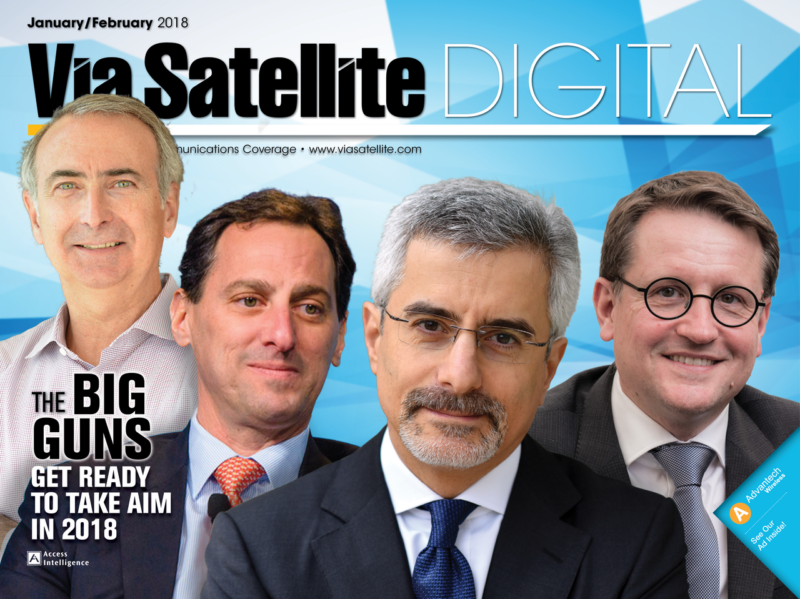
Explore the January/February 2018 Issue
Check out more from this issue and find your next story to read.
Spengler: When we made our investment in OneWeb two years ago, we made an investment and established that partnership, because we believe that to really unlock the applications of the future and create new demand and to expand the space for satellite, we needed to have a broader complement of capabilities to bring and package up services for our customers. From our perspective having OneWeb and Low Earth Orbit (LEO) type services, which have different attributes to GEO services, was extremely valuable to that approach and still is. And we believe that the ability to bring in Ku-band, LEO, Geosynchronous Earth Orbit (GEO) and interoperable satellite services through the same terminal is really advantageous to customers and gives them the diversity of capability that is not there today. It also gives another layer of capacity and capability globally in all parts of world where there may not be a lot of GEO strategy. Our strategy has always been it is not LEO or GEO. We see a role for both orbits, but an integrated strategy going forward.
I would want to add it is not just about the GEO and LEO satellites. It is about the ecosystem to the ground too. That is why we have been working very heavily with OneWeb on developing this terminal that can work with both systems. But it goes beyond that. Our work with Phasor and our modem partners is very important in solving the overall equation of bringing the costs down and bringing new services and applications.
VIA SATELLITE: Has the lack of GEO orders come as a surprise to you?
Spengler: I would say a couple of things. If you look at the overall capability, operators like ourselves and SES are looking at other orbits to complement and expand service capability. We are not going to stop building GEO satellites. GEO satellites are extremely valuable for broadcasting and video applications. We see that as being extremely viable. We see GEO being able to overlay a lot of capacity on any orbit that can leverage the broadcasting and point-to-multipoint capabilities of GEO. We see it as part of the overall architecture. The overall slowdown could be related to smaller operators as well that I think have built satellites with widebeam capabilities. And there has been an oversupply of those kinds of capabilities in the marketplace and perhaps replacement or expansion of those smaller operator networks has been slowed down as we look at what they are going to do in the future.
VIA SATELLITE: How do you see 2018 shaping up from a capital expenditure perspective?
Spengler: We have programs that are continuing. In 2018, we will be launching Intelsat 38, which is the satellite we are building jointly with AzerCosmos to target a number of our media marketplaces and customers. We will be following that with Intelsat 39, which is a satellite that provides services through the Asia-Pacific region and will serve both mobility applications and government applications as well as broadband applications. We have Horizons 3E, which is the last of this series of Epic satellites that launches in 2018 to 2019. That gives us complete coverage of the Pacific Ocean largely from a mobility perspective, but not exclusively. We expect to see some broadband and government applications as well. Of course, we have our Intelsat 37E, which is due to launch at the end of this month.
We have very active investments underway, along with investments in ground infrastructure to support the new services that we are bringing to market. There is a lot of activity across the board.
VIA SATELLITE: Outside of the traditional broadcasting market, which markets do you think offer your operator the most potential going forward?
Spengler: We have always had a very diversified customer base. We have served customers across broadband, mobility, media and government. We see opportunity across all of those areas. If you just think about broadband, for example, there is such a huge opportunity to connect unconnected markets that aren’t connected today. I was in New York attending the Broadband Commission for Sustainable Development with other government leaders and international organization leaders. There is no doubt that satellite has a key role to play with other technologies to bridge this divide that exists today. So, we see broadband as being a leading opportunity over the long-term. There is a lot of work left to be done. We see our role as helping mobile operators. We will continue to work with service providers around the world and help organizations and enterprises expand. There is a robust opportunity there.
Mobility is still an area of great growth. Even though there has been growth in recent years, there is still a long way to go when it comes to connecting aircraft, ships, etc. We are very active here. But there are new applications in mobility, and this ties in with the new work we are doing with Kymeta and the launch of their Kalos service. Their focus is on land mobility and new types of connectivity applications there.
In the government area, we are pleased that we are starting to see our government customers starting to use Intelsat Epic and Intelsat 33E. This allows those customers to get better performance into applications into smaller antennas that may be fixed or mobile. We see more opportunities to deliver those types of services into that marketplace.
Media is also a growing segment for us. I share the comments from others that were on the panel in Paris, in that it is a stable sector. There is still opportunities for growth in the developing world where there is still more demand for High Definition (HD). Places like Europe and North America are more flat. We are focused on all of these segments.
At the same time, we are trying to unlock the future opportunities. Those future opportunities are going to be in land mobility applications, connected car, and connected vehicles of all types like trains and buses. And you have the Internet of Things (IOT). The opportunity around IOT is huge. Satellite has an essential role to play in that ubiquitous coverage and those kinds of applications. There is a lot of opportunity around a lot of areas. The industry is still in a transitionary phase as new capabilities gets launched into space and the ground eco-system catches up with smaller and more capable modems, and flat panel antennas that will enable easier installation and expansion of large quantities of remote terminals
VIA SATELLITE: You talk about land mobile there. Is that really a huge opportunity for satellite?
Spengler: If you look at the long term, connecting cars is the big market. The numbers are enormous. Connectivity to cars in our view is going to be multi-faceted. There will be a number of different connections into the car. There will be Wi-Fi when it is parked in a garage. It could be LTE/5G when it is moving around urban areas. It maybe satellite in other locations. There will be multiple connections for multiple purposes. So you will need to make sure that the software, mapping and navigation systems are kept up-to-date. These will be critical things when you have fully autonomous vehicles. The software and mapping information will be essential, and satellite, with its broad and ubiquitous coverage, will be a key part of that. The essential part is to build the infrastructure both in space and developing the antennas and electronics in a compact and inexpensive way so that it can incorporated into the cars. That is why Toyota and ourselves have invested in Kymeta. We believe this is the big marketplace in the long term.
In the meantime, there are real opportunities to leverage land mobility services and bring them into use, perhaps in the aftermarket of SUVs or other kinds of vehicles whether it is a bus or a van or recreation vehicles or trains. There is an opportunity to develop those markets now, and that is the objective with the Kalo service by Kymeta. This will take some years to develop, but I think the seeds for this opportunity are being planted right now and that is key to our strategy.
VIA SATELLITE: What technology innovation do you think could make the most difference to your business going forward?
Spengler: Antennas are key. One of the challenges we have had in satellite communications, with the exception of Direct-to-Home (DTH), has been that the antenna systems have been pretty simple as they are receive-only. But when it comes to two-way satellite communications, the positive is that they can be quickly deployed to build out infrastructure. The negative is that it is still too complex and too costly. Advancements in flat panel antennas and electronically steerable antennas is really critical to enable the ease of installation and operation. As the cost of these come down, we can start to look at mass market applications, which can be enabled by this simple deployment. That is really a key technology.
I would like to branch out in one area. You also need to enable interconnectivity and interoperability between networks. Satellite solutions need to become part of a much broader telecoms infrastructure. As we go forward, we would like to see satellite become a node in the telecoms network. To the extent that we can be successful in developing standards and bringing terrestrial standards into our products and services, I think that is going to help facilitate the growth of these broader application areas for the future.
VIA SATELLITE: What would you highlight is the single biggest competitive threat to your business over the next few years?
Spengler: The industry as a whole is innovating. I am encouraged by that. There are a number of different approaches to the market opportunities that we have spoken about. I personally think there will be multiple winners. It is not a winner takes all marketplace where a Ka-band solution will win, for example, or a LEO or MEO solution will win. It will take a lot of different approaches and solutions to address the future market opportunities and there will be multiple ways to do it. I don’t necessarily view that as a competitive threat. There are alternative ways to do it, but I think there will be success across the board. A competitive threat to the industry is that we have to keep moving forward, keep innovating. We have to find ways to integrate and support applications across the broader telecoms landscape and be able to interconnect seamlessly with other broader technologies. We need to integrate more. We need to interoperate more, and that will allow us to be part of these bigger and broader solutions across telecoms.
VIA SATELLITE: Has the satellite industry reached a key inflection point in your mind? Will we see more change in the next 10 years than we saw in the previous 30?
Spengler: If you broaden that subject to society and technology in general, I think the answer is yes. I think the pace of change, not just in our industry, but overall is accelerating. So it would be reasonable to say that the pace of change is accelerating in satellite as well. That creates challenges in keeping up with it, but it also presents huge opportunities. But I am optimistic. We need to keep working hard to be part of these future opportunities that are in front of us.