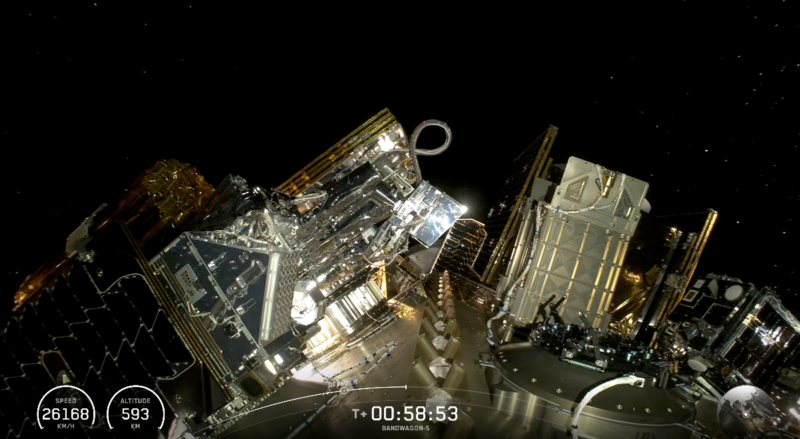
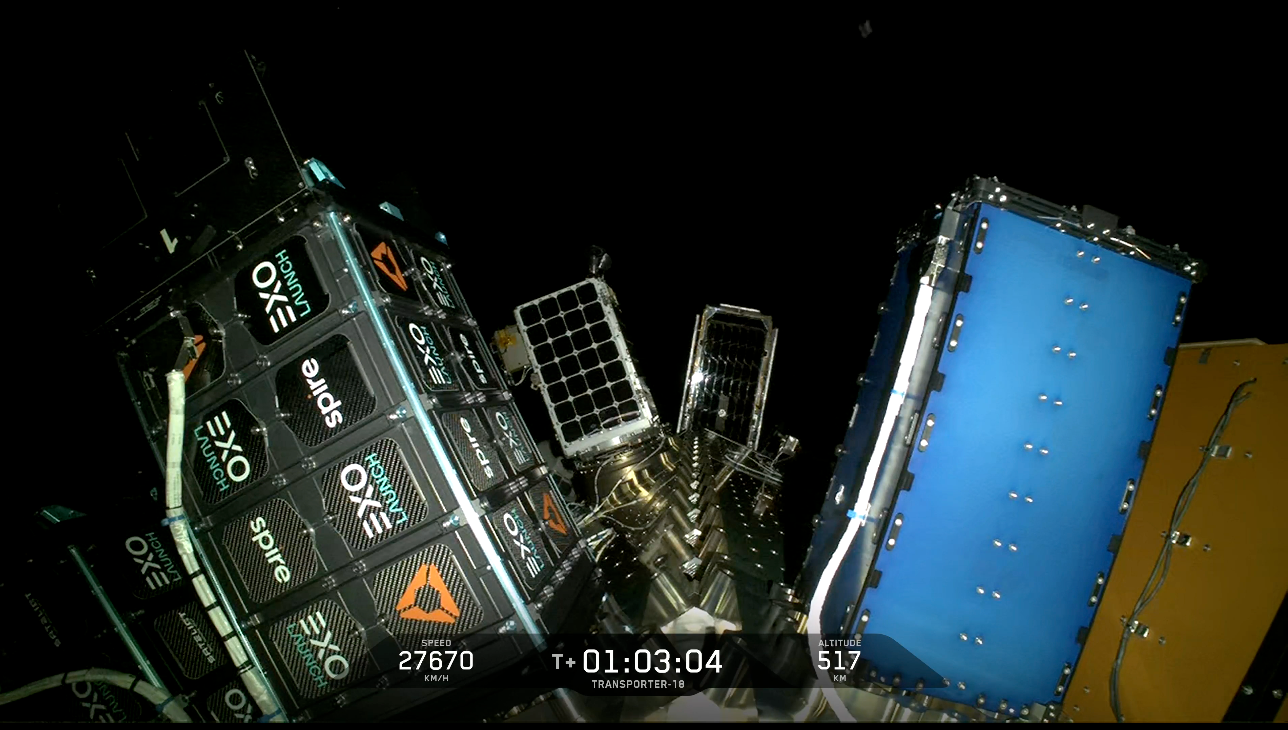
SpaceX launched 130 payloads on an Oct. 1 dedicated rideshare mission, including milestone first missions for a number of its customers.
Transporter-18 is part of an attempt to launch three missions in one day. It began with the Crew-13 Falcon 9 astronaut launch for NASA from Florida at 11:10 a.m. ET. The Transporter Falcon 9 mission took off from Vandenberg Space Force Base in California at 11:32 a.m. PT.
The third mission, a Falcon Heavy mission for the National Reconnaissance Office (NRO), lifted off from Florida at at 11:54 p.m. ET on Thursday.
The Transporter-18 rideshare mission carried a number of notable first missions for companies ranging from satcom, to power beaming, to orbital data centers. SpaceX confirmed at 3:41 p.m. ET the rideshare deployment sequence had concluded.
Planet Labs launched the prototype satellite for Project Suncatcher, a “moonshot” collaboration with Google that will test how Google models and the Google Tensor Processing Unit (TPU) operate in space. Planet was the largest single customer on the mission, also launching the second Tanager satellite, which tracks methane emissions in a partnership with CarbonMapper, and 18 SuperDove satellites, manifested by SEOPS.
StarCatcher launched Protostar, its prototype power node, which will aim to demonstrate power beaming between free-flying spacecraft. This would be the first of its kind demonstration.
There are two power-beaming satellites onboard the mission, as Cowboy Space is launching Reason-1, designed to prove out the company’s technology to use high-power laser to transfer energy from LEO to a receiver on the ground.
The mission also includes the first satellite for Meridian Space called First Customer LInk, which will test the company’s LEO communications technology.
CesiumAstro also launched Element, the company’s first foray into building full satellites. Element is built on Cesium’s own phased arrays, software-defined radios and processors.
For Starfish Space, the mission carries its first Otter servicing vehicle, which will conduct the Small Spacecraft Propulsion and Inspection Capability (SSPICY) mission for NASA.
In addition, Fortastra launched its first demonstration spacecraft, Watchdog v0-A.
The mission included two reentry vehicles by Varda Space Industries, and four orbital transfer vehicles to deploy 41 payloads at a later time.
Rideshare providers Exolaunch, SEOPS, D-Orbit, and Maverick Space Systems all contributed customer satellites to the mission.
Dhruva Space conducted integration for its LEAP-2 satellite, the company’s second commercial mission, which hosts multiple in-orbit demonstration (IOD) missions including Sodern ArianeGroup and TAPAS-1 by India-based Satleo Labs.
Numerous Earth Observation (EO) satellites hitched a ride on the mission for companies based around the world. The mission launched eight satellites for Italy’s IRIDE Eaglet II program, a constellation of mini EO satellites.
Tomorrow.io had two satellites onboard to add to its weather monitoring constellation, while Iceye launched four SAR satellites and Satellogic launched four optical satellites.
Unseenlabs had two radio frequency (RF) monitoring satellites on the mission: BRO-23, part of its first generation, to capacity to its maritime RF surveillance constellation, and BRO-32, a Gen-2 microsatellite that expands its RF detection capabilities across sea, land, and space.
Methane monitoring company GHGSat had two satellites onboard, manifested by SFL Missions.
Spanish IoT connectivity company Sateliot had five satellites onboard the mission.