Latest News
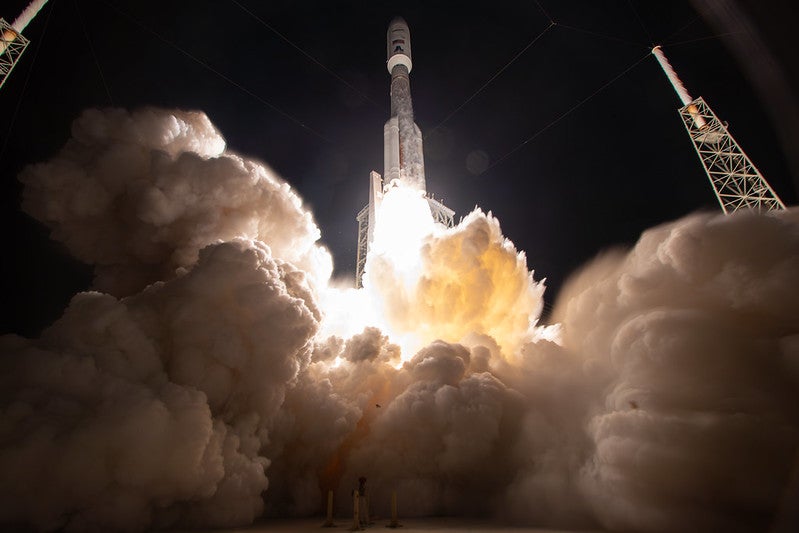
ULA launches the second ViaSat-3 satellite on Nov. 13. Photo: ULA
Viasat’s highest capacity satellite is now on its way to orbit after an Atlas V United Launch Alliance (ULA) launch Thursday night.
ViaSat-3 F2 is designed to add 1 terabit per second of capacity to Viasat’s network — more capacity than the operator’s entire existing network. Part of a satellite trio, F2 is highly anticipated after the first satellite suffered an anomaly with its antenna deployment in 2023. That satellite is now operational, but only delivering a fraction of the capacity that was expected.
ULA launched F2 on an Atlas V rocket in the 551 configuration on Nov. 13 at 10:04 p.m. EST from Cape Canaveral Space Force Station in Florida.
The mission took place after two scrubs last week due to a faulty booster liquid oxygen tank vent valve. ULA said in an update that it removed and replaced it with a new valve.
The spacecraft was deployed to Geosynchronous Transfer Orbit (GTO) 3 hours and 32 minutes into the mission. Viasat confirmed it acquired signals from the satellite after deployment. It will now go through an orbit-raising process to reach its final orbital position, and is expected to enter into service in early 2026.
While the satellite is impressive for having the highest amount of capacity of a single Geostationary Orbit (GEO) satellite to date, a key part of the innovation is its ability to allocate beams to where demand is, Viasat founder and CEO Mark Dankberg told Via Satellite ahead of the launch.
“This satellite is very unique in that it has a view of a third of the world, and it puts beams only where there’s demand. It’s a very large amount of total capacity, but we emphasize utilization — the portion of the bandwidth that is in places where it’s needed,” Dankberg said.
The ViaSat-3 constellation has long been in the works; Dankberg and the Viasat team began to plan for its development even before Viasat-2 launched in 2017. Since then, the satellite industry has gone through massive amounts of change with the market-disrupting Starlink constellation, and the wave of consolidation across traditional operators, which saw Viasat buy Inmarsat in 2023.
Yet Dankberg said one of the most critical challenges for satellite operators remains the same — how to deliver the right amount of capacity to a diverse array of customers exactly where and when they need it, and in the right quantities.
He sees ViaSat-3’s beam-forming capabilities as the answer to that challenge — made stronger by the increase in compute capability in recent years.
“I want all the complexity of figuring that out in data centers on the ground, where computations are the least expensive and the most available,” Dankberg said. “At the time we started ViaSat-3, we weren’t sure that there were any data centers in the world that could handle all the computations required to make these beams. Now what’s changed is computing power keeps increasing, so that lets us increase the sophistication of the way we do the [beam] matching.”
The first ViaSat-3 satellite is geographically focused on the Western half of the United States and over the Pacific Ocean to Hawaii, and the second satellite will be focused over the Americas. The third will cover the Asia-Pacific region, Dankberg said.
At 6 metric tons (13,228 pounds), ViaSat-3 F2 is also one of the heaviest single-satellite payloads. Viasat designs the payloads for the ViaSat-3 constellation. Boeing provides the satellite bus based on its 702MP+ platform.
At more than 25 kW of power, it is the highest power commercial satellite Boeing has ever built, Rachelle Radpour, chief engineer of Boeing’s Space Communications Programs, told Via Satellite before the launch.
Boeing has worked with Viasat on the ViaSat-3 constellation for years, starting during the development of ViaSat-2, which Boeing built for Viasat.
“We partnered with Viasat for the bus and both times, it was a great collaboration. We’ve been so happy to be partners and happy to have their trust to work with them,” Radpour said. “This is all paying off, the fruits of the labor that all the teams have put in. These projects take years of planning, patience, and persistence.”
The pressure is on for Flight 2 to function as expected after the anomaly with Flight 1. While the third party-supplied antenna on the first ViaSat-3 satellite did not deploy correctly, Dankberg notes that Flight 1 still validated the rest of the technology.
“The good thing is we know that all of the signal processing, the beam-forming, all of the things that make it really unique and give it high capacity – all of those things work. Right now, it’s just anticipation. It’s going to be a big, big boost,” Dankberg said.
The third and final satellite in the constellation is following close behind and is expected to be able to enter service in mid-2026, according to Viasat’s latest update.
This story was updated on Nov. 14 with confirmation of signal acquisition
Clarification: The ViaSat-3 satellites are the highest power commercial satellites Boeing has built
Stay connected and get ahead with the leading source of industry intel!
Subscribe Now