Latest News
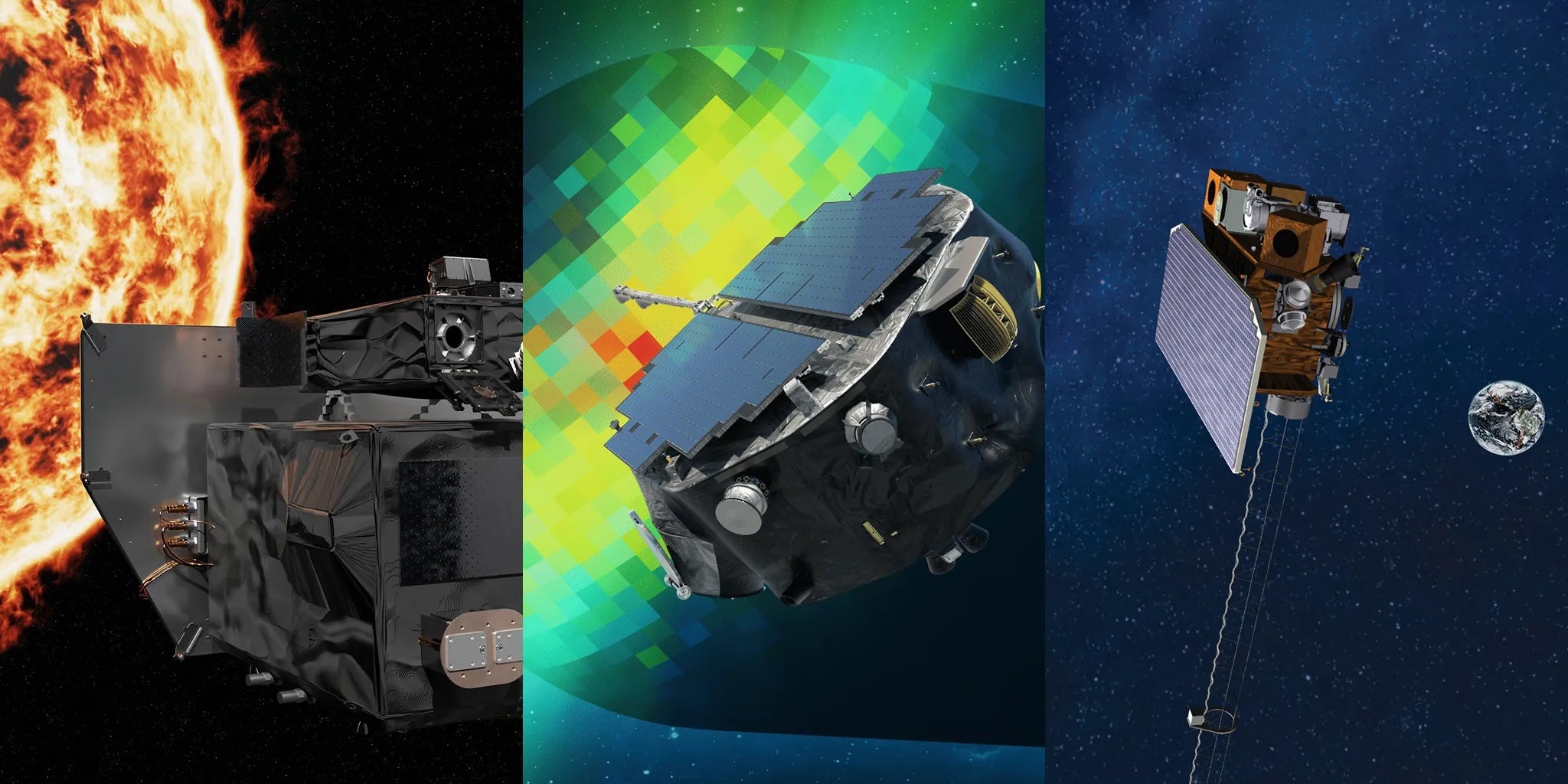
From left to right, NASA’s Carruthers Geocorona Observatory, IMAP (Interstellar Mapping and Acceleration Probe), and NOAA’s Space Weather Follow On-Lagrange 1 (SWFO-L1) missions. Photo: NASA
SpaceX launched three science and weather satellites for NASA and the National Oceanic and Atmospheric Administration (NOAA) on Wednesday. The launch for NASA heliophysics mission IMAP, or the Interstellar Mapping and Acceleration Probe, also carried NASA’s Carruthers Geocorona Observatory and NOAA’s Space Weather Follow On-Lagrange 1 spacecraft.
SpaceX launched the three satellites on a Falcon 9 rocket from NASA’s Kennedy Space Center in Florida on Wednesday, with liftoff at 7:30 a.m. ET. NASA confirmed post-launch that mission managers successfully acquired signals for all three satellites post-launch.
The IMAP observatory onboard the launch will use 10 science instruments to study and map the heliosphere, which is the magnetic bubble surrounding the Sun that shields our solar system from incoming radiation.
The Carruthers Geocorona Observatory is the first mission dedicated to studying Earth’s exosphere, the outermost layer of Earth’s atmosphere. The small satellite will operate at Lagrange point 1 (L1), located approximately 1 million miles between Earth and the Sun.
NOAA’s SWFO-L1 will also operate at L1, where it will serve as an early warning system for potentially dangerous space weather emanating from the Sun. It is a first-of-its-kind operational space weather observatory.
“These three unique missions will help us get to know our Sun and its effects on Earth better than ever before,” said Joe Westlake, Heliophysics Division director at NASA headquarters. “This knowledge is critical because the Sun’s activity directly impacts our daily lives, from power grids to GPS. These missions will help us ensure the safety and resilience of our interconnected world.”
Stay connected and get ahead with the leading source of industry intel!
Subscribe Now