Latest News
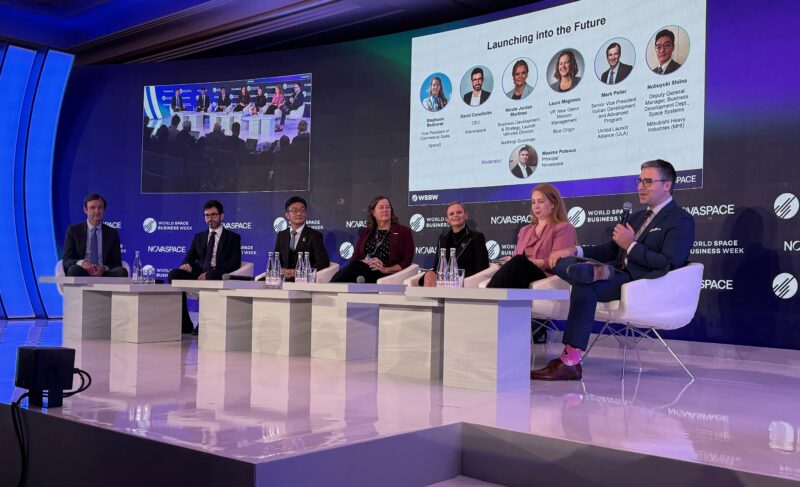
Launch CEOs at World Space Business Week. Photo: Via Satellite
PARIS — On the first day of World Space Business Week (WSBW) in Paris, a number of the world’s top launchers described a market set to enter a new era with an array of new and upcoming vehicles Ariane 6, Starship, Vulcan, New Glenn, and Eclipse.
David Cavaillolès, CEO of Arianespace, admitted that developing a new launcher (Ariane 6) and ramping it up had been “a challenge” for the company. He called the challenge “a day-to-day fight to go faster” and said Arianespace wanted to do some of the fastest first five to 10 flights ever. Arianespace has launched two commercial Ariane 6 missions this year after its debut launch run by the European Space Agency (ESA) last year.
Another key point was talking about “modularity” and being able to serve different parts of the market. “The Ariane 6 was designed for GTO [Geosynchronous Transfer Orbit] but is also excellent for constellations. The rocket is very adaptable. Modularity is key. Ariane 6 has two configurations – heavy lift and medium lift. Now, we want to deliver on a multitude of missions. We are also looking at the economics when launching small satellites. We are assessing what we want to do with different parts of the market.”
Amazon’s Project Kuiper has booked a lot of Arianespace’s upcoming capacity, but Cavaillolès says there are windows in 2028, with 2029 promising to be another inflection point with big launches slated around OneWeb and IRIS².
He sees the overall space industry on the verge of big changes with a shift to more nations wanting soverign infrastructure. “Things are changing. We are talking about huge sovereign infrastructure. I am quite convinced over the next decade, there will be some large sovereign projects.”
United Launch Alliance (ULA) is another player with a rich history, but modernizing for a new satellite world.
Mark Peller, senior vice president of Vulcan Development and Advanced Programs, ULA spoke about the work ULA is doing to improve cadence and bring its Vulcan Centaur launch vehicle to the masses. It has developed a flexible launchpad that it can use for both its Atlas and Vulcan vehicles. It is also building second processing facility and a second mobile platform as it looks to accelerate launch rates. It hopes these moves will see increased customer demand for Vulcan.
“We developed a very capable rocket, and we can apply our rocket to LEO (Low-Earth Orbit). Vulcan is a good fit. We make some adjustments to the configuration to LEO. Vulcan is adaptable,” said Peller. ULA has a backlog of over 70 launches.
SpaceX continues to dominate the launch market and already this year has had a staggering 116 launches. Stephanie Bednarek, vice president of Commercial Sales, SpaceX said next year could see SpaceX hit a high watermark when it comes to launch cadence. Bednarek said the success of this is really down to reusability and how SpaceX is able to learn from every flight, and apply this data to future flights.
Bednarek also gave one interesting stat on the reusability front, saying that a single booster recently hit the milestone of 30 launches. “That is more than some rocket programs,” she said. “Our level of cadence is just not possible without reusability. Reusability as the absolute key to success.”
One of the big questions for SpaceX will be the ramp-up of Starship and how the company will transition to this vehicle. Bednarek believes the transition period to Starship “won’t be as long as you assume,” but said that SpaceX will fly Falcon 9 as long as its “most conservative customers” require it.
Certainly, developments with Starship could dominate headlines in the near future. “We are always very aggressive with our schedule. I think it [the transition to Starship] will happen faster than people really realize. We will be flying Starship and Falcon together for some time. There will be some payloads designed for Falcon, but will go on Starship.”
Another new launch vehicle to watch is Blue Origin’s New Glenn launch vehicle, which is soon set to launch its second mission, for NASA’s ESCAPADE spacecraft.
Laura Magannis, vice president, New Glenn Mission Management, Blue Origin said that the company was seeing a lot of “customer demand” for New Glenn. She also highlighted the importance of reusability and how Blue Origin is investing in tooling and streamlining processes for customers. Maginnis also believes that New Glenn, will be “well optimized” for LEO constellations, as it looks to gain new contracts. Next year will be a key one for Blue Origin and Magannis believes Blue Origin will be able to do multiple launches per month starting next year.
Nobuyuki Shiina, deputy general manager for Business Development, Space Systems Division at Mitsubishi Heavy Industries, Ltd. (MHI) talked about the launch market in Japan and said with a number of new small and medium rocket launchers coming from Japan, this will enable Japan to have better access to space in the future.
One of the final talking points of the panel was the potential for upcoming demand for launch for the U.S. Golden Dome missile defense infrastructure.
Nicole Jordan Martinez, head of Business Development & Strategy, Launch Vehicles Division, Northrop Grumman, said that with Golden Dome potentially requiring lots of launches, Northrop Grumman could be well placed to work on this project as its new Eclipse vehicle is being designed to do lots of launches. Northrop Grumman is co-developing Eclipse with Firefly Aerospace as a successor to the Antares rocket.
Peller also said that Golden Dome fits in well with ULA’s experience in national security launch.
Magannis added, “We are excited to see where the Golden Dome is going and we think we will be part of it. I think for Golden Dome to be a success, launch needs to be integrated into the design.”
Stay connected and get ahead with the leading source of industry intel!
Subscribe Now