Latest News
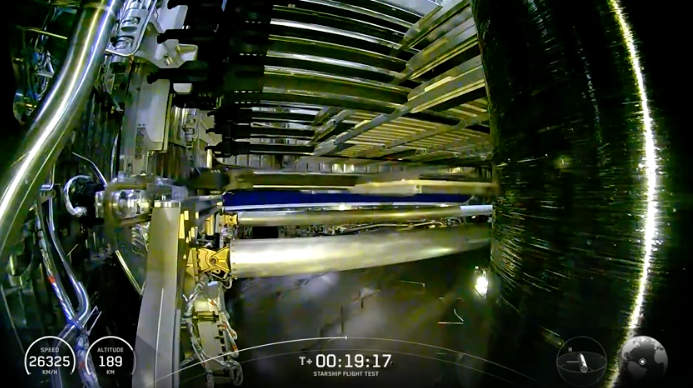
A view inside Starship showing stacked mock Starlink satellites during deployment. Screenshot: SpaceX via X
SpaceX’s 10th Starship test flight made progress after a string of failures this year, successfully deploying a batch of dummy Starlink payloads before completing a soft splashdown in the Indian Ocean.
This marked the first time SpaceX has deployed simulator Starlink payloads on a Starship mission — a step toward its plans to launch Starlink V3 satellites via Starship.
The Aug. 26 test marked a step forward for the Starship program after two tests earlier this year broke apart over the Caribbean and disrupted air travel, and another ended in an uncontrolled reentry.
SpaceX said post-launch that the 10th flight test met all major objectives. After taking off from Starbase, Texas, at 6:30 p.m. Central Time, Starship successfully ascended and went through stage separation of the Super Heavy booster and upper stage Starship. After stage separation, Super Heavy completed a controlled descent and then shut down before a splashdown landing.
Starlink Deployment
The Starship upper stage reached a suborbital trajectory and began successfully deploying eight mock-up Starlink satellites around 19 minutes into the mission through a payload bay.
Starlink terminals onboard the ship transmitted a live video feed for the broadcast. The video showed in real-time how the stack deployed the flat satellites one at a time through the payload bay.
SpaceX has said that each launch of the third-generation, V3, Starlink satellites will add 60 terabits per second of capacity to the network — which is more than 20 times the capacity that the current V2 launches add.
“We’re talking about a massive increase in performance all around which will ultimately enable Starlink to serve as the communications backbone of the missions to the Moon and to Mars,” Tyler Lionquist, Starlink business analyst, said during the broadcast.
SpaceX has said it is targeting starting to launch the third-generation satellites in the first half of 2026.
“Mini Lasers”
The launch broadcast also showed an up-close view of “mini laser” terminals recently tested by SpaceX. Michael Nicolls, vice president of Starlink Engineering, said in a post on X that these mini lasers “will connect third-party satellites and space stations into the Starlink constellation.”
Nicolls said the mini laser is designed to reach link speeds of 25 Gbps at distances up to 4,000 km, and was recently successfully tested in orbit on a Starlink satellite.
Stay connected and get ahead with the leading source of industry intel!
Subscribe Now