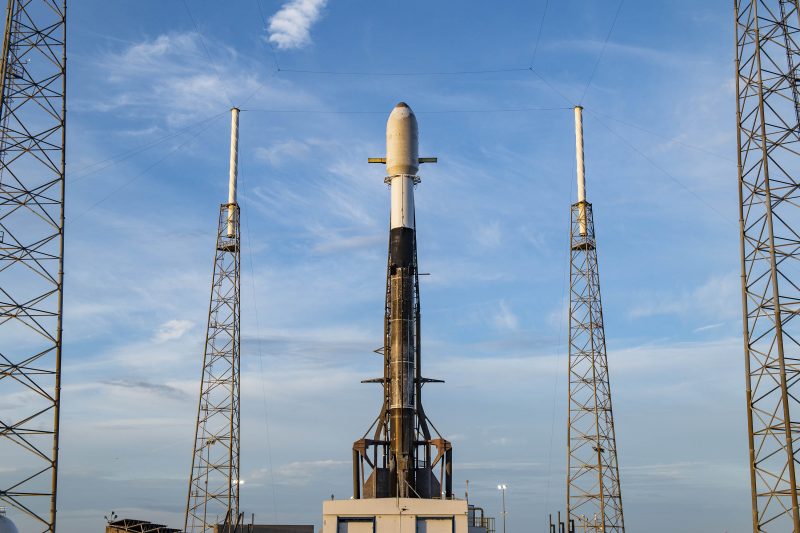
It’s a “good news, bad news” scenario for global launch services market leader SpaceX, as the company won a multi-launch deal for its workhorse Falcon 9 rocket and also received warning signs from a U.S. brand reputation poll published by Axios Harris.
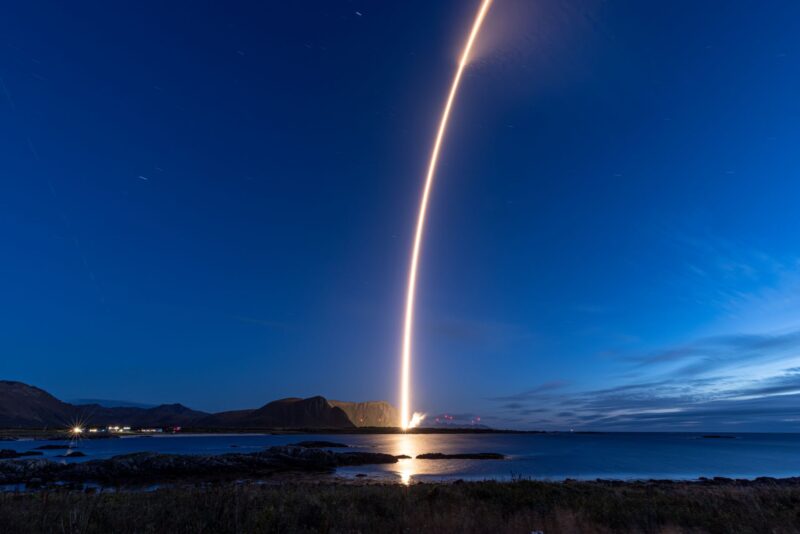
Starting with the good news — SpaceX secured a significant multi-year launch agreement with Germany’s Exolaunch that builds on the existing business relationship the two companies have had since 2020. Exolaunch, which has already participated in 20 SpaceX missions, will now rely on rideshares from the veteran Falcon 9 rocket to place small satellites in orbit for another three years. Exolaunch will pay SpaceX to deploy an undisclosed number of mirco- and cubesats of all sizes up to 16U to various orbits, including sun-synchronous, mid-inclination, and near-polar.
“We’re proud of Exolaunch’s ongoing trust in our capabilities to provide rapid and reliable access to space for their customers aboard our small satellite rideshare missions,” Stephanie Bednarek, vice president of Commercial Sales at SpaceX, said in a company announcement.
The contract extension with Exolaunch shows that SpaceX will continue to rely on Falcon 9 as a revenue generator for several years as it works to push the massive new Starship rocket to market.
In less positive news for SpaceX, Axios Harris published the results of its Poll 100 Reputation Rankings for 2025 on Tuesday, placing SpaceX near the bottom of a list of 100 U.S.-based companies alongside SpaceX CEO and Founder Elon Musk’s electric car company, Tesla. SpaceX ranked at number 86 out of 100, while Tesla ranked at 95 — a drop of 32 spots since 2024. Both companies score higher in categories related to products and innovation and near the bottom in categories related to citizenship, trust, and ethics.
Axios Harris first surveyed 6,231 Americans from January 22 through February 12 and asked each participant to identify which two companies — in their opinion — stand out as having the best reputation today and which two have the worst. From that survey, Axios Harris created a list of the 100 most-visible brands in America, then deployed a second online survey of 16,585 Americans from a nationally representative sample that ran from March 6 through 22.
“Lastly, we asked a third and final set of respondents in a separate set of online surveys about contextual questions on topics related to brands and politics. The contextual findings were conducted online over two waves between May 8 and May 16 among two nationally representative samples of 2,123 (May 8 to 10) and 2,117 (May 14 to 16) U.S. adults,” Axios Harris explained in its poll methodology.
Elon Musk’s popularity ratings have plunged across multiple polls since the billionaire became the de facto leader of the Department of Government Efficiency (DOGE) – an independent cost-cutting organization created by President Donald Trump. Organized protests against Tesla were identified in SEC filings as a key factor in Tesla’s abysmal financial performance in its first fiscal quarter of 2025. The shocking results forced Musk to re-commit to his position as Tesla’s CEO to investors and back away from DOGE.
While SpaceX does not publicly report its finances, there is no sign that SpaceX’s business is declining in the same manner as Tesla. In fact, the company is expected to take full advantage of Musk’s ties to government in securing government contracts for the duration of the Trump Administration. So far, SpaceX’s competitors seem to have little appetite to challenge the company in court on any conflicts of interest, allowing SpaceX to go on the offense in legal matters with the FCC and government regulatory agencies.
The poll results could be a red flag for the space industry as a whole in terms of public interest in space investments and technology. Musk has been one of the most influential personalities driving the United States’ resurgence as a leading space faring nation in the years following the retirement of NASA’s Space Shuttle and the pivot to reliance on private space companies. SpaceX and other space startups brought a new wave of students and entrepreneurs to the space industry.
Musk’s divisive politics, combined with the Trump Administration’s policies on immigration, could drastically reduce the pool of incoming talent to the industry. Musk, DOGE, and the Trump Administration also forced the ouster of thousands of space industry experts across multiple agencies, including FAA, NOAA, and NASA. Politics also exposes SpaceX to a persistent potential long term risk — the results of future elections.