Latest News
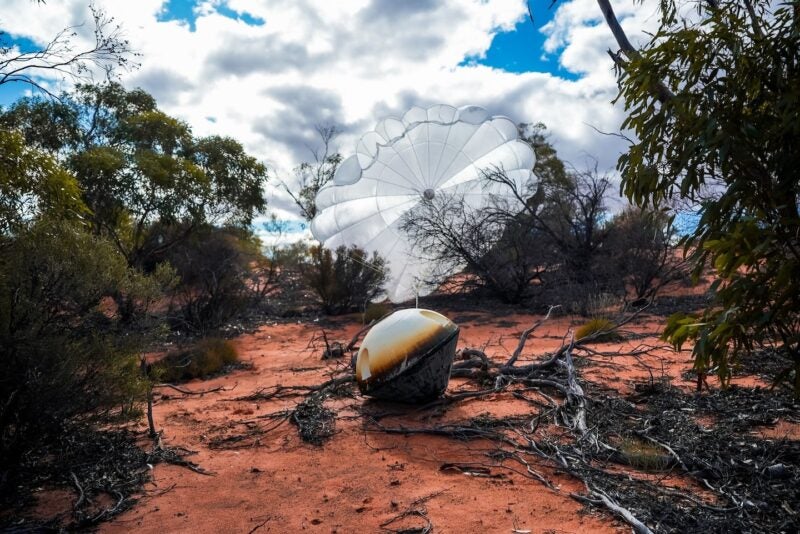
Varda’s W-3 capsule after landing the Koonibba Test Range in South Australia. Photo: Varda
Varda Space Industries on Tuesday said its W-3 capsule successfully landed in South Australia following two months on orbit in a test of an inertial measurement technology in the high-hypersonic reentry environment.
Varda partnered with the U.S. Air Force on the mission under the Prometheus program, in which the two are collaborating on to rapidly conduct technology experiments in the extreme reentry environment. The W-3 reentered Earth’s atmosphere at speeds exceeding Mach 25 before deploying a parachute for landing at the Kooniba Test Range at 19:07 PDT.
The advanced inertial measurement unit was developed by the Air Force and Innovative Scientific Solutions Incorporated. The IMU was designed to operate at the high reentry speeds but this was the first test in that environment.
The W-3 capsule was launched on March 14 aboard a SpaceX Falcon 9 rocket from Vandenberg Space Force Base, Calif., as part of the Transporter-13 rideshare mission. The 120-kilogram reentry vehicle was integrated with Rocket Lab’s medium delta-V Pioneer spacecraft platform that delivered the capsule back to Earth. Pioneer provides power, communications, propulsion, and attitude control.
Launch of the W-3 mission came 15 days after the successful reentry and landing of Varda’s W-2 mission under the Prometheus program that carried Varda’s pharmaceutical reactor, a thermal protection system developed with NASA, and a spectrometer from the Air Force Research Laboratory. Rocket Lab’s Pioneer satellite bus also supported the W-2 mission.
“Varda’s reentry capsule represents a game changing opportunity for both government and commercial partners to test and validate cutting-edge hypersonic and reentry components and technologies,” David McFarland, vice president of Hypersonic and Reentry Test at Varda, said in a statement. “The W-3 mission will provide unprecedented data to advance next-generation space and defense capabilities and continue to provide hypersonic environments to the reentry test community.”
Stay connected and get ahead with the leading source of industry intel!
Subscribe Now