Latest News
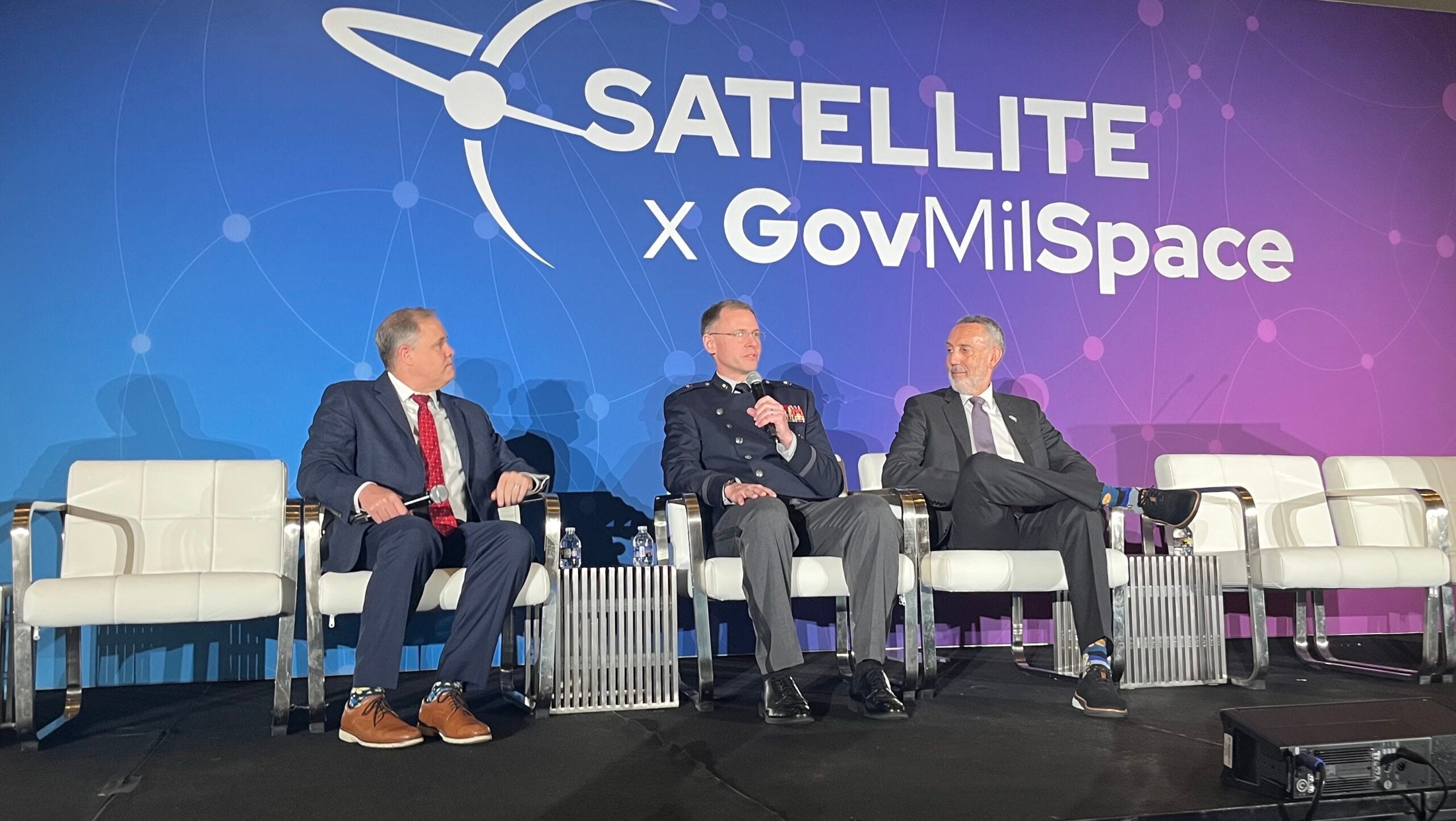
From left: former NASA Administrator Jim Bridenstine, U.S. Space Force Brig. Gen. Nick Hague, and ThinkOrbital CEO Lee Rosen, retired U.S. Air Force colonel. Photo: Via Satellite
With a kaleidoscope of ground radars, electro-optical telescopes, and Geostationary (GEO) spy satellites, the U.S. Space Force can closely track space objects as they hurtle through orbit. But in terms of knowing why they’re there and what they can do, two veteran space warfighters agreed there is room for improvement.
Two distinguished military officials shared visions on the future of the U.S. Space Force and its capabilities in a discussion at GovMilSpace on Monday during SATShow Week, moderated by former NASA Administrator Jim Bridenstine, discussing the branch’s rapid growth and its orbital intelligence gaps.
Ret. Col. and President of ThinkOrbital, Lee Rosen said the United States lacks crucial insight into the intentions and capabilities of its adversaries.
Brig. Gen. Nick Hague, Space Force Assistant Deputy Chief of Space Operations for Operations described the Space Force’s response to an increase of threats from the space domain.
“We’re essentially flying blind in outer space today,” Rosen said. “And probably the toughest problem that you have in the Space Force is understanding what our adversary’s capabilities and intent are.”
Rosen served on multiple missions for Space Systems Command and the National Reconnaissance Office (NRO) during a 23-year tenure in the U.S. Air Force, before an 11-year stint as a vice president at SpaceX. He co-founded ThinkOrbital, a space infrastructure company, in 2022.
Rosen said the United States’ adversaries are enacting their “shenanigans” in plain sight. He said Russia is likely hiding nuclear weapons in orbit and Chinese satellites have been observed “dogfighting” and possibly refueling in space, but attributing those capabilities to them is difficult. He said ThinkOrbital hopes to release the world’s first X-ray image of a satellite from over 10 kilometers away.
“We want to look inside other people’s satellites, because you can get a picture of the outside of your busted knee, but until you get that X-ray, you really don’t know what’s going on inside,” Rosen said.
Rosen said ThinkOrbital has contracted with Space Systems Command to explore the forward basing of space infrastructure that could be deployed at a moment’s notice. He said the company’s tests of microgravity welding could enable the Space Force to construct objects four times the size of the International Space Station in a matter of weeks, off a single launch.
“Whenever I talk about this, everybody goes, “Oh, there’s a big, fat, juicy target,’” Rosen said. “Well, so is an aircraft carrier, but we do things to defend aircraft carriers and layered defenses and things like that that we will have to do in outer space as well.”
Hague said space superiority begins with space domain awareness. He said Space Force tracks over 10,000 satellites and 50,000 orbital objects, but it has to understand the intent behind competitors’ assets, not just their locations.
Jim Bridenstine, a former NASA administrator and congressman, moderated the panel. He said satellites are sometimes observed coming apart in space, which could just be an accident. “Or was it intentional?” Hague said. “That’s tough to discern sometimes. Or is it still alive? We don’t know.”
While in Congress, Bridenstine said, he learned of a satellite that hung seemingly dead near the moon for years before reactivating, flying out into deep space, then returning.
“That should scare everybody,” Bridenstine said. “Because if the number one objective is to avoid operational surprise, and we see the adversary, or I should say, our competitor, doing such a thing, that’s really hard to avoid operational surprise, if they can, no kidding, attack from deep space.”
Hague, a former astronaut with over a year logged in space, first joined the Space Force in 2021 and was promoted to brigadier general in 2025. The service is rapidly growing to address escalating threats, he said, but the challenge is doing it quickly and smartly.
“We’re meeting our recruitment targets,” Hague said. “We have no problem. We got a line backed up for people that want to join the Space Force. We’re going to continue to increase the opportunities to join. But then, how do I deliver those capabilities rapidly?”
Space Force will invest in test and training infrastructure to hold large force exercises and rapidly learn how to match growing threats in space, he said. Its operations going forward will aim to have resiliency baked in, he said, to the point of mitigating first mover advantage.
“That’s really about resilience where it’s just not practical, or the cost of trying to take that first step is so high that there’s no incentive for any competitor to try to take advantage of you,” Hague said.
Hague closed the panel by telling the packed room to think of space as a warfighting domain 24/7, not periodically. Around one year ago, the Space Force released its first Space Warfighting framework.
“If our country goes to war, it really doesn’t impact the 95% of the Guardians that were doing the wartime coding mission already,” Hague said. “It’s critical the things that they’re providing. The missile warning, the satcom, PNT. All of those capabilities underpin the Joint Forces’ ability to do what it needs to do. It underpins our way of life, and that has to happen every day, without fail.”
Stay connected and get ahead with the leading source of industry intel!
Subscribe Now