Latest News
China’s Space Development is Outpacing Expectations and Gaining Momentum, Space Force Official Says
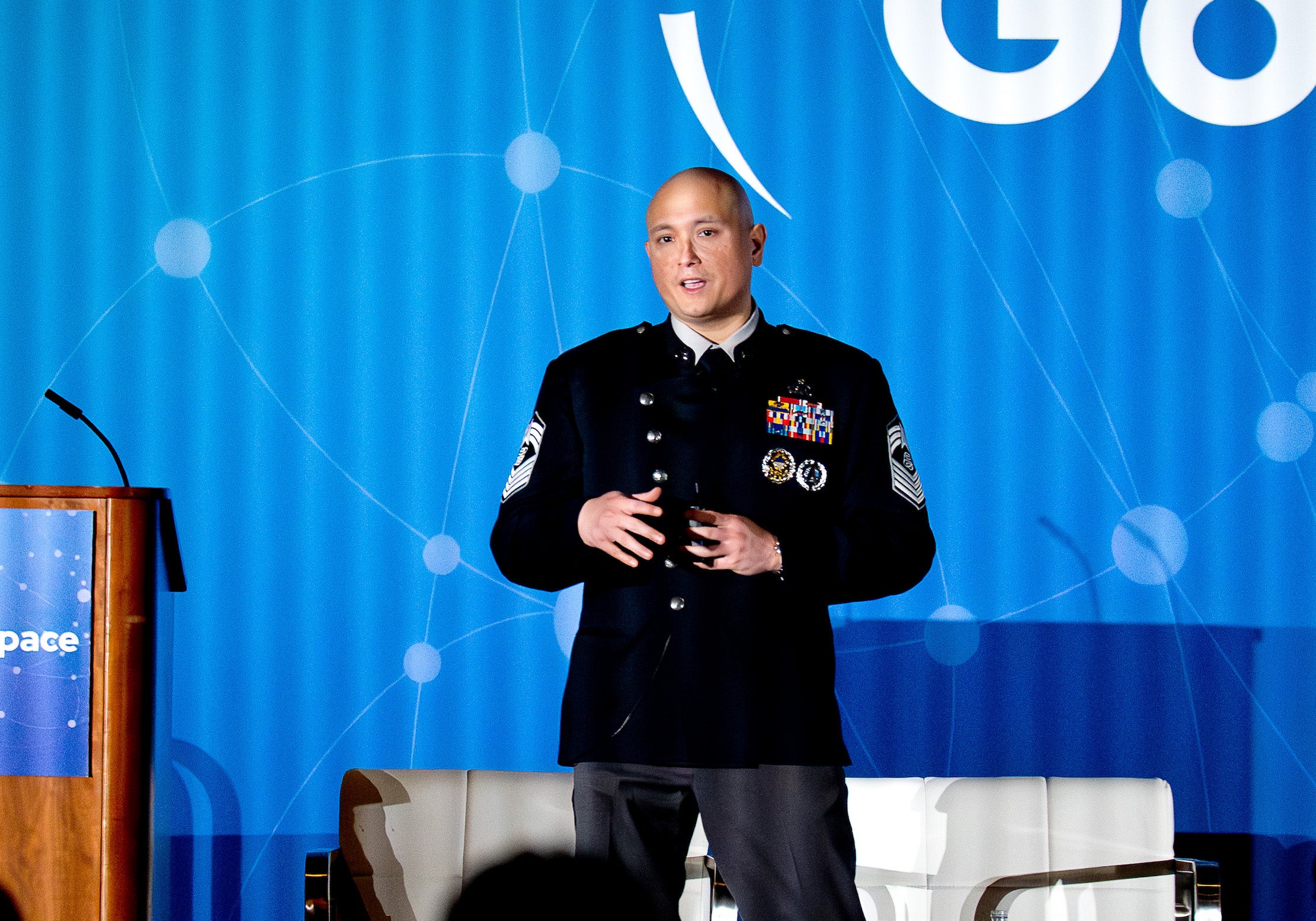
U.S. Space Force Chief Master Sgt. Ron Lerch speaks at GovMilSpace. Photo: Brooke Bryand Creative for Access Intelligence
China’s space asset developments are coming fast and furious as China drives toward the goal of becoming a major space power, outpacing Russia and causing more focused analysis by U.S. Space Command, according to U.S. Space Force Chief Master Sgt. Ron Lerch in his keynote speech at GovMilSpace during SATShow Week.
China is the United States’ “primary competitor in space,” Lerch said, referencing China’s 14th five year plan for economic and social development (China is currently working on the 15th plan). The plan emphasizes strengthening national strategic scientific and technological capabilities and achieving self-reliance in key technologies. Space technologies — satellites, launch systems, deep-space exploration — are treated as strategic high-tech domains within this push.
“The Chinese themselves are the first to have done a space force as part of their major defense reform efforts that were underway after Xi Jinping took over in 2012,” Lerch said. “How did they do? It was an overwhelming success. They met or exceeded the majority of their goals.”
When tracing China’s space development back to 2015, “It’s close to 700% growth on just the number of satellites for the Chinese that are on orbit today,” Lerch said. “That number is not slowing down, as they’re starting to really invest heavily and put on orbit their versions of proliferated constellations.”
What China is demonstrating with their space build-out is a confidence level with its commercial providers, he said. “We know so much of what they do and how entangled the commercial side in China is with the military side, there’s likely a capability that exists for their military assets that’s probably better.”
The U.S. puts more payload on orbit, and does it with a reusable system that enables the launch cadence the U.S. is able to maintain. “We are more efficient at doing it than the Chinese currently are,” Lerch said. “They know this, which is why they value the pursuit of reusable technology, and it is something that we see them actively working towards. We certainly expect those efforts are going to continue to be energized and heavily funded and prioritized, because there’s too much on the line.”
There are now 1,300 Chinese satellites on orbit, Lerch cited, and a number of those satellites are on unknown missions. There has been a significant surge in launches starting in mid-2025.
China is also building up two constellations, currently over 100 spacecraft each and expected to eventually number 13,000 and 15,000 respectively.
“These two constellations are sort of competing against each other, or possibly are going to work in concert with each other. It’s an unknown, really,” he said. “The big takeaway here is that they have been making some pretty good strides. That number of spacecraft on orbit is absolutely expected to grow over the next decade as the Chinese start to master reusable technology and are able to increase their launch cadence and become more efficient at launch.”
The Chinese are also exploring opportunities in cislunar space, with three assets already there doing initial testing for developing communications systems for the Moon and navigational infrastructure to support robotics capabilities.
“This is what a lot of the Chinese are starting to figure out when it comes to a cislunar conversation,” Lerch said. “That’ll be an interesting area that we are already seeing the Chinese get a head start on in terms of the different types of capabilities that they’re putting out there. It’ll be interesting to see just how much that grows here in the next five years. They talk about serving as a space-faring nation — not just a participant — but a leader.”
Stay connected and get ahead with the leading source of industry intel!
Subscribe Now