Latest News
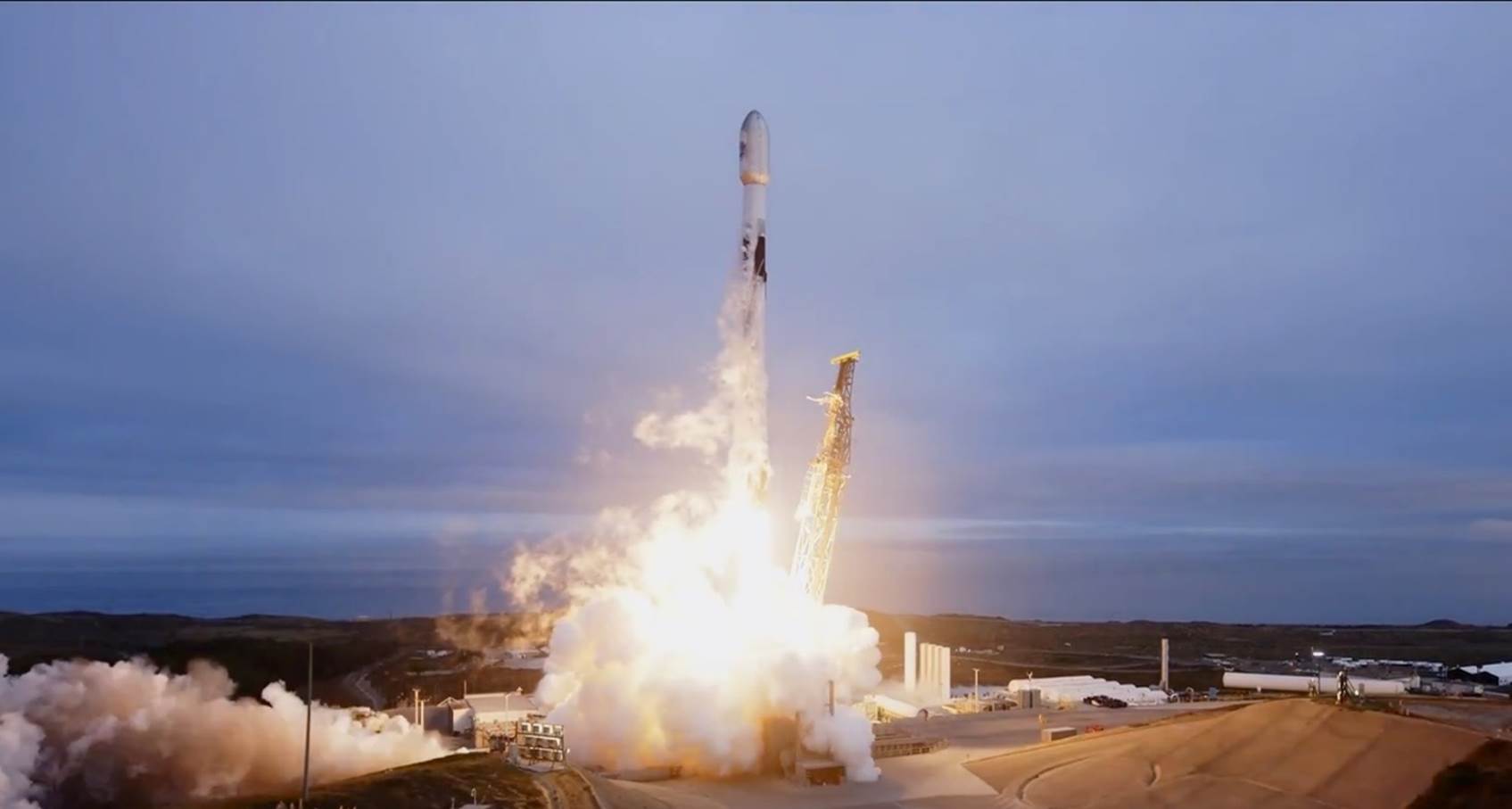
SpaceX launches a mission for the Space Development Agency’s Tranche 1 Transport Layer from Vandenberg Space Force Base in September 2025. Photo: SpaceX
The U.S. Space Force Space Development Agency (SDA) wants to hear from companies able to build ground entry points (GEP) for Tranche 3 of the agency’s Proliferated Warfighter Space Architecture (PWSA).
Next month, SDA may release a solicitation for a five-year GEP development and integration contract. The GEPs are to ease communications to and from the PWSA satellites in Tranches 1, 2, and 3.
A winning company for the GEP contract “will be responsible for performing GEP site civils, procurement, installation, integration, test and verification of GEP site communications shelters, antennas and antenna electronics, optical terminals and optical electronics, and GEP site networking equipment and software at multiple, globally dispersed, GEP installations,” SDA said in a Monday business notice.
“These installations will provide terrestrial links with SDA’s Tranche 1,2, and 3 constellations through a mixture of optical communication terminals (OCTs), RF Ka-band communication, and backup capability in the form of S-band for telemetry, tracking, and command (TT&C). All GEPs are intended to provide autonomous SV [space vehicle] communication in response to scheduled contacts as coordinated through the ground resource manager (GRM) and the local site controller. The GRM maintains constant communication with each GEP to configure contacts, confirm GEP status, and relay contact metrics. As the terrestrial link to a proliferated communications constellation, the GEP transmits uplink commanding to the SV and relays received data back to the operation center for decryption and routing to end users through secure channels,” the notice said.
“Site civils” refers to the civil engineering required for the land development of sites.
SDA has two PWSA operations centers — one at Grand Forks Air Force Base in North Dakota, and the other at Redstone Arsenal in Huntsville, Alabama. The agency said that it finished building the centers in March — the final step being the installation of Lockheed Martin’s Tranche 1 Transport Layer NOVA (NEBULA Operations – Vendor Architecture) software for the Huntsville site. NEBULA is an acronym for Network Established Beyond the Upper Limits of the Atmosphere.
Last month, SDA said that it had awarded Lockheed Martin, Rocket Lab USA, Northrop Grumman, and L3Harris Technologies up to $3.5 billion in Other Transaction Authority rapid prototyping contracts to build 72 satellites for the Tranche 3 of the Tracking Layer.
The missile Tracking Layer and communications Transport Layer are key parts of SDA’s future PWSA to feature optically linked, Low Earth Orbit satellites to speed military actions.
The fiscal year 2026 National Defense Authorization Act proposes a restoration of $500 million for Transport Layer satellites in Tranche 3 — funds that the Department of the Air Force zeroed in its budget request, as the department considers other communications options, including the National Reconnaissance Office-derived MILNET, which has SpaceX as a contractor.
Stay connected and get ahead with the leading source of industry intel!
Subscribe Now