Latest News
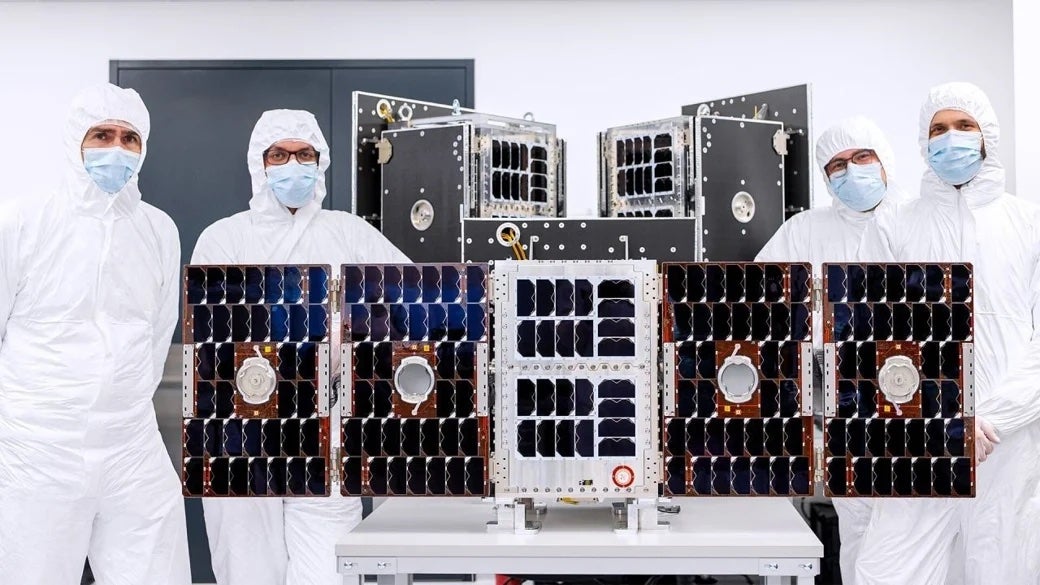
Kongsberg’s first satellite, Arvarker 1 N3X, launched in March 2025. Photo: Kongsberg
Two European defense tech firms — Norway’s Kongsberg Defence & Aerospace and Germany’s Helsing — plan to build a multi-sensor satellite constellation for intelligence, surveillance, and targeting (IST) capabilities.
Announcing the plans on Wednesday, the defense tech firms said the constellation will be delivered by 2029, with an interconnected communications layer to provide sovereign IST capabilities to Europe. The decision to build the constellation is informed by the importance space capabilities have placed in Russia’s war in Ukraine.
The constellation will use Kongsberg satellites, equipped with Helsing’s AI-driven software capabilities to fuse synthetic aperture radar (SAR), electro-optical (EO), and radio frequency (RF) data. The companies plan to establish production facilities in Germany. Sensor technology developer Hensoldt will provide the satellite sensors, and Kongsberg Satellite Services (KSAT) will be involved as well.
The companies have chosen German launcher in development Isar Aerospace as the preferred launch provider, with plans to launch from the Andøya Space complex in Norway. Isar Aerospace’s Spectrum rocket has not yet been successfully demonstrated.
Wednesday’s announcement did not specify the number of satellites or what role government funding will play in the program.
The partners highlighted the importance of integrated space defense systems for Europe. This also comes after Germany recently announced plans to invest 35 billion euro in space defense capabilities by 2030.
“Sovereign monitoring, intelligence, and targeting are fundamental to credible deterrence. Communication, oversight and connectivity are key to operate defence assets effectively, and Europe needs full control over these capabilities,” Kongsberg President Eirik Lie commented. “Germany and Norway together possess world-class space and defence industries, and by combining our strengths, we can field the required sovereign capabilities by 2029.”
Stay connected and get ahead with the leading source of industry intel!
Subscribe Now