Latest News
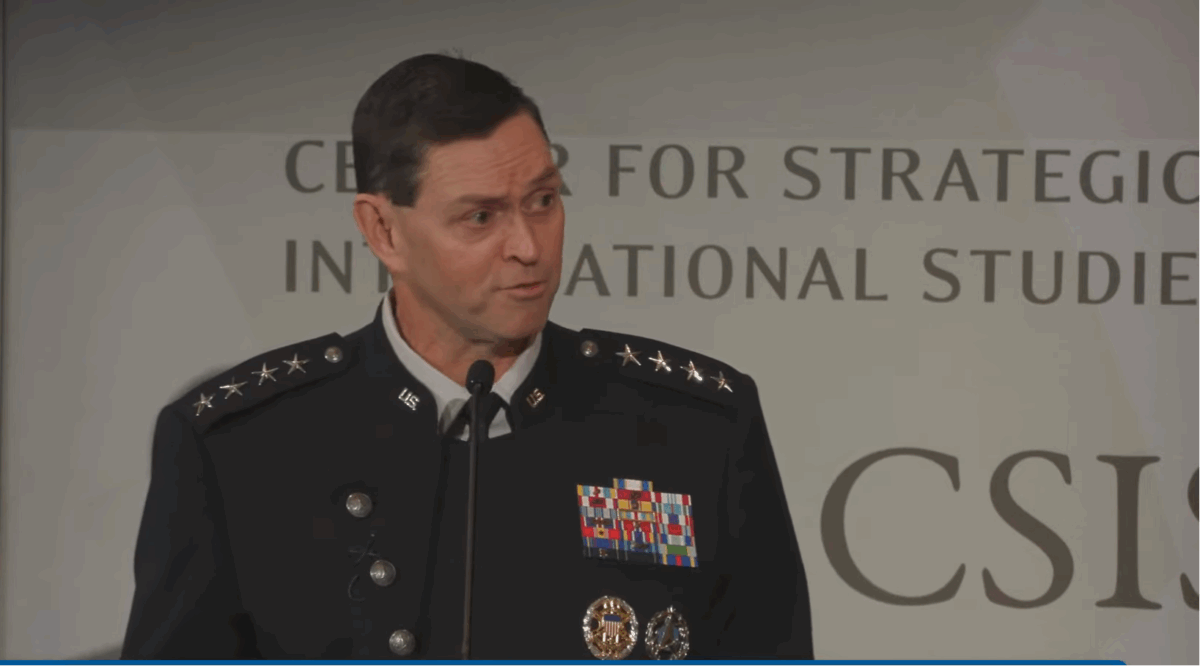
Chief of Space Operations Gen. B. Chance Saltzman addressing a Center for Strategic and International Studies forum on Thursday in Washington, D.C.
The U.S. Space Force is looking to publish its 15-year plan between now and early next year, according to Chief of Space Operations Gen. B. Chance Saltzman.
“I want to publish Objective Force 2025 before the end of the calendar year,” he told a Center for Strategic and International Studies forum on Thursday. “That’s the task I’ve given the staff. Of course, they immediately pushed back, ‘We can’t possibly do that.’ I think they can. I think the bulk of the work is almost complete. While you may not see a published document before the end of December, I can pretty much tell you that the work will be complete, and we will be in final approvals … hopefully publish it to stakeholders in early 2026.”
“We’ll be looking at a time epic out to about 2040,” Saltzman said about Objective Force 2025. “It’s not everything new that’s needed for 2040. It’s all of the systems between now and 2040. There are systems we are flying today that we will continue to use into 2040. The objective force will account for that. There are some systems we use today that we will wean ourselves off of in the intervening years between now and 2040. The objective force will say that, that we plan to sunset in the 2030-35 time frame, and the new system will be growing at the same time to maintain that mission capability.”
The Space Force’s 15-year plans, which are to get annual updates, are to be published every five years. The next, in 2030, will examine service system needs out to 2045.
Objective Force 2025 may include “dynamic space operations” (DSO) for satellite refueling and on-orbit maintenance, depot, and modernization.
This month, a report by the Mitchell Institute for Aerospace Studies, “A Broader Look At Dynamic Space Operations: Imposing Multi-Dimensional Dilemmas on Adversaries,” recommended that a replacement for the Northrop Grumman-built Geosynchronous Space Situational Awareness Program (GSSAP) incorporate refueling “at a minimum, and, ideally, with the capacity to replace or add mission capability.”
Under the future “Andromeda” umbrella contract, Space Force’s Space Systems Command is to undertake the RG-XX program to field a commercial replacement for GSSAP. The GSSAP satellites have used military Satellite Control Network ground stations under Space Delta 6 at Schriever Space Force Base, Colo., and RG-XX is to use those ground stations to minimize the amount of extra training required for ground personnel to operate the satellites.
RG-XX satellites are to have on-orbit refueling to tamp down the number of RG-XX satellites required for initial operations.
The Space Force is to task more than one company to build RG-XX satellites, and the constellation may be significantly larger than GSSAP. Five GSSAP satellites maneuver to conduct rendezvous and proximity operations to monitor and inspect other satellites.
Stay connected and get ahead with the leading source of industry intel!
Subscribe Now