Latest News
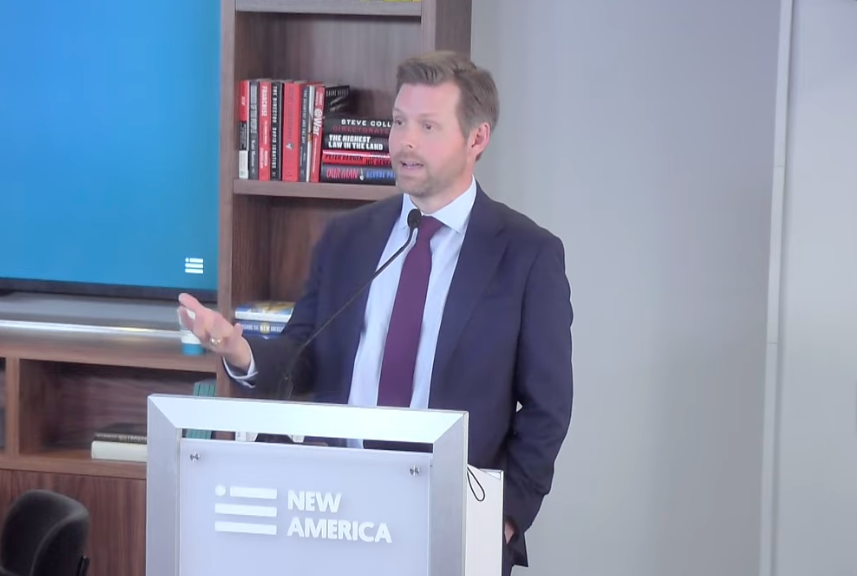
FCC Space Bureau Chief Jay Schwarz speaks at a LEO policy event on Nov. 13. Photo: Screenshot via New America, YouTube
The head of the FCC’s Space Bureau said this week his framework for his space agenda is focused on removing inefficiencies from the system to keep the U.S. from slowing innovation and ceding ground to China in the second space race.
“The CCP [Chinese Communist Party] is aggressively pursuing space dominance. They want to beat us to the orbits. They’re developing new space warfare capabilities, and they want to offer nations around the world their own authoritarian-controlled internet from space,” Jay Schwarz said on Nov. 13 at the LEO Satellite Policy Symposium.
That geopolitical urgency and the promise of economic growth are driving the space agenda at the FCC, he added.
The event was hosted by New America and the International Center for Law and Economics (ICLE) in Washington and livestreamed. A Low-Earth Orbit (LEO) policy working group with members from New America and ICLE recently released a report with recommendations for policymakers.
The FCC has a number of proceedings underway dealing with satellite licensing and satellite spectrum including overhauling licensing; reviewing spectrum sharing; and opening more spectrum for satellite services.
Schwarz outlined a number of areas the FCC sees as inefficiencies to correct, one of which was EPFD limits on fixed satellite service.
The FCC started a proceeding in April to review equivalent power-flux density (EPFD) limits, which facilitate spectrum sharing by GEO and NGSO operators.
“There is good reason to believe that these limits may be over-restrictive, and that there could be a different approach, which will still protect the GSOs, but allow NGSOs to operate at much higher power levels,” Schwarz said. “If that is the case, then these limits are creating substantial deadweight loss because NGSO systems are forced to unnecessarily operate at lower power levels, and therefore are limited in the broadband quality that they can deliver to consumers.”
Without naming SpaceX or Amazon, he pointed to projections from U.S. LEO providers that say they will be able to deliver fiber-like service if they are able to operate at higher power levels. Both SpaceX and Amazon are vocal proponents of changing EPFD limits.
EPFD limits are specified by the International Telecommunications Union (ITU) and were a hot-button topic at the most recent World Radiocommunication Conference in 2023. The outcome was that EPFD limits are not on the formal agenda for WRC-27, but there will be studies through 2027.
When the FCC launched its EPFD proceeding earlier this year, it said it will “continue to monitor and participate in international studies.”
Schwarz also spoke about what he called economic inefficiencies that are the result of regulatory framework.
“There might be situations created where control of a resource, the ability to use this resource, is not in the hands of the entity that can be the most productive with it. If that’s the case, then it will impede us as a nation from winning the space race,” he said.
He described it as an “anti-commons” problem, leading to under-use of a shared resource because entities can exclude others from using it. “If you think for a minute about the framework for space, you could recognize that this could be happening,” he added.
Schwarz had a call-out to those pushing back against updates.
“Often, when there are new transformational technologies and they begin to proliferate, others try to shut them down with regulations and red tape,” Schwarz said. “So often, regulations clothed in sensible-sounding platitudes …. [are] simply the losers facing new technologies and trying to hurt everyone — holding back those technologies because they can’t win market share in the marketplace.”
“I’m not going to name names, but operators and nations are trying to work the system domestically and through international bodies to slow down America in the space race. This is not the way. It’s a foolish path, and we will reject that and respond to it at the FCC,” he added.
Stay connected and get ahead with the leading source of industry intel!
Subscribe Now