Latest News
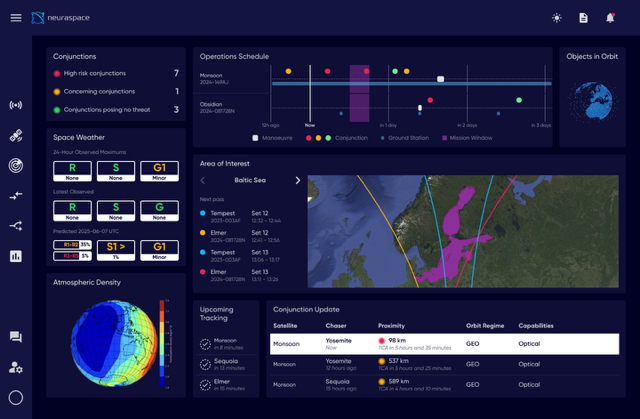
The dashboard of Neuraspace’s DEF offering. Photo: Neuraspace
Neuraspace is launching a space domain awareness tool targeted for the defense sector, called Neuraspace DEF, aimed at helping nations protect their space infrastructure.
Neuraspace CEO Chiara Manfletti tells Via Satellite said the tool looks to inform nations where their assets are in space, if they are protected, and how to keep assets in space safe, and to provide data for a decision advantage for in-space maneuvers.
The company, which is based in Portugal and recently hit its five-year anniversary, has two optical telescopes one in Portugal and another in Chile, that track objects in orbit, and also uses data from partners to inform its platform, which facilitates coordination among satellite operators.
The new offering comes as European nations plan to invest more in space capabilities. Germany, for example, recently announced a plan to invest 35 billion euro ($41 billion) in space defense capabilities by 2030.
Neuraspace has an existing collaboration in the defense space with the Portuguese Air Force and it is participating in the EU’s space situational awareness (SSA) project EMISSARY to provide its core competency in SDA and to serve as the national coordinator for Portugal.
The company recently gave a demonstration with the example of a hypothetical military exercise in the Baltic, tracking activity of allied and adversary satellites, assessing the likelihood of conjunctions and other behaviors in space.
The new system is moving beyond passive and toward active and autonomous control, which Manfletti says will be more important with more and more activity happening in space.
“It’s moving away from that awareness to have an automated pipeline that goes from being aware of that threat, to automatically computing maneuver or evasive action of some kind and then acting upon it without necessarily relying on a human in the loop,” she says.
Neuraspace aims to provide Europe with capabilities that contribute to resilience, civil protection, and peacekeeping. Manfletti adds that understanding exactly what happens in orbit is critical to avoiding unnecessary escalation.
“The more that goes on in orbit — not everything will be intentional or active aggressive aggression,” she says. “We should care about having a good sense of what’s going on in orbit because I think it will also contribute to peacekeeping.”
Stay connected and get ahead with the leading source of industry intel!
Subscribe Now