Latest News
Vulcan Makes National Security Debut, ULA Foresees Significant Ramp Up in Next Two Years
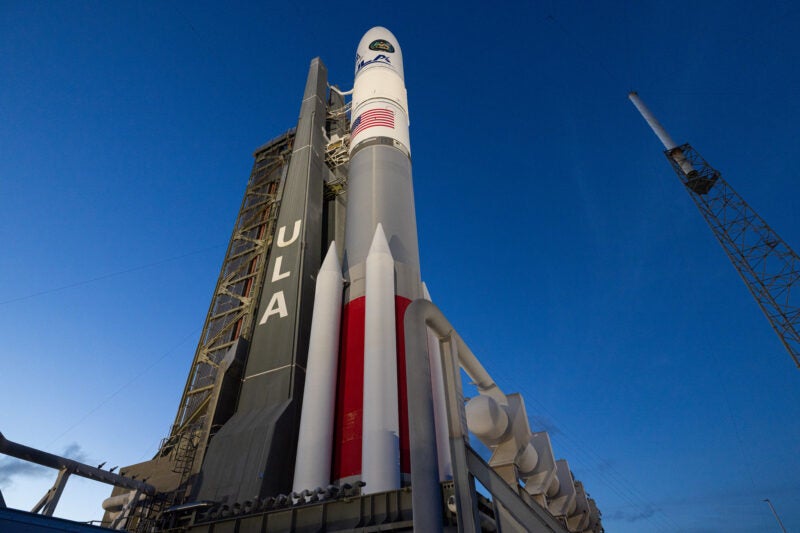
ULA’s Vulcan rocket on the launch pad ahead of the USSF-106 mission. Photo: ULA
United Launch Alliance (ULA) is to ramp up Vulcan rocket launches significantly in the next two years to a possible annual number of more than 30 by 2027 — 60% for commercial and 40% for the Defense Department and the intelligence community.
Tuesday evening, ULA’s Vulcan rocket launched its debut National Security Space Launch for the Space Force. Vulcan took off from Cape Canaveral Space Force Station in Florida at 8:56 p.m. EDT, carrying the USSF-106 mission to Geosynchronous Orbit.
In addition to carriage of a classified payload, USSF-106 is to test novel positioning, navigation, and timing with the Space Force’s experimental Navigation Technology Satellite-3 (NTS-3) by L3Harris Technologies.
L3Harris said that NTS-3 is the Department of Defense’s first experimental navigation satellite system in nearly 50 years. It is fully reprogrammable and will operate at a higher altitude than traditional PNT satellites.
ULA is a Boeing-Lockheed Martin partnership.
Vulcan is to replace Atlas V. Atlas V is the descendant of a family of rockets for the United States’ first ICBM and supported national security missions 54 times since 2007. The last national security-related launch of a ULA Atlas V was the USSF-151 mission for the U.S. Space Force in July last year.
Atlas V has 13 remaining commercial launches, seven of which are to occur this year and next — six for Amazon‘s Project Kuiper to expand broadband connectivity and one to put a Viasat ViaSat-3 communications satellite into orbit.
Last year, ULA launched five times — two certification flights for Vulcan, two Atlas V launches, and the final for the Delta rocket — a Delta IV Heavy for the National Reconnaissance Office’s NROL-70 mission.
Annual SpaceX launches per year of its Falcon 9 typically number 100 or more for commercial and national security missions.
Since 2017, SpaceX has re-used hundreds of Falcon 9 boosters. ULA plans to explore reusable rockets as well.
Tory Bruno, the CEO of ULA, told reporters last week that ULA plans to launch 20 to 25 times annually in 2026 and 2027, but he said that the alliance may be able to increase that to more than 30 in 2027. Before the end of the year, ULA is to reach a tempo of two launches per month — a “new tempo for us that we are growing into,” Bruno said.
After [that tempo] has been done for more than a year, we expect to find efficiencies and any bottlenecks that can be fixed, and, therefore, as we roll into 2027 with all that experience under our belt, we would hope to have more flexibility going forward,” he said.
ULA is to focus on “expansion of [rocket] reusability” beyond engine and aft section recovery, said Bruno, adding that “we have other ambitions relative to reuse that I’m not ready to elaborate on, but I’ll share with you that recovering the aft section and booster is not the end of that journey.”
Vulcan has endured a series of delays, including those involving certification. USSF-106 was to launch by the end of last year. Vulcan received national security launch certification in March. Due to certification delays, Space Force switched launches of the seventh and eighth GPS-III satellites from Vulcan to the SpaceX Falcon 9 rocket. Lockheed Martin is the GPS-III contractor.
“I see a modest but steady growth on the national security side as the infrastructure is built out to cope with the threats from Russia and China,” Bruno told reporters. “There will be a space layer attached to Golden Dome that will add to that, and the ‘internet in space’ is the driver for commercial launches and we’re going to see growth in that as well.”
ULA is 77% done in converting the Atlas V-pad at Vandenberg Space Force Base, California to allow Vulcan use, and the alliance expects to have the pad certified “and able to fly missions” before the end of the year, he said.
A version of this story was first published by Defense Daily. Rachel Jewett contributed to this article
Stay connected and get ahead with the leading source of industry intel!
Subscribe Now