Latest News
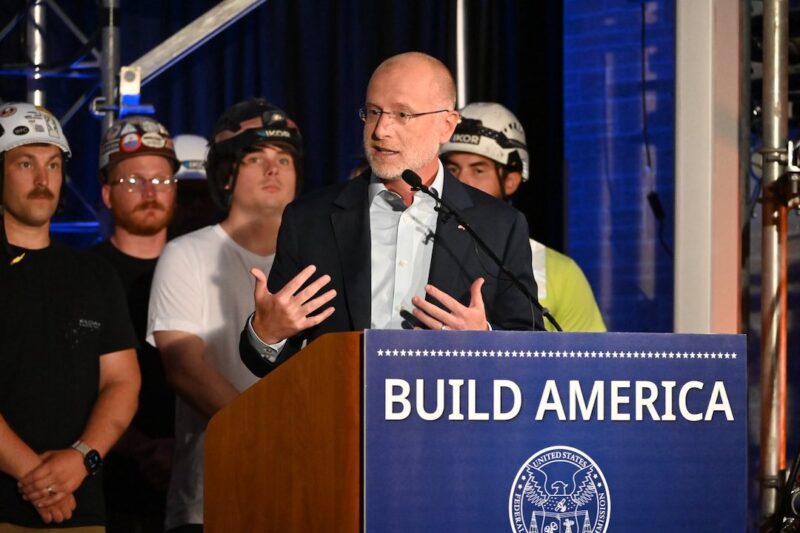
FCC Chairman Brendan Carr outlines his policy agenda in a speech on July 2. Photo: FCC
FCC Chairman Brendan Carr detailed his policy agenda for the FCC in a July 2 speech, including a number of details relevant to the satellite industry, including action in the C-band, and freeing up more spectrum for satellite broadband.
Carr gave a speech in Sioux Falls, South Dakota on Wednesday on the FCC’s “Build America Agenda,” to build more high-speed infrastructure, free up more spectrum for wireless, and cut regulations.
On the wireless front, Carr pointed to the FCC starting an inquiry in February seeking comment on freeing up additional mid-band spectrum for new services in the upper C-band. Carr praised the FCC’s move in 2020 to reallocate the C-band for wireless use, which was a massive undertaking for satellite operators to clear the spectrum in exchange for compensation.
“Like almost all spectrum efforts these days, that one was no easy task. But the FCC’s talented staff rose to the challenge and found a path forward so that America’s telecom workers could build. Fast forward to today and the C-Band now powers new and competitive offerings from in-home broadband to high-speed mobile offerings from coast to coast,” Carr said.
SES CEO Adel Al Saleh said earlier this year that SES, which was one of the primary players in the 2020 C-band proceedings, will support the FCC’s objectives, and there is “significant value” in SES and Intelsat’s combined C-band holdings.
Carr detailed policy plans for the space industry in the speech, saying that the FCC’s guiding principles in this area are “speed, simplicity, security, and satellite spectrum abundance.”
Carr talked about speeding up the licensing process for satellite services, an issue that Space Bureau Chief Jay Schwarz has also highlighted.
“On speed, we’re clearing out satellite application backlogs and reducing processing times at a record pace. On simplicity, we’re working to eliminate unnecessary rules that throttle the satellite industry, such as obsolete power limits and cumbersome siting restrictions. On security, we launched a proceeding that looks at bolstering and safeguarding the services provided by our GPS system. On satellite spectrum abundance, we’ve opened a rulemaking that could free up more than 20,000 megahertz for satellite broadband,” Carr said.
His comments reference a proposal kicked off in April on power limits that facilitate spectrum sharing by GEO and NGSO operators. Known as equivalent power-flux density limits (EPFD) limits, the issue was a contentious one at the WRC-23 spectrum conference. SpaceX has petitioned the FCC to start this proceeding, and Viasat and EchoStar both objected.
Carr also referenced the proceeding that started in late May, which could open more than 20,000 megahertz of spectrum for satellite broadband, a move that the Satellite Industry Association (SIA) encouraged.
“From high-speed consumer broadband offerings to groundbreaking scientific research to mission-critical services that protect our homeland, our space industry is delivering real results for the country. America must continue to lead the world when it comes to space. That means we need U.S. companies to dominate in orbit,” Carr said in his speech.
Stay connected and get ahead with the leading source of industry intel!
Subscribe Now