Latest News
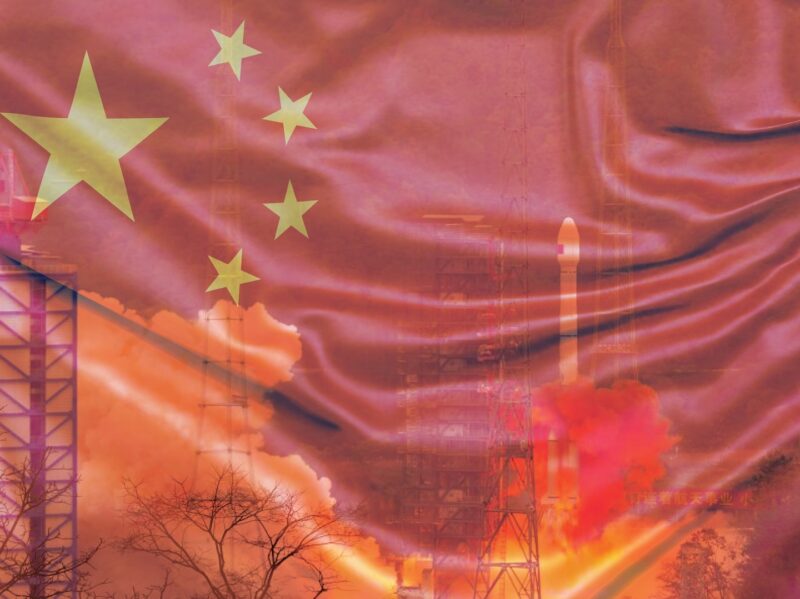
A launch at China’s Xichang Satellite Launch Center. Xinhua image and Via Satellite archive illustration
LONDON — Increasing understanding of Chinese spy satellites took center stage at this year’s Military Space Situational Awareness Conference in London, which brought together leaders and academics in space data last week.
“The Chinese don’t believe there’s a separation between Western state satellites and companies that sell to Western governments, believing such satellite markets to be something of a fig leaf,” said Dr. Brendan Mulvaney, director of the China Aerospace Studies Institute, which is part of the U.S. Dept. of the Air Force. “Therefore, they are all viable targets as far as China is concerned.”
Mulvaney spoke about a number of publicized Chinese projects such as the Tiangong Space Station, the Hainan commercial spaceport, the capacity of Chinese spy satellites, and the international ramifications.
“Xi Jinping has stated the goal of becoming a global superpower in space — to meet and exceed the scientific, technological, and military capabilities of the United States in orbit,” Mulvaney said. “That includes deep space and diversified orbits … and eventually space launches with international partners from HICAL, their commercial spaceport on Hainan island. We should not underestimate their ability to do this.”
Presentations from ExoAnalytic Solutions, Kratos, and Slingshot Aerospace demonstrated real-time tracking of Chinese satellites supposedly shadowing their American counterparts.
When Hugh White, senior director of Space Domain Awareness Services at Kratos, was asked to speculate on the capabilities of modern Chinese military and intelligence satellites, he said these satellites have “a lot” of capabilities.
“We know that there is downlink & uplink jamming,” White said. “There’s nothing stopping a spy satellite from maneuvering next to another and broadcasting in the same frequency range, though I’m not aware of that happening intentionally.”
He also echoed the speculation that spy satellites such as the Russian Luch Olymp satellites – widely thought to be spy satellites – have collected upstream traffic intended for the satellites they shadowed in recent years.
A Waking Dragon?
Via Satellite spoke to Mulvaney about his findings of China’s space capabilities and ambitions.
“From developing new tactics, techniques, and procedures, to practicing them on orbit, the People’s Liberation Army (PLA) continues to advance their space capabilities rapidly,” he said. “This accomplishes both a training and deterrence aspect, i.e. they are demonstrating the capability, capacity, and willingness to expend a lot of Delta-v to maneuver their satellites in new and assertive ways.”
These moves are the result of decades of concentrated work in China on the nation’s science and technology base with authoritative policy levers across academic, industrial, and military spheres.
“In many areas, China has already caught up with the democratic West, in some places they are close on our heels. Without long-term focus and funding, the advantage that the democracies of the world have enjoyed for decades may slip away,” he said.
Yet Mulvaney was cautiously optimistic about the potential for a more harmonious future between East and West.
“China is an important member of the international community, and this is especially true in space. The democratic nations of the world need to think carefully about where it is acceptable, and at times beneficial, to work with China on scientific endeavors that do help all mankind, such as deep space exploration, understanding and mitigation of weather-related changes,” he said. “But at the same time, must be clear eyed in the dual-use nature of other technologies and how the Party-State apparatus of China will leverage those for military and strategic gain.”
He believes cooperation in space between the BRICS intergovernmental organization nations of Brazil, Russia, India, China, South Africa, Egypt, Ethiopia, Indonesia, Iran and the United Arab Emirates, and second world nations is ‘absolutely’ foreseeable.
Mulvaney expects Chinese non-military space companies to become world leaders in providing space launch capabilities and satellites to other nations.
One example is Qianfan, China’s “thousand sails constellation,” a Low-Earth Orbit (LEO) internet megaconstellation in development from the Shanghai Spacecom Satellite Technology, intended to constitute over 15,000 satellites and rival Starlink.
These activities “will likely start in Asia, but will be very active in Africa and South America as well,” he said. “This will provide economic benefits to both China and their client states. When there isn’t an active armed conflict occurring, there is a lot of money to be made in space in the coming decades, and all nations are going to want to take part. China has positioned itself to be in the leading pack.”
Stay connected and get ahead with the leading source of industry intel!
Subscribe Now