Latest News
Bringing Together Commercial Operations for Military Use Hinges on Integration Roadmaps
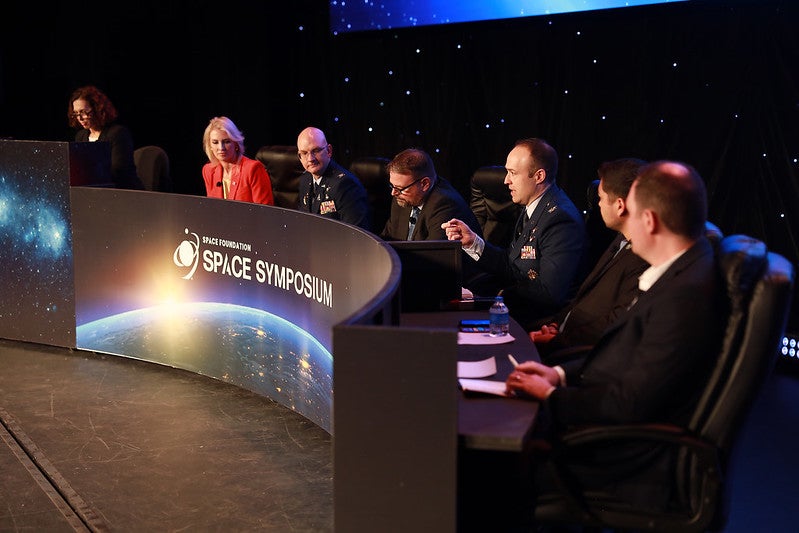
Commercial space and military leaders on April 10 at Space Symposium. Photo: Space Foundation
COLORADO SPRINGS, Colo. — Commercial space and military leaders are working through challenges to achieve greater integration of private sector capabilities for military use. Col. Richard Kniseley, senior materiel leader of the Commercial Space Office, Space Systems Command (SSC), said Thursday at Space Symposium that it sometimes feels like a “grassroots movement” working together across the commercial business community.
“It was about bringing together industry, those commercial enablers,” Kniseley said. “Now we’ve got to get commercial more into our space architecture. And we’ve got a lot of different things going on right now.”
Kniseley said Congress sent a letter instructing all of the U.S. Department of Defense (DoD) program executive officers to break apart all mission area requirements and show what can go commercial, what can go international, and what needs to be military purpose-built in-house.
On Wednesday, President Trump released an executive order aimed at modernizing defense acquisitions, with a “first preference” for commercial solutions.
“We’ve had a lot of great success over the past two years, but now we are really going to kick it into overdrive.” Expectations are going to be high, Kniseley said, and hopefully, with that a budget comes along, the resources come along and the road maps come together to show how everything will start to be integrated.
Part of Col. Eddie Ferguson’s job is executing the commercial integration strategy for the U.S. Space Command released last year. Ferguson is the command’s chief of Advanced Warfighter Capabilities and Resource Analysis Division.
That Space Command strategy includes bringing commercial capabilities in for the warfighter’s use, and doing modeling, simulation, and analysis. “Our job is to write requirements and advocate for resources,” Ferguson said. “We have a 2027 timeframe that General Whiting gave us, and that largely means that we have to try to use commercial partnerships, preferably with dual use technologies, because that’s what’s going to deliver in the timeframe that we’re looking at.”
From the side of industry, Christina Agnew, vice president for Space at Palantir, said Palantir has “fought the hard battle to be where we are today in delivering commercial capability for the defense ecosystem.”
She acknowledged that the company has faced roadblocks about accreditation and access to the customers. “But the shift we have seen with our community of partners, commercial and defense, has unlocked a lot of the access that really, in the past years, wouldn’t have been possible,” she said.
Todd Gossett, vice president for Space and National Security Initiatives with SES Space and Defense, said that his organization has been integrated for years. “We’ve been there,” he said. “But now, as we’ve seen over the past decade, there is a much more purposeful integration of these commercial capabilities into the military, alongside the military’s purpose-built capabilities and what we now call space architecture.”
Gossett said that people in positions of authority in government say that they can do this commercial integration. “But their incentive is to make a performance cost schedule in those acquisition programs,” he said. “I think getting over how they have been rewarded in the past, and how they can get incentivized to better adopt a new way of thinking, has been a challenge.”
Another challenge to integration are the adjustments in requirements to use commercial services in a military context, noted by Michael Madrid, chief growth officer of Starfish Space. “We feel that as a commercial company there is a fundamental tension in the relationship where we are developing something that we think is the best way to solve a problem, that may be different than what a government customer has asked for or has envisioned for that need. There may be things that our commercial customers don’t need that a government customer does need,” he said. “If you react to that tension by just doing whatever our government customer wants, I think we lose some of the benefit of it being a commercial service in the first place.”
“I don’t really want to be called a commercial company,” argued Joe Morrison, vice president and general manager of Remote Sensing at synthetic aperture radar (SAR) startup Umbra.
“When we collaborate with our government partners, most of the great features we’ve built into our products have come from talking to customers,” Morrison said. “They tell us a need, and then we build to the need.”
The challenge for the government is to “not sit back and get lectured by companies about how you should meet your mission,” he said. “That makes no sense. You’re the expert in your mission. You’re the expert in acquisitions. The challenge is — Can you develop enough trust? If you’re not willing to share with us your actual needs because you don’t trust us, then we won’t be able to help you.”
Kniseley said that bottom line, commercial is a trusted asset and partner in wartime. “They’re providing extreme capability right now. They’re taking that business risk from an enemy standpoint who already views them as a threat.”
Stay connected and get ahead with the leading source of industry intel!
Subscribe Now