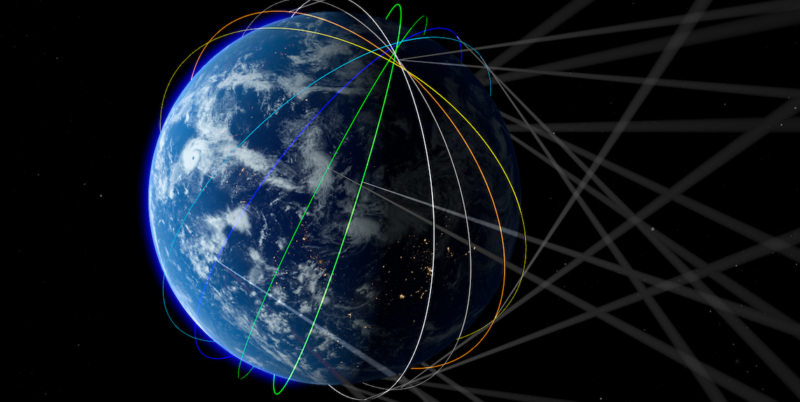

Growth in Low-Earth Orbit (LEO) and Mobile Connectivity were the highlights of Eutelsat’s third-quarter results, as LEO-driven revenue was up 65% year-over-year.
Overall, Eutelsat reported 293 million euros ($343 million) in revenue in its third quarter, which ended on March 31. This was down 2.3% on a reported basis, and up 3% on a like-for-like comparison.
Government Services, Mobile Connectivity and Fixed Connectivity all saw growth, which offset a double-digit decline in Video business during the quarter.
Mobile Connectivity had the most momentum at 27% year-over-year growth, due to growth in the aero market. Mobile Connectivity revenue was 45 million euro ($53 million) during the quarter.
Eutelsat highlighted Japan Airlines’ adoption of a multi-orbit in-flight connectivity (IFC) offering from SES, which will distribute Eutelsat’s LEO capacity. This agreement covers 40 wide-body aircraft.
“We are not an integrator. The Japan airlines contract is via a distributor — in this case, it’s SES. But SES distributes LEO capacity as do other distributors, which includes Panasonic, Gogo, and Anuvu,” Investor Relations Officer Joanna Darlington said of the deal on the operator’s investor call. “The Japan Airlines contract is pure capacity as [is] all of the LEO capacity that we sell to airlines via distributors.”
Eutelsat said that 600 aircraft have been connected with its LEO capacity for IFC, as well as an additional 160+ private jets.
Government Services and Fixed Connectivity grew 12% and 11% year-over-year, respectively. Both were influenced by LEO growth. Government revenue growth was driven by the acceleration of LEO activities through services delivered in Ukraine and rising demand from non-U.S. governments.
Video, on the other hand, declined 13% year-over-year to 128 million euros ($150 million). Eutelsat noted the decline was impacted by sanctions on Russian channels imposed at the beginning of the year and capacity contracts that were terminated on the Express AT1 and AT2 satellites.