Latest News
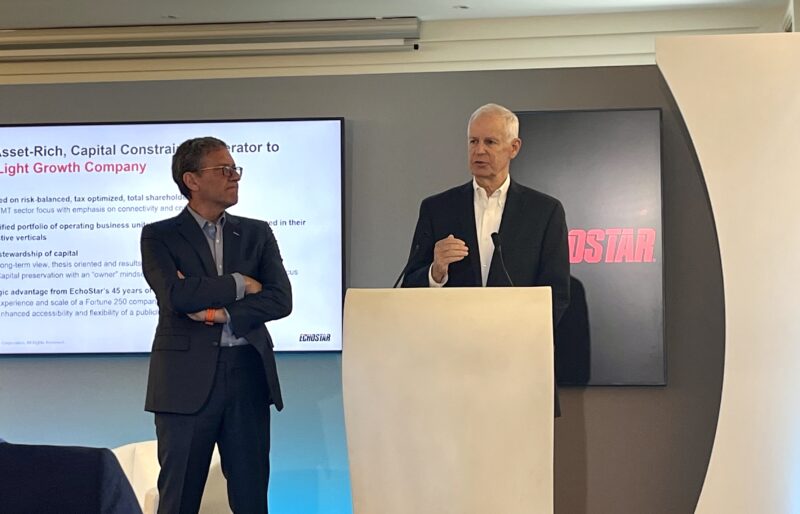
EchoStar CEO Hamid Akhavan, left, and Chairman Charlie Ergen, right. Photo: Via Satellite
PARIS — After EchoStar’s spectrum sales under the pressure of an FCC investigation, the company is at a pivot point with its new status of light in assets and heavy in capital.
“We are going to be an asset-light, growth company,” EchoStar CEO Hamid Akhavan told a press conference on Monday at World Space Business Week in Paris. “That’s the forced pivot that we had to make by disposing of our spectrum. We had not planned on selling at this time because over time, that could [have been] a more value-enhancing infrastructure for us — much more than what we managed to get today.”
Akhavan acknowledged the press conference was originally slated to cover EchoStar’s direct-to-device (D2D) constellation plans, which were shelved just over a month after it was announced with the spectrum to SpaceX. With this event coming just a week later, Akhavan and Ergen were open that they are still figuring out what’s next for EchoStar and how it will deploy the capital from the spectrum sales, including the wireless spectrum sale to AT&T.
EchoStar’s core brands — Dish Network, Sling TV, Boost Mobile, and Hughes — remain and the company intends to keep its core emphasis on connectivity and communication.
This marks EchoStar’s fourth pivot, co-founder and Chairman Charlie Ergen said.
“Every time we pivoted, it was always a little scary at first,” Ergen said. “This pivot is the same thing for us. [It’s] not personally exactly where we wanted to go, but we’re also excited about … [the] pivot to something that we’ve never had before, which is a lot of cash.”
Akhavan said the situation with the FCC inquiry was “very difficult” for EchoStar and put the company at risk of potential bankruptcy if its spectrum rights had been taken away.
“This was a forced situation for us,” Akhavan said. “We actually had no way forward but to make the most of what we have — which we believe would have been far more value-enhancing in the long term. But in the short term, we had to liquidate some of our spectrum to meet the needs of the nation and the FCC.
He maintained that EchoStar had met its obligations and commitments to the FCC but said the company “respectfully understood that FCC wanted to have our spectrum in the hands of other parties that could — sooner than ours — bring it to more efficient use.”
Ergen said that the hand the FCC dealt EchoStar left the company with “only one logical path.” He said EchoStar does not believe the FCC could take away its spectrum licenses, but gave some insight into the decision EchoStar made to sell the spectrum.
“We would win the battle and lose the war because we were frozen at that point in time,” Ergen said. “How do you build a network, how do you get return to shareholders when you don’t know how long the proceedings are taking to solve that?”
Ergen also said that EchoStar went to SpaceX around eight years ago with a proposal to collaborate on direct-to-device, which SpaceX declined. He spoke highly of SpaceX as a vendor from EchoStar’s prior work with SpaceX, and EchoStar’s investment in SpaceX as part of the spectrum deal.
“Now that we are going to be cash-rich and asset-light, one of the first investments is SpaceX. Of all the things that I see in the world today, if I could make one investment other than ourselves, it would be SpaceX,” Ergen said.
He also spoke to how valuable the spectrum that SpaceX purchased is for direct-to-device services with the highest priority from the International Telecommunications Union (ITU), for SpaceX to build its Starlink Direct-to-Cell service.
“I imagine SpaceX will build thousands of satellites. It’s for them to say, I don’t know. They have the ability to combine broadband satellites and handsets. If you think about what they’ll be able to do — they’ll be able to go to your home and the phone in your pocket. If you really think about what that means, it’s a big moment. I’m bullish.”
There will be offshoots to SpaceX’s business that EchoStar may be able to capitalize on as well, such as IoT connectivity. “They’re not going to do [everything] , it’s just too small. We’re in a good spot,” Ergen added.
The spectrum sale to SpaceX included a long-term commercial agreement allowing Boost Mobile subscribers to access SpaceX’s Starlink Direct to Cell service. Akhavan said this setup “allows us to marry space and ground connectivity in the most effective way anybody can. Watch us take advantage of that and hopefully be the most unique, differentiated offering around the world for Boost subscribers.”
EchoStar coined the phrase “hybrid mobile network operator” to describe its status with Boost Network post spectrum sale. Akhavan said that the core of Boost is the cloud-based network, which it retains, without operating the radio system.
“We believe in the age of AI, there’s going to be a huge need for new products and new services to be offered to enterprises or consumers, and I think we’re well positioned to do that,” Akhavan said. “That was always our aspiration to do it. We thought we could do it on our own, but now we kept the best of what we could using AT&T’s infrastructure.”
In terms of the Hughes business, Akhavan said Hughes has been pivoting to a more enterprise-focused business than consumer-focused in recent years. With that shift, Hughes has grown its presence in the aviation market and Akhavan said it’s looking to scale the aero business and he’s optimistic for a number of new contracts. He added that Hughes is focused on the defense market, and software-defined engineering for resilient telecommunication systems.
“There’s an incredible amount of demand in enterprise — not just [for] satellite connectivity. What we’re focused on is resilient connectivity — that’s a combination of satellite and terrestrial. One of the things that we really focus on is making sure that we marry all sorts of different ways to give the customers what they need, which is resonating very well for mission critical industries and governments.”
Stay connected and get ahead with the leading source of industry intel!
Subscribe Now