Latest News
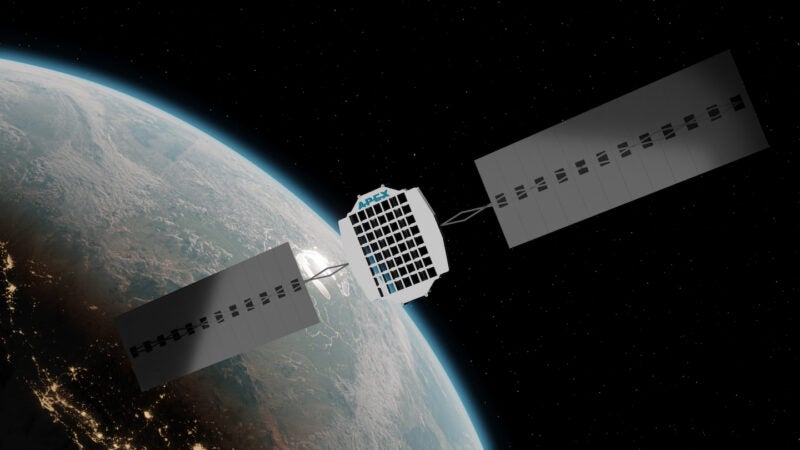
A rendering of Apex’s Comet satellite platform. Photo: Apex
Excited by strong customer demand, investors are pouring another $200 million into satellite bus developer and manufacturer Apex to enable the company to continue buttressing efforts to accelerate production and vertically integrate.
The new funding round follows a $200 million Series C round four months ago that positioned Apex to be able to go from 12 spacecraft buses a month to 18 and pursue its vertical integration strategy.
The earlier raise boosted “customer traction” for commercial and government applications, which in turn demonstrated a need for further expansion and vertical integration, driving investors to seek to further invest in Apex unsolicited, Ian Cinnamon, the company’s co-founder and CEO, told Defense Daily.
“And the honest truth of it was, at first, we didn’t want to take the money, so we said no,” Cinnamon said in a Sept. 11 interview prior to the announcement. “But we realized it would simply enable us to really deliver on these constellation deals for customers much faster. So, we decided to go ahead and do it.”
Recently, following the Series C round, Apex made two big moves that laid the foundation to be able to produce 18 buses a month. These include leasing a 55,000 square-foot facility adjacent to its existing 50,000 square-foot building in Los Angeles, and acquiring in late August the Hall-effect Thruster technology from in-space electric propulsion startup Phase Four.
The additional space opens the aperture to build more subsystems and components in-house, a strategy the company is pursuing to resolve supply chain delays, accelerate production, and improve quality. In addition to the electric propulsion systems acquired from Phase Four, Apex is in various stages of research and development of its own solar panels, reaction wheels, flight computers, and avionics, Cinnamon said.
With the Series D round, investors value Apex at over $1 billion. Cinnamon said the raise strengthens the company’s balance sheet and will help enable it to pursue further acquisitions, which could bolster vertical integration, talent, and key suppliers.
Demand for Apex’s buses is being driven in part by the Trump administration’s new Golden Dome effort for a homeland missile defense shield, and “massive” commercial and government opportunities, he said.
In March 2024, Apex launched its own spacecraft into orbit built on its Aries bus that can operate in Low-Earth Orbit (LEO) and Geostationary Orbit (GEO) and has a payload mass up to 150 kilograms. Apex has delivered Aries buses to customers but they have not launched them yet, Cinnamon said.
Nova, another Apex bus, has a payload mass up to 500 kilograms and is expected to fly for the first time in 2026 as a company test platform. Apex is also developing a larger bus it calls Comet. Nova and Comet are designed for LEO operations.
Apex is not currently producing 12 buses per month but Cinnamon said the company is delivering to customers and is negotiating additional deals for commercial remote sensing and government missions, including pathfinder satellites for missions like missile tracking, warning, and fire control.
The technology investment firm Interlagos led the Series D round.
Stay connected and get ahead with the leading source of industry intel!
Subscribe Now