Latest News
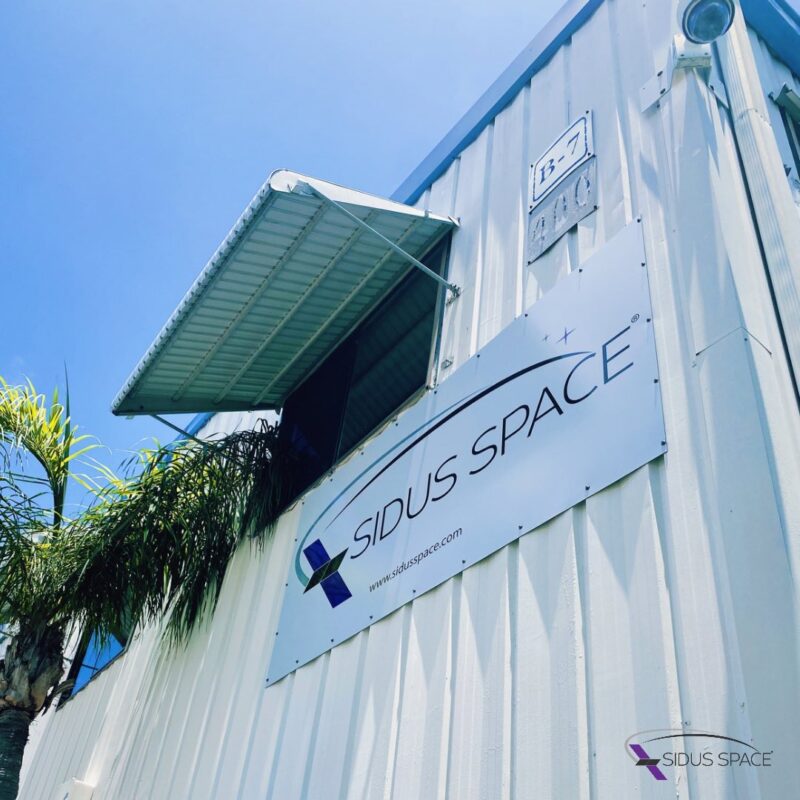
Sidus Space Headquarters at Cape Canaveral, Florida. (Photo by Sidus Space)
Sidus Space reported a 36% year-over-year increase in revenue in the second quarter of 2025, which the company said is due to pivoting away from legacy services in favor of new commercial models.
CEO Carol Craig told investors it was a “pivotal” quarter for the company as it focuses on satellite manufacturing and integration; space-based data and AI services; and its commercial product lines including its onboard computing system.
“We continue to advance our mission of transforming space access and delivering vertically integrated solutions across hardware, software and data,” Craig said.
Net loss in Q2 was $5.6 million compared to $4.1 million in the same time last year.
Sidus Space has lost contact with its first satellite, LizzieSat-1, which has been in orbit for about 18 months, Craig told investors.
LizzieSat-1 has a potential orbital debris-related anomaly and the company is “actively working to reestablish contact,” Craig said. This was the company’s our inaugural satellite and has supported multiple customers.
Sidus Space successfully launched its third satellite, LizzieSat-3 during the second quarter. Once LS-3 is online, Sidus will be able to recognize new revenue in its data-as-a-service offerings to commercial and government users.
Its second satellite, LizzieSat-2, remains in the commissioning phase. Sidus Space is manifested to launch two more LizzieSat satellites towards the end of 2026.
Craig also highlighted the potential opportunity for Sidus Space to bring its capabilities to the Golden Dome missile defense concept.
“Our ability to deliver domestically manufactured hardware, integrate AI-powered sensing capabilities and support rapid deployment cycles uniquely qualifies us to support both prime contractors and direct government initiatives,” she said. “We’ve seen increased engagement around mission-enabling technology, particularly in LEO, where our LizzieSat platform serves as both a demonstration asset and a scalable architecture for future national security applications.”
Stay connected and get ahead with the leading source of industry intel!
Subscribe Now