Latest News
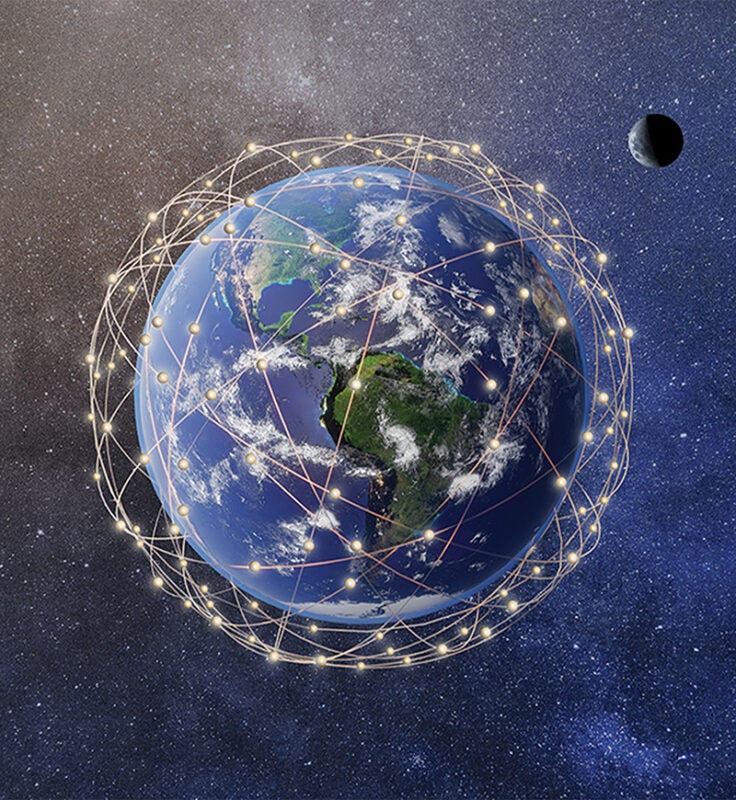
Rendering of Telesat’s Lightspeed LEO constellation. Photo: Telesat
Telesat’s backlog for its Lightspeed Low-Earth Orbit (LEO) constellation is now nearly $1.1 billion Canadian dollars ($800 million) after signing a capacity deal with Viasat in April.
Earlier this year, Telesat reported a Lightspeed backlog of around CA$600 million, indicating the operator has signed roughly CA$500 million in new commitments since late March.
Telesat CEO Dan Goldberg told investors during the first quarter 2025 call on May 6 that he’s optimistic Telesat will secure additional commitments over the course of the year, which would bring Lightspeed’s backlog to more than the backlog for services from Geostationary Orbit (GEO).
Viasat plans to use Lightspeed capacity for aviation, maritime, enterprise, and defense markets. Viasat recently announced development is underway on a new proprietary electronically steered antenna (ESA) terminal for the aero market called Viasat Aera to enable dual-beam connections across multiple orbits with a single antenna.
Goldberg said he expects there will be other significant commercial deals, and government opportunities for Lightspeed, but the timing of government commitments is uncertain.
“The Viasat contract is a very meaningful contract,” Goldberg said. “I think there will be other commercial players that will sign significant deals. Maybe they won’t quite be at the Viasat level, but they could be still in that nine-figure [range], when I think about conversations we’re having and what the pipeline looks like.”
Goldberg sees meaningful opportunity for Lightspeed to support governments that plan to increase NATO spending.
“Lightspeed has been specifically architected to meet a lot of the rigorous requirements that governments have in terms of constellation capabilities, cyber standards, and other standards that government users have in terms of resiliency,” Goldberg said. “We have had multiple conversations with various governments around the world as governments think about leveraging LEO to meet their growing space requirements.”
Telesat has a critical design review for Lightspeed with manufacturer MDA Space in six months and Goldberg maintained the company is expecting the first launch for Lightspeed to happen toward the end of 2026.
Q1 2025 Results
Telesat saw a 23% revenue decline in the first quarter of 2025 compared to the same time last year. Telesat reported revenue of CA$117 million ($85 million).
The revenue decline is due to a lower renewal rate with a North American broadcast customer, a reduction in service to an Indonesian rural broadband program, and lower equipment sales to Canadian government customers.
Telesat forecasted that 2025 will bring a steep revenue decline, projecting 27% decline in 2025 at the midpoint. The operator reiterated this guidance on Tuesday.
At the same time, Telesat is spending more on operating expenses as it grows headcount for Telesat Lightspeed and reports higher legal and professional fees. Operating expenses for the quarter were CA$53 million ($38 million), an increase of 13% from 2024.
Adjusted EBITDA for the quarter was CA$67 million ($49 million), a decrease of 39% from the same time last year.
Stay connected and get ahead with the leading source of industry intel!
Subscribe Now