Latest News
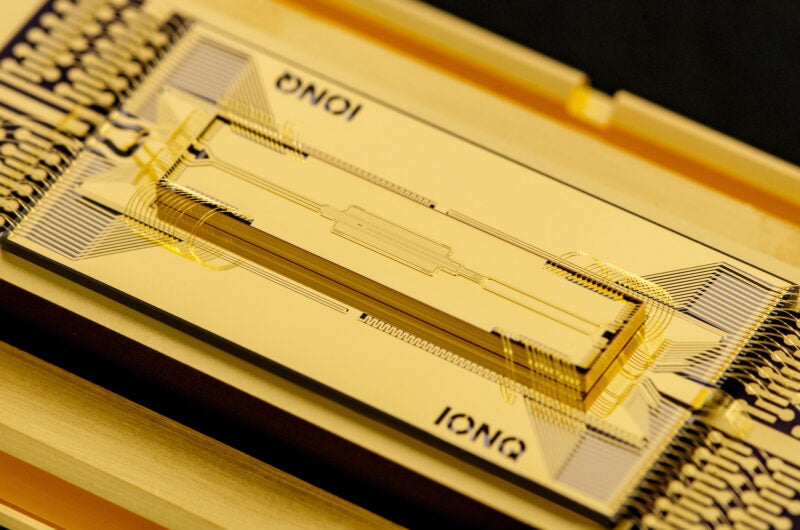
An IonQ ion trap, a critical part of a quantum computer. Photo: IonQ
With IonQ’s acquisition of Capella Space, the quantum computing company is looking to expand the security of quantum networking to satellite networks.
IonQ, based in College Park, Maryland, operates in both quantum computing and quantum networking, which ensures the security of communications. In July, the company closed its acquisition of Earth Observation satellite company Capella Space, which operates commercial synthetic aperture radar (SAR) satellites.
Via Satellite recently spoke to both IonQ CEO Niccolo de Masi and Capella Space CEO Frank Backes about what the acquisition means for both IonQ and Capella.
“When we stood back and looked at where the world is going, we realized that the most vulnerable pieces of modern communication networks are ground-to-space, space-to-space and space-to-ground,” de Masi said. “We wanted to be the first player in the world to get quantum key distribution (QKD) working, both for our government, friendly governments, and for commercial players who value security, like banks.”
Acquiring Capella Space is part of a roadmap to expand IonQ’s quantum security offerings from the ground to cover the space part of networks.
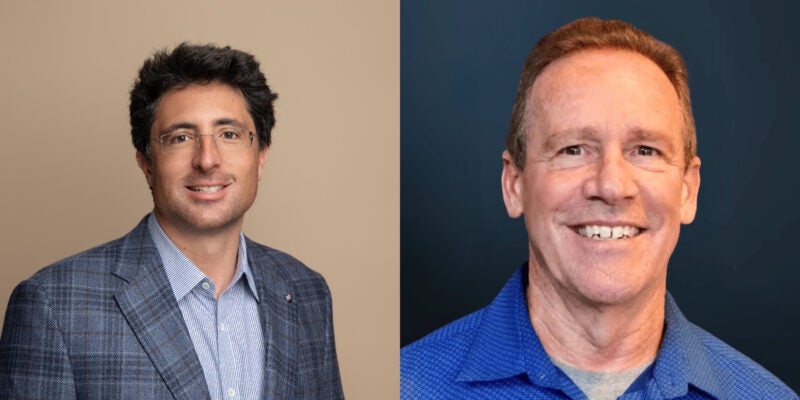
IonQ CEO Niccolo de Masi, left, and Capella Space CEO Frank Backes, right.
Capella CEO Frank Backes has long had an emphasis on cybersecurity for space systems, and was the founder and former president of Space ISAC. He sees the potential of the combination and bringing quantum networking to space.
“IonQ’s strategic plan is the first time that I have seen the full capability of compute, networking, and security all coming together in one strategic plan that is now mature enough to start to be deployed operationally,” Backes told Via Satellite.
He believes that commercial space adoption has been held back by being limited to commercial practices to move data, and quantum security will bring greater adoption.
“From a nation standpoint, the U.S. [and] our allied nations, they want an absolute, trusted, secure architecture from the point of tasking a system for intelligence information, to the point of capturing that information on the satellite, transferring that data to a processing capability either on orbit or on the ground, and then delivering the post-processed analytics information back to the customer who needs it,” Backes said.
“They need a complete, end-to-end system that they can accurately trust. There’s a tremendous customer base globally for that kind of capability,” he added.
Capella Space has an existing contract with the Space Development Agency to fly an optical terminal onboard its satellites to space-to-space and space-to-ground optical communications. Capella plans to take IonQ technology that has already been validated on the ground and deploy it as a payload on its spacecraft, Backes said.
“The basic research and the validation of the technology has already occurred,” Backes said. “It’s really about getting that technology ‘space-ready’ to go into an architecture that was already being built to support optical interlinks.”
Capella will maintain its brand and its work in SAR and Earth Observation, and also move into interconnecting space networking with terrestrial networking, Backes said.
“The entire Earth Observation market desperately needs a high-speed, trusted transport layer for our Earth Observation data,” Backes said. “It needs to be more than just a government-controlled infrastructure. The world needs that capability.”
Capella Space is part of a string of recent acquisitions for IonQ to accelerate the deployment of interconnected quantum systems, including QKD company ID Quantique; quantum networking company Lightsynq. IonQ is also in the midst of a deal to acquire quantum computer manufacturer Oxford Ionics and has a development deal with satellite terminal manufacturer Intellian.
In terms of Capella Space, de Masi says that IonQ can move faster by owning in-space assets and pursuing vertical integration, and he highlighted Capella’s work with government agencies as a growth vector for IonQ.
He believes quantum computers’ impact on cybersecurity is going to take the world by surprise, noting that quantum computers are moving forward faster than Moore’s Law, doubling at an exponential rate.
While there’s debate about when “Q-Day” will happen, referring to the hypothetical day in the future that quantum computers will be able to crack encryption that secures the internet, de Masi cautions it’s coming sooner than people expect. “That’s going to take the world by surprise on the security front,” he said.
“People don’t recognize that QKD is mathematically unbreakable,” de Masi said. “It’s safe to say that most of our QKD customers today are the ones that are not in the news for data breaches. We’re at the base layer of the security stack. If that’s not hackable, you’re generally in good shape.”
The Capella acquisition brings a space component to IonQ’s roadmap, even the potential for a future quantum computing data center in space.
“We’re building the world’s most advanced quantum computers, and perfectly secure quantum network communications, but we recognize that the world today expects a seamless, full internet experience,” he said. “They want quantum computers that are networked together, and they want quantum security on every piece of the network, and that’s where Capella comes in.”
Stay connected and get ahead with the leading source of industry intel!
Subscribe Now