Latest News
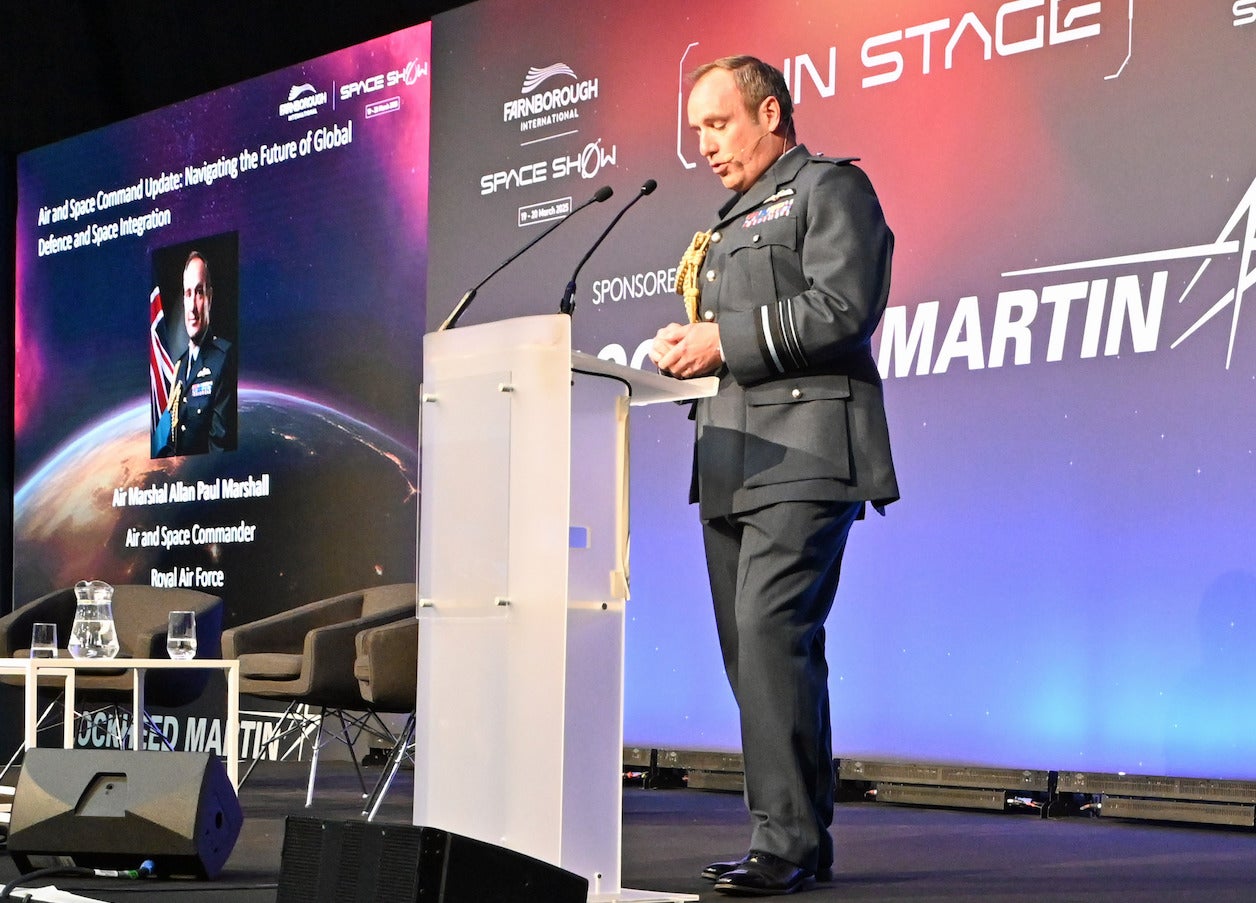
Air Marshal Allan Paul Marshall, Air and Space Commander, Royal Air Force, speaks at the International Space Show in Farnborough in March. Photo: Via Satellite
FARNBOROUGH, UK — A greater reliance on space heightens the importance of space cybersecurity. One of the top officials in the U.K. military outlined the United Kingdom’s plans for space in military operations at the International Space Show in Farnborough last month, and addressed space cybersecurity issues as well.
Air Marshal Allan Paul Marshall, Air and Space Commander, Royal Air Force, told the event in a keynote said that challenges in space have “increasingly come to life” as the U.K. looks to become a credible space power.
“You have things like space based ISR, the need for low latency intelligence/information. Any movement on Earth will be able to picked up from space. We need a cyber-hardened architecture. The space-enabled architecture will be the center of military operations going forward. We need to make sure we speed up procurement processes. Ukraine has taught us this. Space will allow us to integrate us more as nations,” Marshall said.
Marshall emphasized that commercial satellite companies are leading the way, and it was important that organizations like the Royal Air Force can identify new trends both now and in the future.
He added, “We are at inflection point in terms of space. The challenge is very clear. Ukraine has opened our eyes. Technology will develop very quickly. There will be a strong commercial influence in what goes on, on the battlefield. We have seen the impact of switching off space-based communications. The cost of entry, launch in space is exciting because many can get into it. But it is also dangerous.”
What was clear through the keynote is the importance of space from a military perspective. Marshall added, “We are not at a standing start. UK Space Command is in its fourth year. Allied cooperation is going well. We are working with closer with our government partners and with industry. Having created Space Command, we are now normalizing it, and embedding it in the heart of our defense.”
In a sobering assessment of where the world is right now, Marshall said the current geopolitics “are the most dangerous” he has seen in the last 30 years saying there are more ‘authoritarian’ states now.
Marshall was asked about the audience about the current relationship with the United States, given the current geopolitics. He said the U.K. needs sovereign capabilities where essential, and work with allies when necessary.
“Our relationship with U.S. Space Force and U.S. Space Command is very intimate, we have a very close relationship with them,” he said. “I have seen nothing to indicate that things that have changed. They want us to invest more and it is clear that there could be increasing investments in space.”
A reliance in space in defense is increasing and the space sector and economy are now huge. It means a more focused and revamped strategy when it comes to space and defense in the U.K.
“Space is now at the core of what we do and not just an enabler. Our adversaries are able to target faster. It is critical that we rely on space. What do we need to do? We need Space Command to grow. It will protect and secure our interests in space,” Marshall said. “We need an organizing principle and vision. We need to be credible enough to deter others. We need resilience in our architecture. It is all about the control of space. We need to assure our access to space. If we don’t have freedom to operate, we won’t be able to move. The control of space is a pre-cursor of military operations. If you lose control, that could have a significant impact.”
UK Space Agency
The theme of change was a strong one at the Space Show with the issue of security a prominent topic. Chris White-Home, deputy CEO of the UK Space Agency (UKSA) said, “Everything we do now in space contributes to our security, national security and economic security. I think they are the same thing. You are seeing big increases in defense spending. Secure by design has to become more important to us now. We are looking at ways to do that work better to design resilient systems. The flip side of risk is opportunity. There is a real opportunity for the U.K. to play on the global space stage.”
White-Home highlighted launch as a good example of how different parts of the space community in the United Kingdom can work together. “Having assured access to space seems a very sensible thing for a space faring nation in a volatile geopolitical era. Putting satellites into the Polar or Sun Synchronous Orbit from Scotland is super important. We are looking to do a lot of joined up thinking. We need to join things up much better to make good on the government’s investment,” he said.
Sarah Jones, UK’s Minister for Industry, conveyed that the current government is sees defense as a “core pillar” of its industrial strategy.
“We need to be kept safe. We are in a different place than we have been for decades. We know your [space industry] work is crucial in terms of security and boost for the economy. Space technology underpins so much that the U.K. relies on.”
Jones highlighted increased defense spending from NATO, and an understanding that the government must work with private sector to drive economic growth. In January, for example, the U.K. government made a direct investment into launcher Orbex.
“We are positioning the U.K. as a leading partner in Europe for access to space. We are leading trade missions. We are here to support you,” Jones said.
Stay connected and get ahead with the leading source of industry intel!
Subscribe Now