
The FCC granted SpaceX a sweeping approval for 1 million satellites to form an orbital data center constellation. Granting the approval on Nov. 25, the FCC said it enables SpaceX to deploy its Starmind constellation “at unprecedented scale.”
The approval authorizes SpaceX to deploy an optically linked satellite constellation of 1 million satellites at altitudes between 500 km to 1,002 km. The constellation is intended to primarily communicate via optical inter-satellite links, with Ka-band communications within Starlink’s authorization for limited backup and emergency operations
The FCC approved the application and gave SpaceX a number of waivers, despite petitions to deny from Amazon, Viasat, and the American Astronomical Society (AAS), as well as public comments calling for more scrutiny from groups including the Secure World Foundation.
The agency argued that many concerns about the application about the feasibility and long-term impact of orbital data centers are outside of the FCC’s regulatory mandate. “In many cases, the comments seek to substitute the government’s judgment regarding the viability of business endeavors for that of the applicant and private enterprise. We decline to do so,” the FCC said.
While other comments raised questions about orbital congestion that can come from a 1 million-satellite constellation, the FCC argued that it does not place limits on the number of space stations that can be authorized with similar orbital parameters.
Analysts have noted that orbital data centers are in line with SpaceX’s long-term vertical integration plans combining compute, satellite operations, and launch, but remain technically and economically unproven.
The decision marks a rapid approval from the FCC as SpaceX filed for the constellation at the end of January, when SpaceX acquired xAI, bringing Elon Musk’s space and AI businesses into one company.
It is also the first time the FCC has approved an orbital data center constellation, and a number of other applications are pending. The agency said it is reviewing other applications and “intends to issue decisions on each expeditiously.” Starcloud has also filed with the FCC for an 88,000-satellite constellation, and Blue Origin has filed for a 51,600-satellite constellation called Project Sunrise.
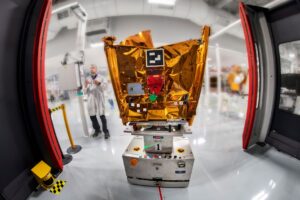
SpaceX describes the Starmind satellites with a compute payload of 175 kW on average, and up to 250 kW. The satellites are designed with deployable liquid radiators to deal with heat, and solar arrays based on the arrays used in the Starlink constellation.
SpaceX plans to begin launching Starmind satellites in 2027, President and COO Gwynne Shotwell told investors in October.
The FCC approval is for a 15-year period that begins once SpaceX has launched a Starmind satellite to orbit, with a deadline to launch one satellite by November 25, 2033. SpaceX has a 10% deployment milestone on November 25, 2035; a 50% deployment milestone on November 25, 2038; and the remaining milestone on November 25, 2040.
The approval came with a number of waivers, including for spectrum for TT&C operations and for processing round rules with SpaceX instructed to operate on an “unprotected and a non-interference basis” in certain bands. The FCC argued it grants similar waivers for “innovative and untested technologies” to operate on a non-interference basis.
The FCC also did not require further review under the National Environmental Policy Act (NEPA), in line with recent deregulation, and said that concerns about the impact to the atmosphere when satellites re-enter the atmosphere and burn up “remain speculative and not supported in the record.”
Organizations like the Secure World Foundation, which advocates for sustainable and peaceful uses of outer space, called for greater regulatory oversight over the orbital data center filings. SWF commented on SpaceX, Blue Origin, and Starcloud plans calling for system-level analysis and disclosure and a phased, demonstration-based authorization approach to deployment.
SWF argued these constellations are a “qualitative shift” in the scale of satellite constellations.
“These are not incremental expansions of existing Non-Geostationary Orbit licensing practice. They raise novel technical, environmental, and governance questions that extend beyond the FCC’s routine licensing practice and expertise, and they warrant closer regulatory scrutiny and system-level evaluation,” the organization stated earlier this year.
FCC Chairman Brendan Carr called the FCC’s decision opening a “bold new frontier.”
“Compute campuses or data centers are essential to sustaining America’s leadership in [super intelligence]. By moving compute capacity beyond Earth, SpaceX and the many competitors working on their own orbital data centers are meeting the moment. This is the kind of American ingenuity that can unite our strengths in space and advanced technology, reinforce our economic leadership, and expand prosperity here at home,” Carr said in a statement.