Latest News

Chris Weber, Amazon Leo VP of Leo Business talks launch ramp-up at SATShow 2026. Photo: Brooke Bryand Creative for Access Intelligence
More than 200 Amazon Leo satellites are loaded onto six dispensers at Cape Canaveral, ready to be launched into orbit in the coming months as Amazon prepares to ramp up launch cadence for its megaconstellation, Chris Weber, the company’s vice president for Leo Business told a lunchtime fireside chat at SATShow on Monday.
“We have over 200 in our processing facility at the Cape, ready and stacked to be picked up and delivered to space,” he said of the broadband satellites that Amazon Leo. In a statement the company said its dedicated production facility in Kirkland, Washington, has the capacity to build as many as 30 satellites per week, and that a seventh dispenser is already in French Guiana awaiting launch.
Amazon had 11 launches since last April, he added, which was the most launches in the first 12 months of any constellation. Amazon Leo currently has 212 satellites into orbit, after a February mission with Arianespace.
“The good news is we expect to double that [launch cadence] in the next 12 months,” Weber said. The company had signed contracts for more than 100 launches, planning for 20-plus this year alone, he added, noting Amazon is using four providers — Arianespace, Space X, United Launch Alliance and Amazon founder Jeff Bezos’ own Blue Origin.
Amazon announced that three launches are planned in the next month — two with ULA on Atlas vehicles, and one with Arianespace.
Using four launch providers, Weber said, comes with added complexity because each one required the satellites stacked in a different dispenser. But launch diversity was essential for resilience and to achieve the company’s “very aggressive schedule” of launches.
“We think there’s value in diversity, and it gives us access to more launches,” he said, “Right now we’re looking at every avenue to accelerate.”
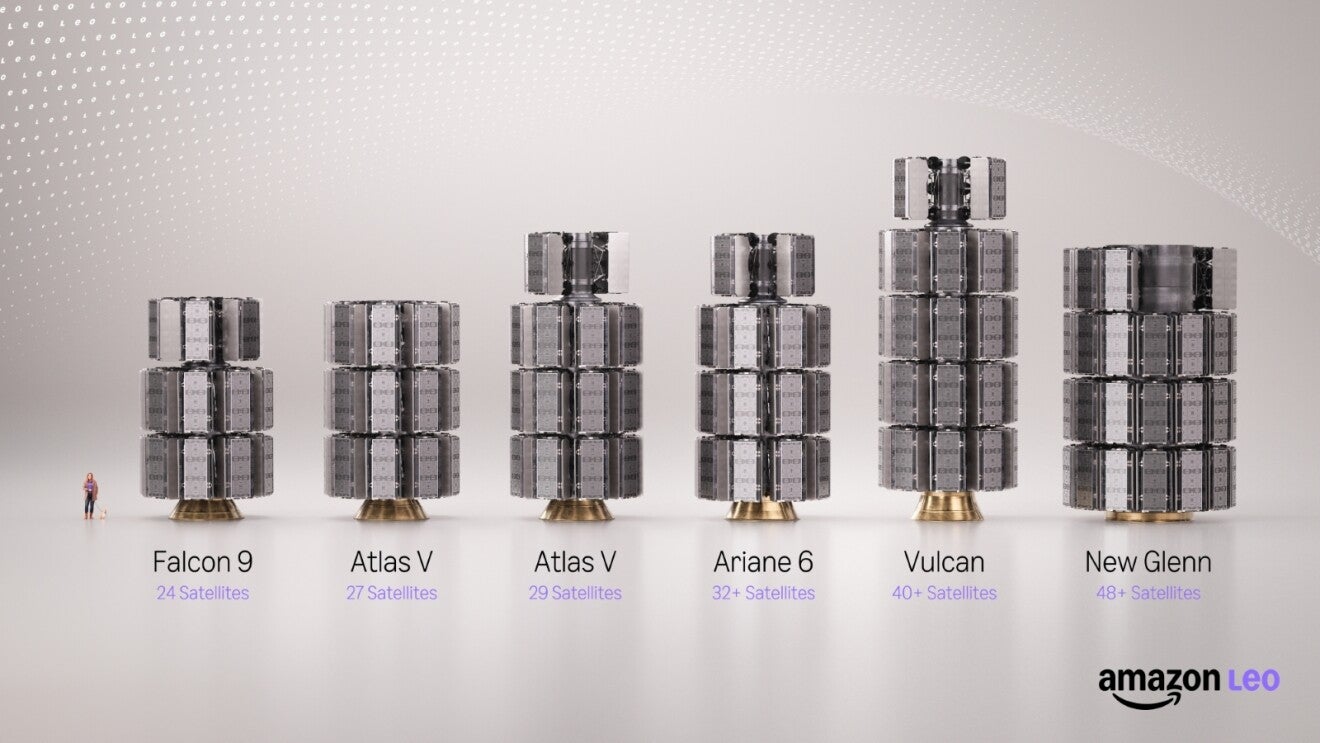
Amazon Leo launch configurations for its various launch providers. Photo: Amazon
The company also faces a looming deadline: Its original Federal Communications Commission (FCC) authorization requires the company to have more than 1,600 satellites in orbit by the end of July this year. In a filing last month, the company asked for an extension, saying it would have 700 or more in orbit by the deadline, citing a shortage in near-term launch availability.
Weber also gave some insight into how Amazon plans to start service for the constellation, rolling out initially in two bands, one in the northern hemisphere and one in the south, Weber said. As more satellites are launched, expanding the coverage zones, the bands will extend toward the equator and the poles. Both bands already have ground infrastructure installed and running. When a geography goes live, it will provide services to all categories of customers: consumers, businesses, and governments.
Weber said that Amazon Leo seeks to differentiate itself from the competition in a number of different ways. Performance-wise, the constellation is designed to offer “industry leading” download speeds of 1 gigabit per second and upload speeds of 400 megabits per second. It will also offer attractive security features, like advanced encryption and the ability to use company services to create a private network.
“What that essentially allows you to do is go from our satellite into your AWS Cloud infrastructure or into your private data center, without ever touching the internet. That security part, we think, is really differentiated,” he said.
Over the last few months, Amazon has been announcing a series of customers for Amazon Leo including airline JetBlue and a tie-in with AT&T. Weber hinted that more customer announcements are coming in the near future.
Stay connected and get ahead with the leading source of industry intel!
Subscribe Now