Latest News
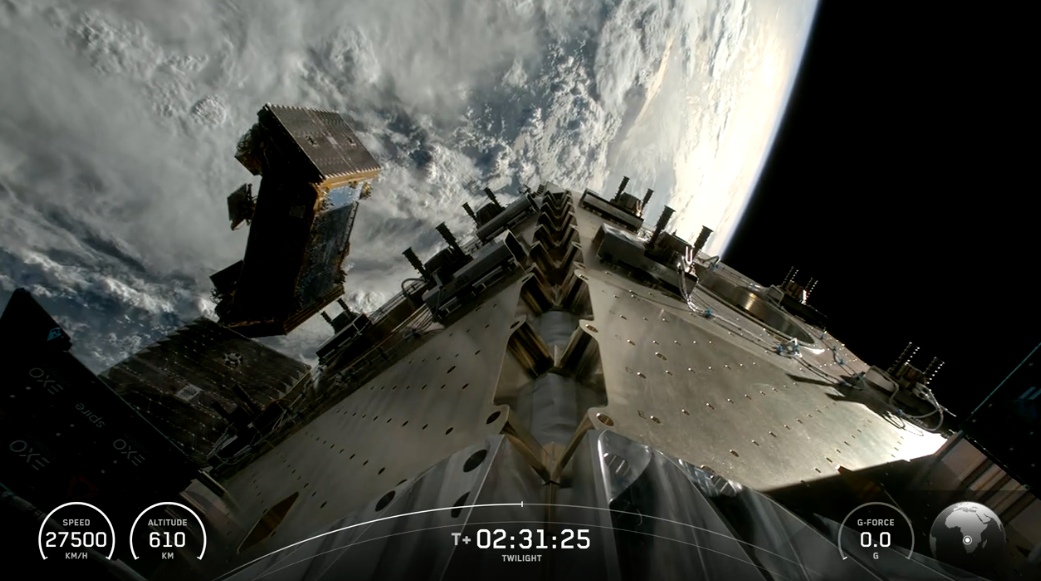
A Kepler Communications satellite is deployed on the Falcon 9 Twilight rideshare mission on Jan. 11, 2026. Screenshot via SpaceX
SpaceX’s “Twilight” rideshare mission on Sunday deployed the first tranche of Kepler Communications’ next-generation optical satellite constellation.
The Twilight mission launched on a Falcon 9 rocket on Jan. 11 from Vandenberg Space Force Base in California, taking off at 5:44 a.m. PT. The mission launched to dusk-dawn Sun-Synchronous Orbit (SSO). There were 40 payloads on the flight.
For Kepler, the mission launched ten 300 kg-class satellites, each equipped with a minimum of four optical terminals. Kepler’s network is designed to provide real-time connectivity, on-orbit compute, and hosted payload services for government and commercial customers.
Kepler describes its network as similar to the terrestrial internet in space by “dynamically routing data between satellites to provide resilient, real-time connectivity between space and Earth.”
The Canadian space startup previously launched pathfinder satellites, which have demonstrated space-to-space, space-to-ground, and space-to-air optical relay in a variety of demonstrations with partners.
“This launch brings a new paradigm to space applications,” said Mina Mitry, Kepler CEO and co-founder. “Our optical relay satellites make it possible for users to rapidly deploy their missions with a real-time, connected, cloud environment, fundamentally changing how data flows on orbit and what space systems can achieve for people and planet.”
Kepler confirmed post-launch the mission was successful and the satellites will now enter the commissioning phase.
The mission also launched satellites for a number of other customers including two Acadia satellites for Capella Space, two satellites for Tomorrow.io, one satellite for Umbra, and one satellite for Surrey Satellite Technology Ltd. (SSTL).
Exolaunch deployed 22 satellites on the mission. The company manifested two satellites for Iceye, Cluster 13 of three satellites for HawkEye 360, and the Flamingo-1 satellite for Vyoma. Its other customers included Spire Global, Turkish company Plan-S, Dcubed, and Aistech Space.
The mission also launched NASA’s Pandora mission, a small satellite designed to study the atmospheres of exoplanets. NASA also funded BlackCAT and SPARCS, two spacecraft onboard the mission.
This story was updated on Jan. 11 after the launch
Stay connected and get ahead with the leading source of industry intel!
Subscribe Now