Latest News
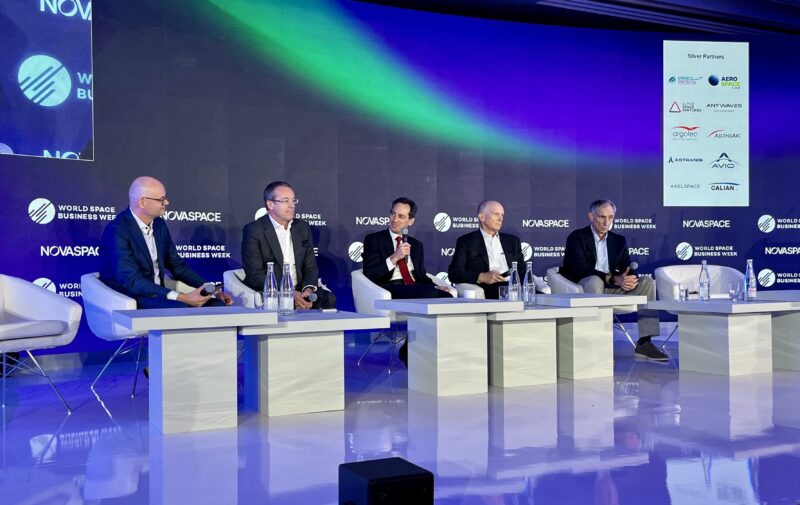
From left: Moderator Nathan de Ruiter, Jean-François Fallacher, Dan Goldberg, Paul Gaske, and Mark Dankberg. Photo: Via Satellite
PARIS — Global satellite operators continue to see growing demand for satcom from global governments, top CEOs told the opening day of World Space Business Week attendees on Monday.
Telesat CEO Dan Goldberg said he underestimated how large government demand would be for Lightspeed, Telesat’s Low-Earth Orbit (LEO) constellation in development. “We always expected it would be large when we pulled the trigger and started building Lightspeed, but I think we underestimated how big it would be,” he said, adding that government demand is “huge.”
“In current conflicts, Starlink in particular has proven to be absolutely consequential and decisive, which has underscored for governments all around the world the importance of having that type of a capability,” Goldberg said. “U.S. allies have committed to spend a lot more money to meet their NATO commitments and that’s true for the government of Canada, I think it’s true for most governments. There’s a big desire that those capabilities be sovereign.
Closer to home, Goldberg sees a large opportunity with the Canadian government, and said other nations could also be in the mix for services based on Telesat’s Lightspeed constellation. “There are lots of other countries that need this capability. Ideally, they would like to build it themselves. But for the foreseeable future, there will be governments around the world leveraging commercial LEO constellations,” he said.
There could also be an opportunity for Telesat and the Canadian government to work with the European Union when Lightspeed enters service ahead of IRIS² while it waits for IRIS2 to come online. “I believe the government in Canada is very open to that. We’d be hugely receptive to working with our European partners to make that capability available in a sovereign, secure way,” he said.
Jean-François Fallacher, CEO, Eutelsat added that the geopolitical situation is showing that warfare is changing. “There is more and more interest in our assets whether those are GEO or LEO. We are working with a lot of our partners, especially our OEMs and the supply chain to harden communications for more government usage,” he said.
Mark Dankberg, CEO, Viasat added that looking at what is going in Ukraine, it shows the increasing importance of space capabilities, and showcasing the high amounts of bandwidth needed to run applications. Ukraine is showing many different facets to satellite usage.
Dankberg added, “There are counter measures to LEO and GEO systems. The rate at which the countermeasures are evolving is fast. From a technology race perspective, there’s opportunity to come up with more robust systems. The thing that is becoming an issue from a national security perspective now is that there are few boundaries between civil, military, and commercial targets anymore.”
Interestingly, when talking about the pros and cons of GEO and LEO, Dankberg said one of the interesting learnings to come out of Ukraine is that there is very “localized activity” meaning it a challenge for the industry to deliver in very localized parts of Ukraine where actual capacity is needed.
One of the interesting comments on the panel was whether there would be new business cases for GEO satellites around video. Goldberg said on this, “While there are GEO satellites in orbit, there will be leveraged with LEO. They can be a nice complement to those LEO networks. I think it will be hard to close business cases for GEO satellites. I think the use for multi-orbit will ultimately be a narrow use case, so potentially a government user with niche needs.”
Viasat and Hughes, which both have a direct-to-consumer have also seen declines in consumer broadband subscriptions in recent years with competition from Starlink, but Dankberg thinks Viasat will still grow its consumer broadband subscribers.
“Consumer broadband is the highest volume, lowest yield. If you have a portfolio of services, this one will be on the lowest rung. It is in the portfolio. I think we can grow the number of customers in consumer broadband, despite of this.”
Hughes COO Paul Gaske said that consumer broadband is facing headwinds not just from LEO, but from broadband subsidy programs and pressure as wireless operators provide fixed wireless from their towers. Hughes is responding by migrating capacity over to higher growth areas.
“We have a lot of demand for our aviation customers and some of our other business customers, and we fully expect to be moving that capacity actively over spaces that show more capability to grow,” Gaske said. “Additionally, we’ve invested heavily in Fusion technologies bringing together multiple satellite capabilities like LEO, GEO, and even terrestrial. Fusion technology we think is the future for us.”
However, it is clear the impact of Starlink and Amazon’s Project Kuiper is being keenly felt in the market. Fallocher talked about how the connectivity business is being heavily disrupted. He spoke of the “elephants in the room” — Starlink and Project Kuiper and how Eutelsat will continue to concentrate on the B2B part of the market, rather than the B2C side. “Our two American competitors are completely disrupting the market. Starlink and Kuiper, we are the only European alternative to them.”
However, as Starlink has shown, the growth for satellite services in connectivity is potentially massive.
“The TAM [total addressable market] on the global broadband connectivity side is vastly bigger than the addressable market for satellite-delivered multi-channel video services,” Goldberg said. “I hate to see the direct-to- home video market inexorably declining over time, but there is a massive market for enterprise broadband connectivity that meaningfully eclipses the market that I think is going away for good.”
Stay connected and get ahead with the leading source of industry intel!
Subscribe Now