Latest News
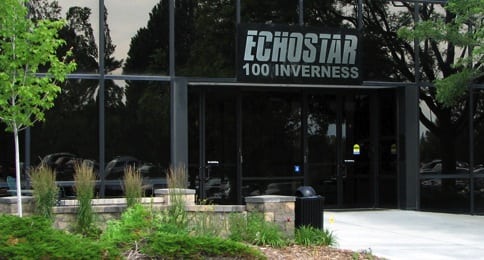
EchoStar headquarters in Engelwood, Colorado. Photo: EchoStar
EchoStar is moving forward with plans for a standards-based direct-to-device (D2D) constellation, placing an initial $1.3 billion order with Canadian manufacturer MDA Space for 100 Aurora satellites.
The contract announced Aug. 1 is for 100 satellites, but EchoStar plans to expand it to 200 satellites to even thousands of satellites in Low-Earth Orbit (LEO). The constellation will provide talk, text, and broadband services, using non-terrestrial network (NTN) 3GPP standards.
The constellation will operate in EchoStar’s AWS-4/S-band spectrum in the 2 GHz band — spectrum holdings the FCC launched an inquiry into in May, along with an inquiry into EchoStar’s 5G network buildout.
EchoStar CEO Hamid Akhavan addressed the FCC’s inquiry in an investor call on Friday, saying it has “led to considerable amount of uncertainty over our spectrum rights.” Akhavan was limited in what he could say about the FCC inquiry, but said that EchoStar “stands behind” and has delivered on its commitments to the FCC.
“We have had numerous collaborative conversations with the FCC, the administration, and various parties to try and reach a constructive solution that is beneficial to EchoStar and consumers, while also addressing the FCC wishes and fosters U.S. leadership in telecom. It is our highest priority and a huge focus of the leadership team,” he said.
Akhavan said that EchoStar Chairman Charlie Ergen met with FCC Chairman Brendan Carr on June 11 and following that, President Trump has “encouraged the parties involved to reach a positive resolution.” Ergen reportedly met with Trump directly after the Carr meeting.
Bloomberg also reported this week that the FCC has pushed for EchoStar to sell some of its spectrum. Akhavan would not comment on the report and said the report didn’t come from EchoStar.
“We have not eliminated any options from the table. The FCC has not necessarily given us a very detailed mandate of a certain thing or another. We’re still in collaboration with the FCC and other entities to see what might be a good solution that everyone is happy with,” Akhavan said.
EchoStar opted to delay several interest payments over the summer citing the FCC inquiry, but Akhavan said Friday that EchoStar is making the payments.
While EchoStar is investing in the LEO satellite constellation amid the FCC inquiry, the company said it is pausing its 5G network buildout, instead focusing on optimizing its current network and adding customers. Akhavan said while the terrestrial network is in place and buildout can be slowed down to allow time for more clarity, this is a “critical time” for D2D.
“[When it] comes to space. I don’t have that luxury to wait. The opportunity is here and now, and if I wait a few more months, my business model gets impacted negatively,” he said. “We have decided to continue on the path we have been on direct-to-satellite because we cannot wait. That is critical time.”
EchoStar has made no secret about its plans to launch a LEO constellation for D2D services and has talked about it for years, without announcing specifics until the MDA contract on Friday. Akhavan told investors in May that getting the timing right on a constellation would be critical to match up availability with 3GPP-compliant devices that can communicate with satellite.
EchoStar’s D2D Constellation Plans
Under the contract with MDA Space, the satellites are set for delivery in 2028, with commercial service starting in 2029.
MDA Space said the initial order for 100 satellites is worth $1.3 billion, and the full contract for more than 200 satellites would increase to $2.5 billion.
EchoStar estimates the new LEO project in total will cost $5 billion, including satellites, launch, gateways, etc. It will be self-funded by EchoStar, Akhavan said.
He emphasized to investors that EchoStar’s differentiator from other D2D offerings is a wideband service, the same capability as 5G mobile phones, from space. “You’re going to get the same connectivity and you will not be able to tell the difference whether you’re connected to the satellite in the sky, or you’re connected to the cell in your neighborhood,” Akhvan said.
The business model is primarily wholesale, and EchoStar plans for partner relationships with mobile carriers around the world on a non-discriminatory basis, Akhavan explained.
He said the plan for this network goes back to the Dish/EchoStar merger justification, bringing together Dish’s spectrum and EchoStar’s technology.
“We have worked very hard to standardize and develop our spectrum piece, marrying it to our AWS-4 and S-band so that you can have the exact same 5G architecture that we have in our network on the ground — in the sky,” Akhavan said. “It seems very simple in concept, obviously takes an incredible amount of work that has been done for over a decade to materialize. Nobody else is doing that.”
This is MDA Space’s fourth LEO constellation order in just over three years, as MDA Space is building Telesat Lightspeed, and two constellations for Globalstar. EchoStar joins Telesat and Globalstar’s “C3” constellation as anchor customers for the Aurora software-defined satellite platform.
MDA Space CEO Mike Greenley commented that it speaks to MDA’s differentiated Aurora product line and its expanding production capacity.
“This contract also demonstrates our continued market momentum as we strategically position MDA Space to be the prime contractor of choice for satellite operators offering direct-to-device and broadband connectivity,” Greenley said.
Stay connected and get ahead with the leading source of industry intel!
Subscribe Now