Latest News
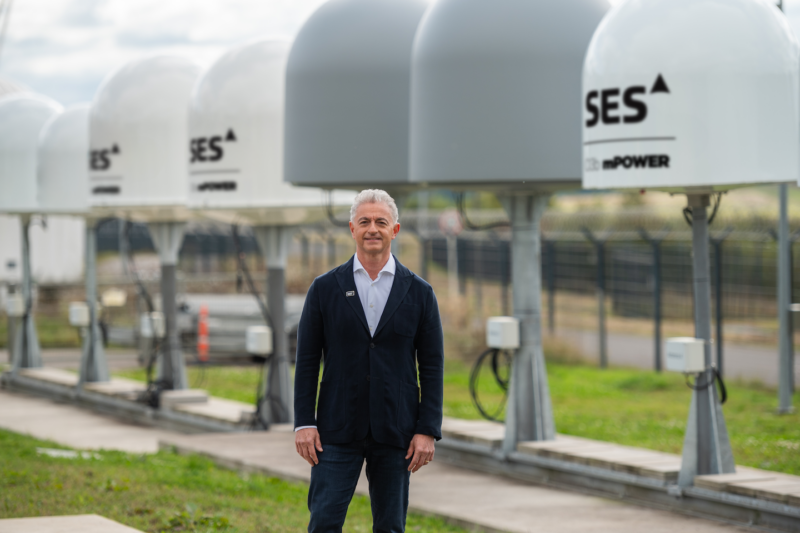
SES CEO Adel Al-Saleh. Photo: SES
Following the close of the Intelsat acquisition, Via Satellite interviewed SES CEO Adel Al-Saleh about the path forward as one company. In Part Two of the conversation, Al-Saleh talks about key growth markets for the combined company, including bringing Medium-Earth Orbit (MEO) capabilities to the aviation market — and his view on further industry consolidation.
This is Part Two of the interview — Read Part One here
VIA SATELLITE: After defense, what would you say is the next main target market for the company?
Al-Saleh: Aero is huge for us. The combined company has an incredible network that is very relevant to what the airlines are looking to do, both in Geostationary Orbit (GEO) and Medium-Earth Orbit (MEO). While SES has always been active in the aero business, we have always provided indirect services. This means our satellite capacity is being used by the leading satellite providers to offer continuous services to the airlines. In contrast, Intelsat adopted a different strategy following the Gogo acquisition where they directly engaged with airlines and built capabilities to service, sell and support the airlines business directly.
Our strategy moving forward will be to adopt a more direct approach. We will continue offering capacity to our partners who will require it. But the primary objective and priority is to deploy our capacity to support direct business. There is plenty of opportunity for the partners to participate, and we have plenty of capacity to offer with our multi-orbit capability. Our strong GEO offering is highly relevant to the aerospace business. For instance, the success of SES Open Orbits, where we have started creating roaming alliances through GEO fleets, is a testament to this. Additionally, Intelsat’s continued success with renewals and acquisitions in the aerospace business further underscores our capabilities.
All of this will continue and be complemented with Low-Earth Orbit (LEO) through Intelsat’s partnership with OneWeb, their new electronically steered antennas (ESAs) that support multi-orbit services, and the introduction of MEO to airlines. Right now, we have not introduced MEO at scale. We have had a few airlines that have tested it and loved it, but we want to expand it. We had been limited with the capacity, but the capacity is coming on board for MEO, so aero is going to be our key segment for growth.
VIA SATELLITE: Is the fact you are going to have a more direct approach towards airlines an admittance that SES’s previous approach to the aviation market was wrong?
Al-Saleh: No. Previously at SES, we had not built that capability to go direct to the airlines. There was a limitation of what we could do and how fast we could grow. We started to address that limitation with SES Open Orbits and build up our own capabilities. However, that has been accelerated with the Intelsat acquisition. We now have the legacy Intelsat team who knows how to do it well and is already servicing 3,000 planes, and we can continue to go direct in our aero business.
VIA SATELLITE: What about the maritime business?
Al-Saleh: We have been very successful in the cruise business. We exist on almost every major ship, and we co-exist with Starlink, and very soon probably with Kuiper. Despite that, we continue to prove to our customers there is a need for that dual source. There is a need for network resiliency where MEO networks come into play. The cruise operators were the next market after government where we went direct to provide them with a MEO capability. So, that is a very important segment for us, combined with the commercial shipping capability that Intelsat has, and the platforms that Intelsat built to support that business. Providing MEO capability will be a game-changer, significantly impacting the maritime business just as it did for the cruise industry.
VIA SATELLITE: Besides maritime, aero and government, is there one less heralded market that you would highlight for SES?
Al-Saleh: Yes. If you speak to our new leader in the fixed and maritime business, Jean-Philippe Gilet, he will tell you we are super passionate about the energy sector. We have seen incredible traction and understand the need for connectivity in very difficult to reach places. Not just on the ships, the mines, etc. If you think about companies drilling in the middle of the oceans, deserts, they need that broadband connectivity. We are very excited about this market and have recently achieved significant success.
Telecommunications companies and mobile operators that need to fulfill their coverage obligations remain very important customers for us. Companies such as Orange, Deutsche Telekom, Vodafone, and Chunghwa Telecom rely on mobile backhaul connectivity that we provide through our MEO and GEO capabilities. These two segments – although not often talked about – generate double-digit or even triple-digit millions in revenue, and we continue to invest in that.
VIA SATELLITE: After this deal, do you see other consolidation taking place now among the operators or is this the final piece for now?
Al-Saleh: I believe you will see some more consolidations, particularly involving regional players who are finding it increasingly difficult to compete. While they will always be successful in their home markets, serving customers globally is only possible through scale. This mean having an extensive network and the ability to continuously invest into their networks. A network’s value is determined by its continuous development; you can’t afford to let others overtake you. Companies that cannot consistently invest in their networks will struggle, leading to consolidation through major partnerships or mergers and acquisitions.
I also believe the whole service industry around satellite will continue to face pressure. Some of the managed service providers that use our capacity to offer solutions to customers will have to look at ways of consolidating as well. The trend of consolidation is far from over.
I do think this is the last major consolidation. There aren’t any global players left, but there are small-to-mid-sized players that could come together.
VIA SATELLITE: What does SES need to do to substantially grow profits and revenues over the short to mid-term as a result of this deal?
Al-Saleh: Integrating the company is our number one priority. That includes taking the portfolio that we have and really making it come together. When we do that, it will become super compelling to our customers. To be able to access our 90 GEO satellites, our 30 MEO satellites, our ground infrastructure. We have more than 150 teleports, and 50 points of presence (POPs) around the world. When we bring all that together for customers and their ease of consumption, this will make a big difference. When I talk about integration, it is about bringing those solutions in a much more cohesive way, so our customers see the value of our portfolio and is very compelling to them. That is what you will see. I gave you an earlier example in aero. Intelsat was very strong in aero, but didn’t have access to MEO assets. Now, they have a whole new network that they can include in their proposals to their clients and position it very well against LEO constellations, for example.
VIA SATELLITE: Finally, now that the deal is complete — does the hard work start now with a new chapter for the company?
Al-Saleh: Yes absolutely. This deal was primed. Despite unsuccessful attempts in the past, both companies knew each other well and a lot of work had already been done. I walked into a situation where I had to decide what is the right move. We were able to do this quickly, in just over 14 months. While it may seem easy to some, it was incredibly challenging to achieve the outcome we did, with no divestments or restrictions on how we operate. However, the real hard work begins now with the creation of a new company, a new culture, and a new innovator. It was hard work, but this is just the beginning for us, and we are excited about it.
Stay connected and get ahead with the leading source of industry intel!
Subscribe Now