Startup company NanoSatisfi plans to launch its first cube satellite on August 4, allowing anyone to rent time and conduct their own experiments on it for as low as $250 per week.
ATK will exhibit its titanium propellant tank capabilities at the 49th American Institute of Aeronautics and Astronautics (AIAA) Joint Propulsion Conference in San Jose, Calif.
According to a new study conducted by Australia’s Commonwealth Scientific and Industrial Research Organisation and Australian National University, carbon dioxide has boosted green foliage in the world’s driest regions through a process called “CO2 fertilization.”
The Global Positioning System (GPS), which millions of people use every day for precise navigation and timing, recently became more accurate and reliable as the fourth Boeing GPS IIF satellite began operating in the U.S. Air Force network.
Placing Oklahoma on the map as a potential satellite launch venue is not an easy task, according to Oklahoma’s Secretary of Science and Technology, Stephen McKeever.
The U.S. Federal Aviation Administration (FAA) and NAV CANADA have partnered on a range of technical and operational issues in support of the development and deployment of space-based Automatic Dependent Surveillance – Broadcast (ADS-B), according to a written statement from NAV CANADA.
SAVIS Tegnologia has selected Advantech Wireless to provide a geographically redundant military satellite communication network system for SISFRON, the largest border security program in Latin America.
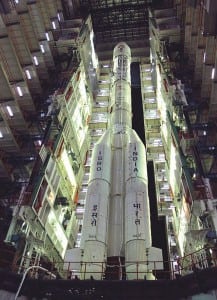
The Indian Space Research Organization (ISRO) successfully put its first navigation satellite – the Indian Regional Navigation Satellite System 1A (IRNSS 1A) – in the geosynchronous orbit at 27 degrees to the equator
.jpg)