
Viasat celebrates its 40-year anniversary in 2026, alongside Via Satellite. The enormous changes in the last four decades begat enormous opportunity, and fortunately Viasat has been able to convert opportunities into growth.
Our first business in the 1980s was defense satellite applications. We developed interoperable satellite networks for U.S. and international air, maritime, undersea, and land mobile forces. We helped develop networking standards for ultra high frequency (UHF) satellite, user modems, and network management systems. We pioneered early tactical dynamic Demand Assigned Multiple Access (DAMA) networks, reaching peak burst speeds in the tens of kilobits per second! An enabling innovation was our development of packet networked high assurance cryptographic devices. That work laid the foundation for modern high assurance internet protocol (IP) networked cryptography used for virtually all transmission media – scaling to data center fiber speeds.

Explore the September 2026 Issue
Check out more from this issue and find your next story to read.
We followed UHF with mesh DAMA for X-band tactical satellite – at megabits per second (Mbps) speeds. That helped establish a foundation for modern satellite tactical networks – those in the Protected Tactical Satellite (PTS-x) family – ultimately leading to our recent PTS-G proliferated GEO award. Mesh DAMA technology enabled crossover to commercial mesh VSAT networks at C- and Ku-bands. In the mid-90s those networks were SS7 telephony switched – but some adventurous souls leaned into the internet, so we focused on IP connectivity. That turned out to be a good growth path!
Our team was very strong technically, but global scale, distribution, and support were essential ingredients, so we made a big decision to acquire the satellite division of Scientific Atlanta – which was then focused on cable broadband. We acquired their antenna systems business along with VSAT. That turned out to be a big help, enabling us to vertically integrate into the satellite network gateway segment – which required sizable 9+ meter antennas and corresponding RF gear back then. That antenna business has flourished and grown well over 2,000 percent!
By the late 90s, broadband was a magic word and we were ready. In 2001 we won a satellite broadband trifecta – building networking equipment for gateways and airplanes for the first commercial broadband in-flight connectivity (IFC) networks for Boeing, one of the first Ka-band enterprise networks for Astrolink (look it up!), and the complete consumer Ka-band user and gateway terminals for WildBlue. But, that autumn a perfect storm of 9/11, the Joint Strike Fighter (F-35) award (then the largest defense program ever), and DirectTV’s ill-fated deal to sell itself to EchoStar combined to kill or substantially delay all three projects within a few weeks of each other. Talk about stress!
Working through the virtually simultaneous cancellation or suspension of our three largest programs, representing much of the company’s backlog, was a grueling test of resilience. Fortunately, our portfolio diversity of commercial and defense business enabled us to not only survive, but to thrive. We completed production testing of new Tactical Data Networks radio products and competed very successfully to equip U.S. and allied tactical fighters with state-of-the-art Situational Awareness (featuring resilient terrestrial radio links, secured by packet cryptographic equipment inspired by our earlier DAMA networks).
Nevertheless, we were convinced, despite the bursting of the “internet bubble,” that satellite unicast (vs. broadcast) was coming – and we invested in further vertical integration. Eventually WildBlue came to market and we were ready with the first vertically integrated Ka-band user terminals and gateway networks. End user speeds reached 1.5 Mbps, and we learned a lot about consumers, distribution, and scale.
We learned the real breakthroughs needed for satellite broadband to scale were in space – not on the ground. At the time total satellite throughput capacity was in the range of single-digit gigabits per second (Gbps). We thought we could do 100 Gbps through a single satellite. It was a bet-the-company moment – again – that we could be a satellite operator and service provider. And, again, our timing couldn’t have been much worse. We began a half billion-dollar capital project in 2008 – just as the worst financial crisis since the Great Depression made raising capital virtually impossible. Another trial by fire.
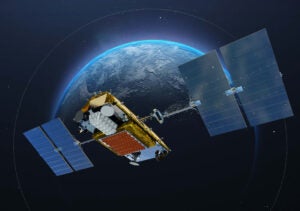
The strength of our business portfolio enabled us to weather that storm, too, and we acquired WildBlue (our former customer). ViaSat-1 worked just like we drew it up (it’s still in use today – and one of the most cost-effective Geosynchronous broadband satellites). We learned a lot about broadband market segments, the technology needed for orders of magnitude reductions in bandwidth cost, and the critical significance of geographic distribution and density of bandwidth demand. Oh, and ViaSat-1 had the bandwidth and coverage to help transform the commercial IFC business from paid to free – with the introduction of free IFC, that even supported video streaming, with JetBlue back in 2013.
The basic insight behind betting on ViaSat-1 was that, just like terrestrial networks, there was much elasticity of demand with lower satellite unit bandwidth pricing for consumers and enterprises. But to capture that value one had to have enough bandwidth to serve steadily compounding per capita consumption demand – a very challenging double whammy. In the language of Clayton Christensen, the Harvard business professor behind the “Innovator’s Dilemma,” that has been the dimension of value behind success in broadband of all forms. We believe this is still underpinning the growth in satellite communications writ large across all bands and all orbits (so far anyway). There are indications though, that, just like the book says, that even that dimension of value will be superseded by another.
Interestingly, in the mid-2010s Viasat was targeted by a short-selling hedge fund touting the “theme” that satellite broadband was an obsolete technology and that mobile LTE would end the digital divide. That thesis hasn’t aged well. But our stock did take a hit for over a year, requiring more patience and determination – until ViaSat-2 went into service.
Meanwhile, we have continued to focus on the premise that there is very high demand elasticity with more competitive bandwidth delivery – within the constraints of having the right amount of bandwidth at the right place, at the right time, and with sufficient reliability and resilience. We continue to push boundaries and take risks – all intended (as Christensen artfully points out) to get us on technology learning curves that will not only enable competitive success today, but also in the foreseeable future as dimensions of value evolve and change, and those learning curves work their exponentially compounding magic. We’ve encountered more tests of our staying power, and made more big investments on beam forming, spectrum, and new (to the satellite industry) business models.
We are all, right now, in the midst of the greatest changes ever in the satellite industry. Certainly, the huge influx of capital in what is a very capital-intensive industry is a dominant issue. Of course, access to capital and returns on capital are ultimately tightly coupled – which, at least, raises questions about an AI bubble vs. internet bubble. Another important factor is the ever-increasing role of space in national security and sovereignty. All that is compounded by the rapid evolution of warfare, the potential militarization of space, and the role of regulations on national and global scales. Change and opportunity on a grand scale. Buckle up! VS
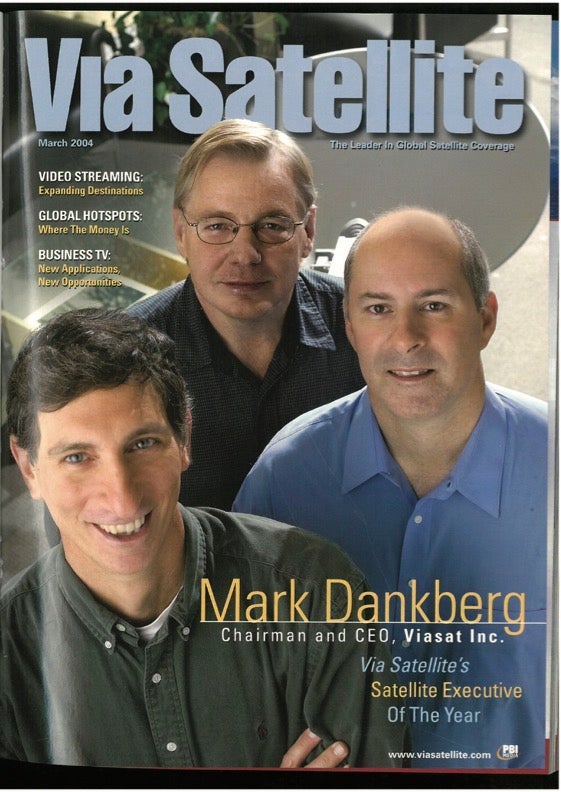
Mark Dankberg is the CEO of Viasat