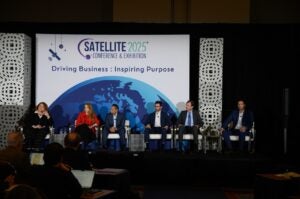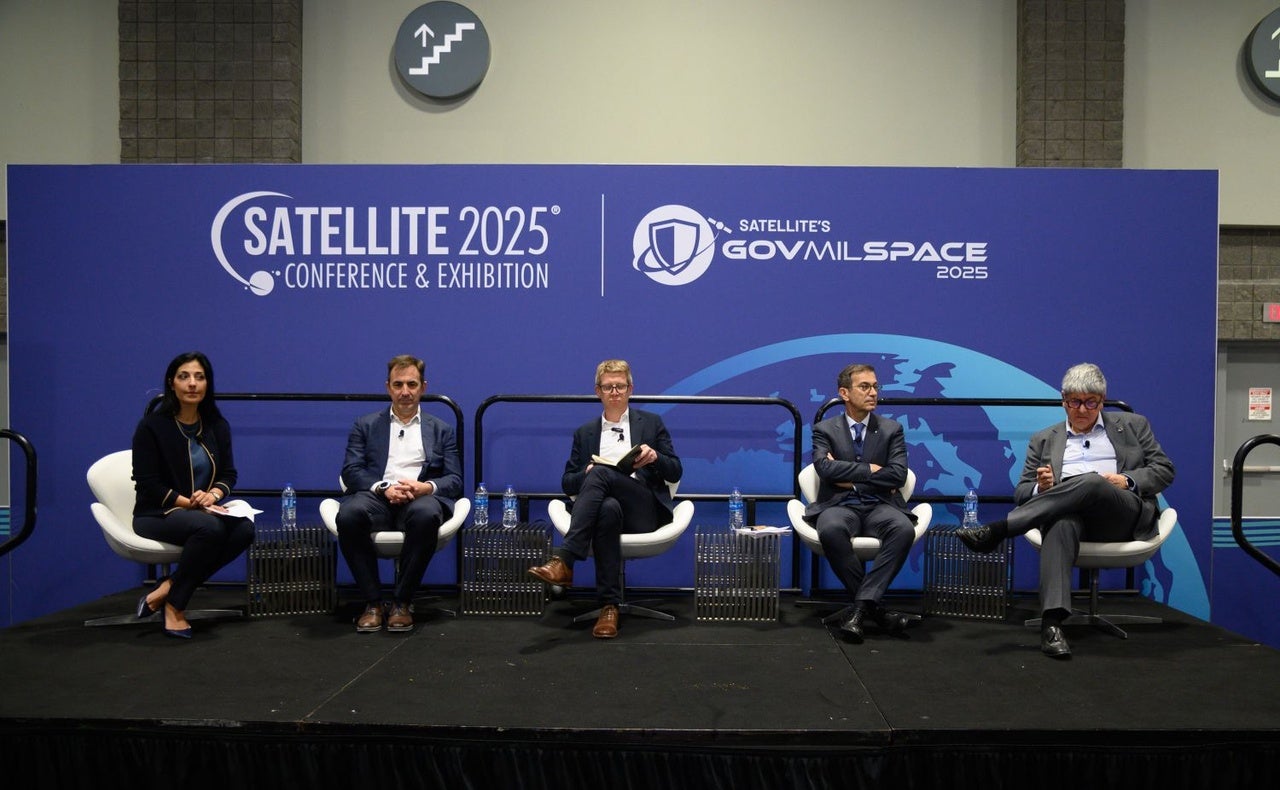

Satellite CTOs debated manufacturing shifts, telecoms integration, quantum key distribution, and the unfulfilled promise of multi-orbit at SATELLITE 2025’s CTO panel.
SES Chief Product and Innovation Officer Xavier Bertrán called for a fundamental shift away from boutique satellite solutions: “We’re currently being very heavily disrupted. What’s needed is a fundamental shift in the legacy business model.” He noted manufacturing is already changing — away from complex harnesses toward integrated circuits, stacking, and higher-volume production: “You’re seeing a shift in manufacturing … you’re seeing a move away from harnesses, to more integrated circuits, more component stacking, more higher volume, higher scalability solutions.”

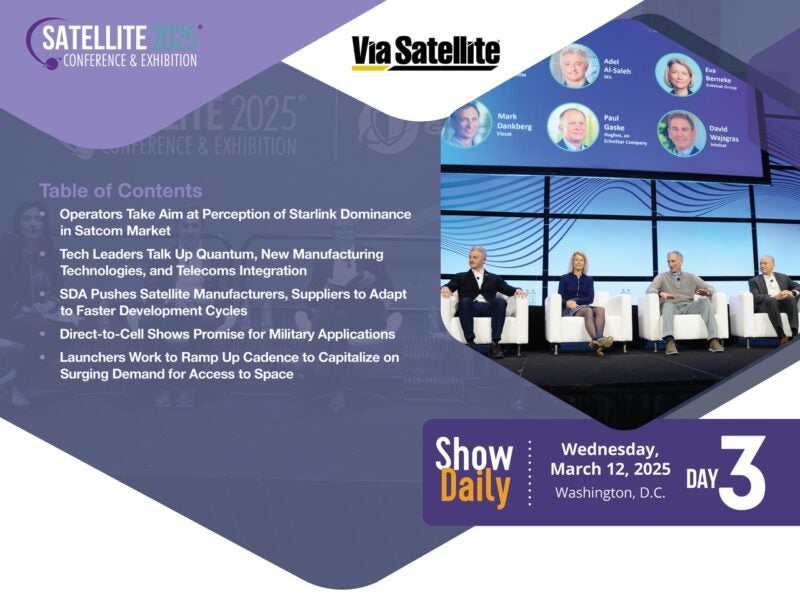
Explore the Show Daily 2025 Day 3 Issue
Check out more from this issue and find your next story to read.
Hispasat CTO/COO Antonio Abad Martín said LEO constellations demand a different manufacturing philosophy — because of the numbers involved, “some of them can fail and the service will still be there,” allowing lower per-unit reliability thresholds and more efficient mass production.
Neo Space Group CTO Mark Dickinson agreed that commodification is lowering prices but warned: “No one is going to thank you for building the cheapest possible spacecraft if it doesn’t work.” He was impatient on multi-orbit delivery: “We heard a lot of predictions about multi-orbit … A lot of money has been spent, but we haven’t really seen a system optimized for that. It’s time for delivery.”
Martín highlighted quantum key distribution as a new satellite market: quantum computing will soon break contemporary encryption, and QKD optical keys can only travel 100 km on fiber, making satellites essential for global distribution. Hispasat has invested 100 million euros in QKD technology for a satellite launching in 2028: “By 2029, we will be able to do quantum key distribution over a third of the world.”
Telespazio CTO Marco Brancati said the explosion in satellite capacity can only be realized “if we put necessary intelligence on the ground.” AI-driven network management will soon allocate bandwidth dynamically across providers, routing traffic based on capacity, load, and even weather — “the key to the efficient use of this additional capacity and to the success of multi-orbit strategies.” VS