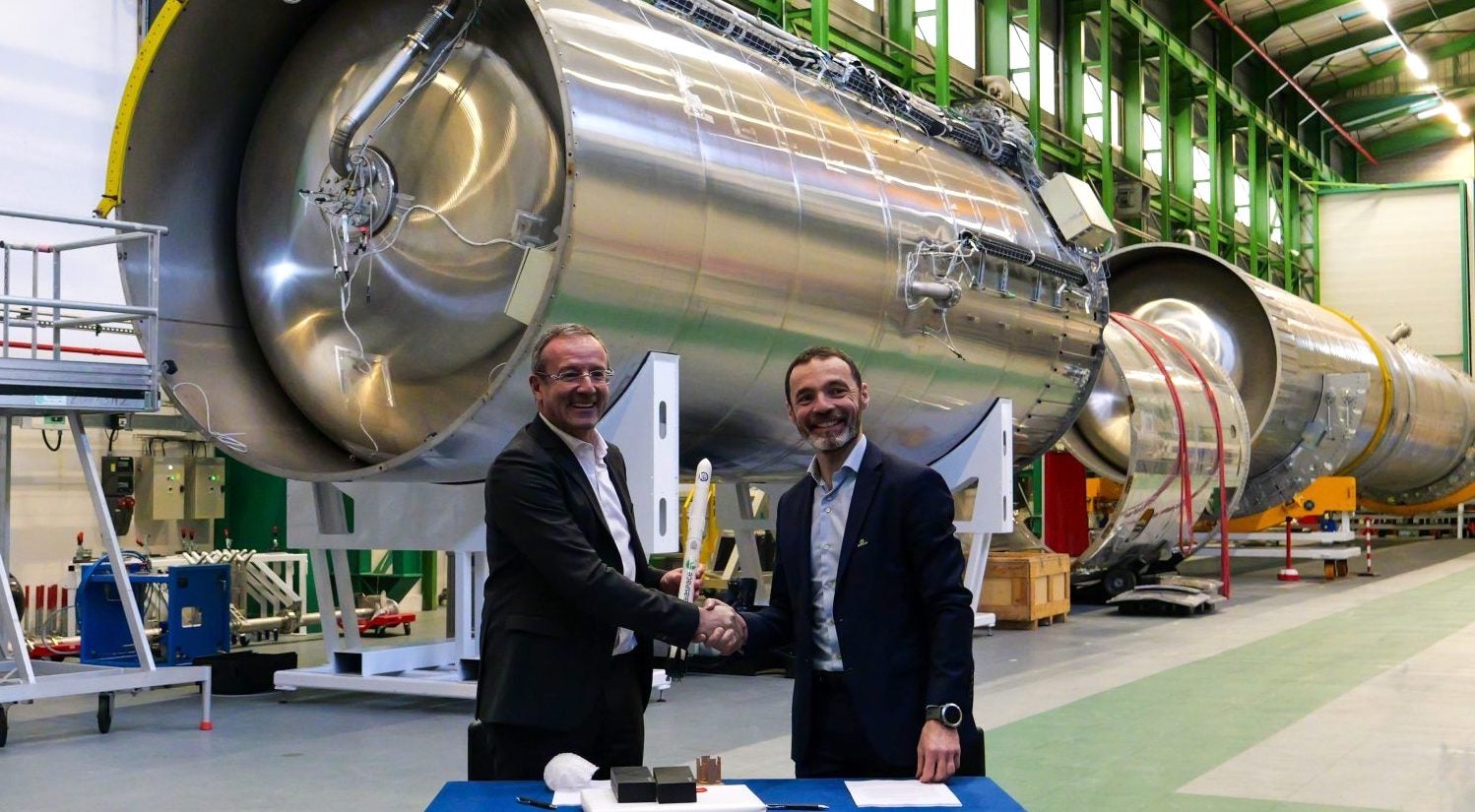
French launcher in development MaiaSpace is looking to buck industry trends and bring a new rocket to market for European launch services. At the start of the year, it won a multi-launch contract with Eutelsat OneWeb in a vote of confidence for the company. MaiaSpace CEO Yohann Leroy spoke to Via Satellite about this deal, as well as the prospects for the company.
MaiaSpace, a subsidiary of ArianeGroup, has set a goal to bring a launcher to the launch pad less than five years after the company was created. As the company was created in April 2022 — it wants to launch before April 2027. Leroy hopes it will beat this deadline and MaiaSpace will be ready to launch as soon as the end of this year.
“There are obviously risks that we may not meet that target, But this is our internal objective. [We have a] five-year timeline for the first version of our launcher,” Leroy said. “Our first launch will not be an orbital launch, and we will not try and recover the first stage.
Leroy said the company plans to launch seven to eight flights to progressively demonstrate the technologies, to then make a recovery attempt on its eighth or ninth flight, in the timeframe of 2028 to 2029.
With the Eutelsat launch contract, MaiaSpace has now signed two launch contracts and plans to sign more this year.
“We don’t want to have just one single customer that would put us into a situation of dependency. We don’t give specific figures, but our objective is to sign several additional commercial contracts this year,” Leroy said.
Eutelsat did not specify how many launches this agreement involves, but Leroy said that OneWeb will represent more than 50% of its launches for the first three years of operations of the Maia launcher.
“It is not very often that a new launcher like MaiaSpace, can get this level of commercial visibility even before the first flight is performed. It is also a validation of our commercial strategy,” Leroy said. He sees the contract as an important vote of confidence.
“It is also a demonstration of our credibility from a technical but also from a planning standpoint,” he added. We are talking of an experienced customer with technical expertise that looked in details at our roadmap, at the performance of the launcher, at where we stood. The fact that Eutelsat decided to sign with us shows that they trust we will make it.”
Over recent years, we have seen a number of European launch companies emerge, but very few successful launches. U.K. launcher Orbex, for example, entered administration in February after it was unable to raise funds.
Leroy hopes that MaiaSpace can buck industry trends, and not only launch, but also showcase a speed that perhaps we haven’t seen from European launch players. Leroy also describes an agile, iterative approach at the heart of Maia’s development.
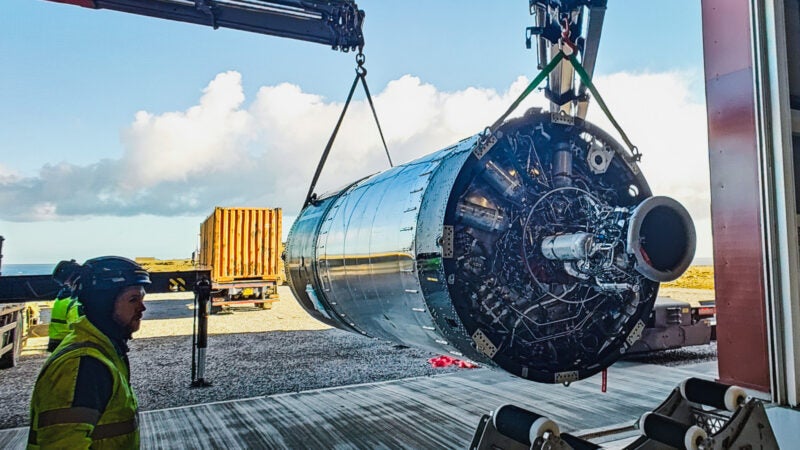
“We started later, but we try and run faster. We do not want to reinvent the wheel. When the company was created in 2022 we decided not to start the development of a new rocket engine, but rather to bet on an engine that was in development for several years, namely the Prometheus engine. This is one of the reasons why we believe we can reduce the development lead time compared to a standard project,” he said.
Leroy says the company has two high level objectives here. It wants to develop the rocket in half the time that is typically required. He cites the fact that in most cases, it takes 10 years from company creation to first flight, and that MaiaSpace wants to do this in five years. Secondly, MaiaSpace wants to divide the cost by a factor of three compared to what those costs would be if we were to develop the launcher in a traditional manner.
“What is important to have in mind is that we don’t put as an additional constraint the fact that the launcher will be perfect from a first flight. We have a more iterative and incremental logic. We accept the fact that the first launcher will have a bit less performance than what we target, ultimately. So, this gives an additional degree of freedom to descope if necessary, some elements that we ideally would like to keep, to maintain or to reach that goal of having a launcher on the launch site in less than five years after the company creation,” he added.
As a subsidiary of ArianeGroup, Leroy notes that the company aims to develop the Maia rocket in half the time it took to develop the Ariane 6.
“We do not pretend that we are smarter than our colleagues from ArianeGroup. We go faster because we decided not to start from scratch, but also because we cut in some corners to go faster. We take a bit more risks than what the Ariane Group colleagues took when they developed the Ariane 6 rocket. If we go back to the more traditional way of doing things, then the timeline will shift and the costs will go up — potentially, very significantly,” he says.
The big challenge for any launch company, aside to prove the reliability of the rocket, is to build a long-term, profitable business. Leroy notes it will take a couple of additional years to become profitable after proving the launch capable. The first two to three years of operations will likely come with losses.
Leroy notes that the costs will be higher for the company at the beginning of its learning curve. He also said MaiaSpace is prepared to offer price discounts to incentivize customers to come onboard. The company aims to begin flying in 2026-2027, with the aim of being profitable around 2030.
We are living in turbulent geopolitical times, with Greenland’s territorial integrity on front page news across the world this year and European security as a major topic. Is time to be a European launch company?
Leroy says it used to be a “taboo question” of European preference for European launch services.
“We know that in the U.S., institutional satellites are launched with U.S. launchers. The same in other parts of the world. It’s only in Europe that institutional satellites can be launched by launchers which are not European,” Leroy says. “I would say that it is important for Europe to get independent access to space. However, this makes no sense, or cannot be sustainable if we do not factor in the economic equation. You cannot afford to be autonomous in space is if you are not one way or another competitive.”
Leroy believes that European institutional satellites need to be launched at a price that is reasonable. He also believes that for a launch service operator to be profitable, it needs to rely not only on the institutional market, but also on the commercial market. And this is especially true in Europe, because the institutional market is much smaller than in the U.S., between seven and 10 times smaller.